
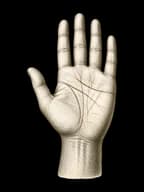
In palmistry, the heart line is the upper major crease that palmists usually trace beneath the fingers. Its length, branches and breaks have acquired many symbolic meanings. None establishes how loving you are, who you will marry, or whether a relationship will last.

You can learn the vocabulary without giving it authority over your relationships. The useful distinction is between a visible feature, an author's interpretation and your own experience.
Make a heart-line note with a visible endpoint
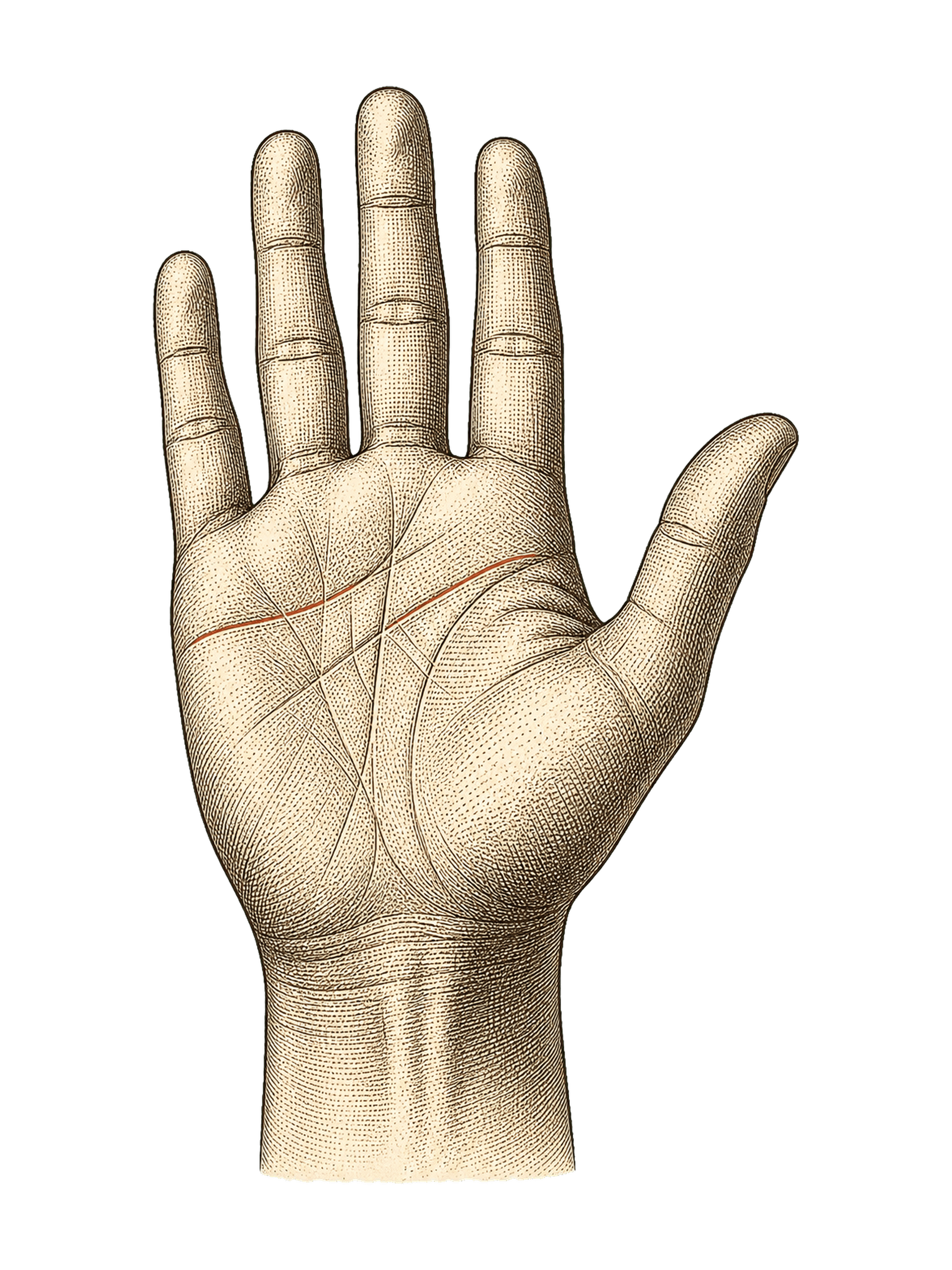
A useful heart-line note identifies the route, endpoint and any clear branches. Those details let you compare a historical drawing without turning it into a relationship profile. Begin with the upper major crease under the fingers, not the small edge markings above it.
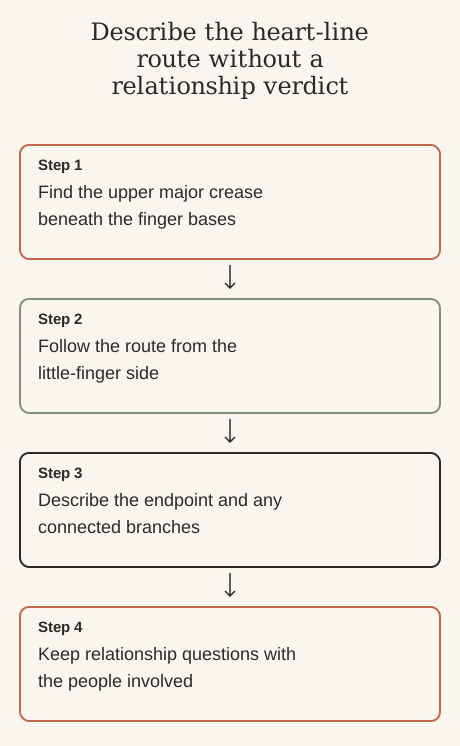
Follow the upper major crease and record its course before consulting traditional meanings.
- Find the upper major crease beneath the finger bases.
- Follow the route from the little-finger side.
- Describe the endpoint and any connected branches.
- Keep relationship questions with the people involved.
For example: “Upper crease crosses toward the index side; one short connected branch near its end; the final endpoint is faint.” That is enough to discuss the visible pattern. If the interruption itself is your question, continue to the linked broken-line guide rather than assigning it a breakup story. For a conversation prompt, ask what helps you feel listened to and answer from actual experience. A person with a different crease could ask the same question and give a different answer.
For a closer look, look closely at interruptions and overlaps; identify the separate edge creases; locate the neighbouring head line.
Want to see yours?
Scan your palm for a full interpretive reading.
Place your palms here
Both palms, please: your left on the left, your right on the right.
Tap to upload
Tap to upload
Required · 18 or older
Photo privacy · Refund terms ·Details
- Your photos are sent to our analysis provider to write your reading. This browser may temporarily keep pending photos for sign-in or recovery. Photos sent from your phone are kept temporarily for hand-off. See our privacy policy for details.
- When you press Read my palms, both photos go to our analysis provider for a clarity check before payment. This checks the photos, not the validity of a reading.
- Doesn't sound like you? Email us within 7 days of your first reading for a full refund, if you haven't used a second. If a photo can't be read, your credit is returned.
- Next: your reading uses one of your readings, or a short checkout if you have none.
Photo tips
 Photo tips
Keep your palm flat, fingers slightly apart and lines in focus. Use bright, even light, and photograph each palm the same way.
 ✓ Like this
 ✕ Too dark
 ✕ Fingers cut off
Find the line before interpreting it
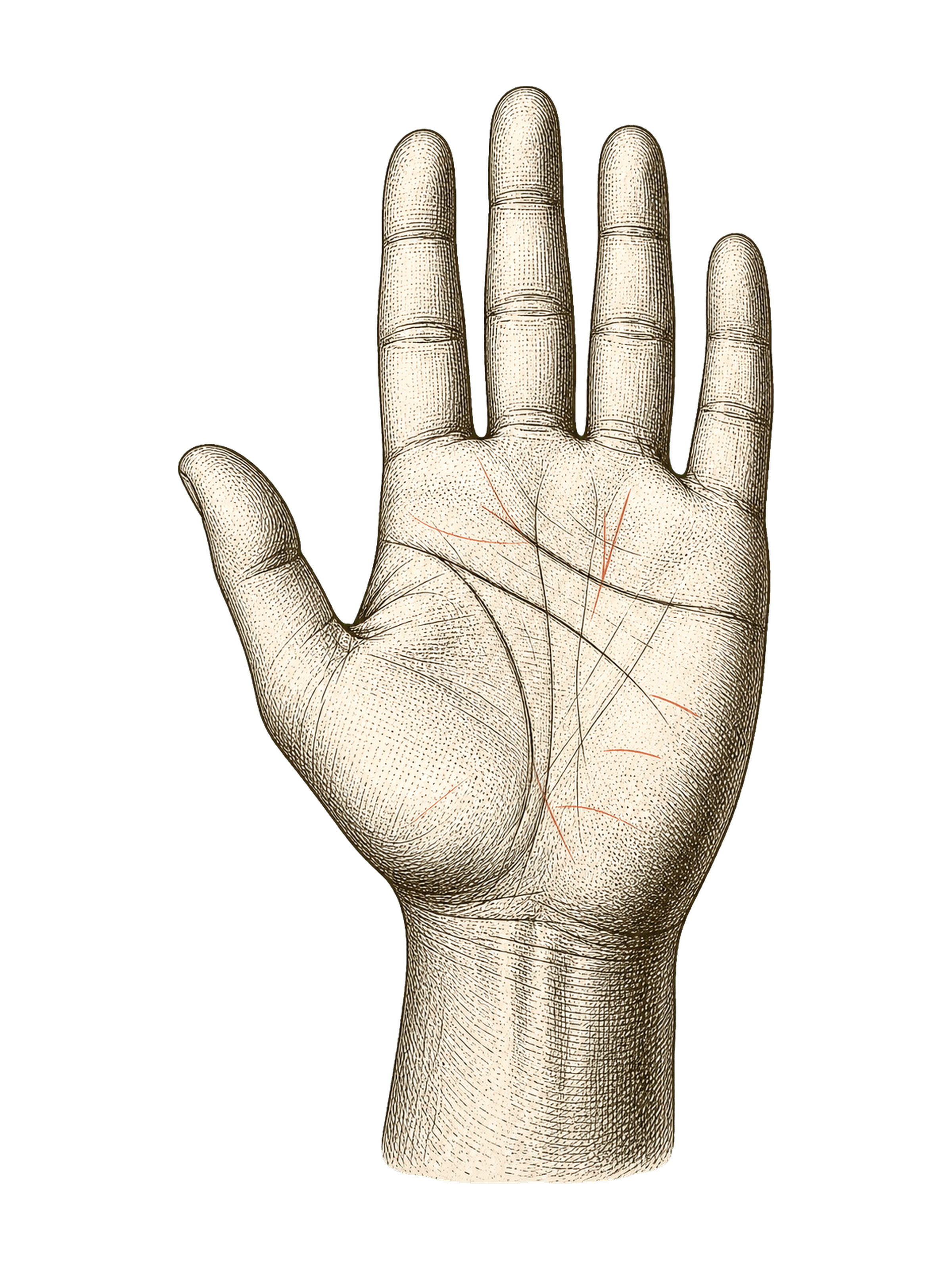
Hold a hand palm-up and look below the finger bases. In a familiar palmistry diagram, the heart line crosses the upper palm from the little-finger side towards the index-finger side. It sits above the head line rather than curving around the thumb like the life line.
Use the fingers as landmarks, not “left” and “right” on a screen. A mirrored photograph can reverse those directions.
Do not force every palm into the same layout. If you see one dominant cross-palm crease rather than two clearly separate ones, our single transverse crease guide explains that distinction without making a diagnosis.
What the historical source claims
Chapter VII of Cheiro's Palmistry for All (1916) links heart-line forms with affection and relationship experiences. It also makes predictions and judgements that a modern reader should not treat as established facts.
The source matters because it records one influential writer's system. It does not validate a relationship test, and it should not stand in for every Indian, Chinese or Western palmistry tradition.
Here is how to keep a description separate from a verdict:
| Visible description | A useful boundary |
|---|---|
| A line extends farther across the palm | Length does not measure generosity or the amount of love you can give |
| An ending divides into branches | A fork does not establish indecision, loyalty or compatibility |
| A mark appears to stop and resume | A gap does not forecast heartbreak |
| Small linked shapes appear along it | A chain does not diagnose anxiety or unusual sensitivity |
| The line is hard to distinguish | Uncertainty in a picture is not a missing emotional capacity |
What does a forked heart line mean?
First, it means you may be looking at a branching crease. Check that a nearby crossing mark is actually connected before naming a fork.
Different interpretations can attach different stories to that shape. We do not have evidence here that it identifies overthinking, a particular attachment style or the kind of partner you need.
If the branching image appeals to you, make the metaphor your own: “I can want closeness and need time alone.” That sentence is an optional reflection, not a fact read from the hand.
Turn the metaphor into a conversation, not a label
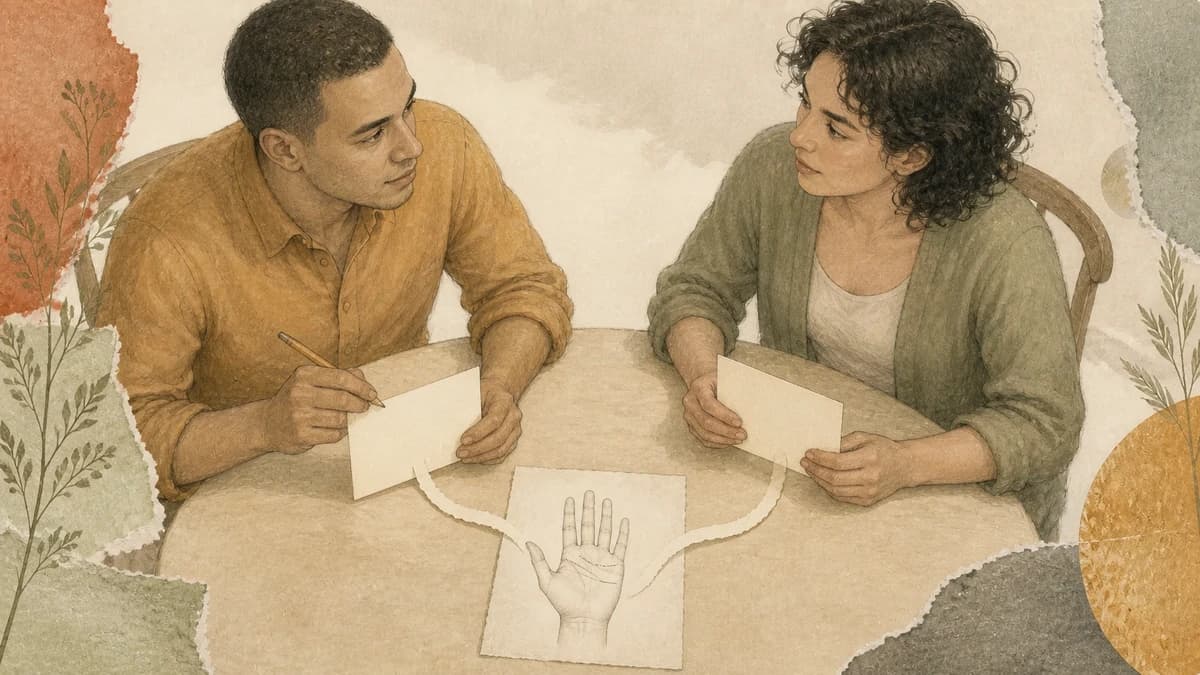
Imagine two people at a table. A palmistry sketch lies between them, but each has a blank card. The important words have not been supplied by the diagram.
A possible question is: “What helps you feel listened to when something matters?”
Another is: “When I go quiet, what do you assume—and what might I actually need?”
These are suggested conversation starters, not a tested intervention. Ask whether the other person wants to discuss them. Do not tell them that their hand proves the answer.
You can also answer privately or leave the exercise alone. Disagreeing with a reading does not mean you are hiding from an uncomfortable truth.
What about breaks, chains and changing lines?
Our broken heart-line guide looks more closely at apparent interruptions. A photograph may not clearly resolve every small mark.
If two photos seem different, compare the light, angle and hand position before building a story about change. The palm-line changes guide separates appearance, anatomy and palmistry claims.
A crease is not a way to assess heart health. For symptoms or health concerns, seek appropriate professional advice rather than a palm interpretation.
Is a short heart line bad?
No visible length makes someone emotionally inferior. A palmistry classification is not a grade.
Can the line predict marriage or a breakup?
Do not use it for either. Choices, circumstances and another person's actions cannot be reliably settled by this mark.
Can I explore it with PalmMingle?
PalmMingle offers an optional AI palm reading. Treat it as imaginative interpretation, not a personality assessment or a promise that every feature will be correctly identified. You can also keep the questions above entirely offline.
The hand can provide an image for a conversation. It cannot answer on either person's behalf.
Palmistry is an interpretive tradition, not a diagnostic tool. PalmMingle frames palm readings as entertainment and self-reflection, not prediction.