
How it works
AI palmistry
What a machine can actually read in a hand, what it is grounded in, and the questions it will not answer.
What does it mean for software to read a palm?
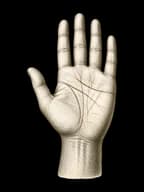
It means two separable things, and most writing on the subject blurs them. The first is observation: locating the creases, the mounts, the finger proportions and the hand shape in a photograph, and describing them. That part is ordinary image analysis, and a machine is genuinely good at it — better than a beginner, because it does not get bored halfway down the palm or skip the hand that is harder to see.
The second is interpretation: saying what a downward-curving head line indicates about how someone thinks. That part is not measurement at all. It is the application of an interpretive tradition, and a machine has no privileged access to it. It knows what the tradition says because the tradition is written down. That is the whole of the claim, and it is worth being blunt about it, because the version of this pitch you usually see implies the second part inherits the reliability of the first.
How does the system actually read a hand?
You upload a photograph of each open palm, left and right. Before anything else happens, each image is checked to confirm it shows a readable hand at all. If it does not, or if the lighting and focus are not good enough to distinguish a shallow crease from a shadow, the reading is refused and the charge is returned. It would be trivially easy to generate a confident reading from an unreadable photo, and that is exactly why the check exists.
Where the image passes, our system works through the hand in the order a practitioner would: the four major lines, then the mounts, then finger proportion and hand shape, then the relationship between the two hands where both were supplied. The written reading follows that structure, so you can check any statement against the part of your hand it came from rather than taking the whole thing on faith.
What is the interpretation grounded in?
Two texts, named explicitly rather than implied. The first is Hast Samudrika Shastra by K.C. Sen (1960), the foundational Indian treatment of hand reading — lines, mounts, finger analysis and the traditional timing methods. The second is Sulabh Jain’s Dictionary of Indian Palmistry Symbols (2017), a modern reference mapping the symbol vocabulary to traits and patterns.
Naming them is not decoration. An interpretive system that will not say where its interpretations come from can say anything at all, and usually does. Ours is answerable to a specific body of writing you can go and read for yourself — including the parts where it disagrees with the Chinese and Western traditions, which it frequently does. That disagreement is itself informative, and we have written about it in three traditions, three very different answers.
Is it accurate?
Accuracy is the wrong question, and we would rather say so than sell you a percentage. Accuracy requires something to be accurate against. For a medical test that is a diagnosis; for a weather model it is tomorrow. Palmistry has no such reference — there is no fact of the matter about what a chained heart line “really” means, only what the tradition says it means. Any accuracy figure attached to a palm reading is either measuring agreement with the tradition, which is circular, or it was invented.
This page used to carry such a figure. It was not measured, and removing it is the honest correction. If you want the longer version of this argument, it is in is there any science behind palm reading.
So what is it reliably good at?
Consistency, which is a real and underrated property. A human reader is affected by what you told them before you opened your hand, by how the previous reading went, and by what they can see of your face. Our system reads the lines that are in the photograph. Show it the same hand twice and it will describe the same hand. Show it a hand whose head line is short and straight, and it will tell you what the tradition says about short, straight head lines — whether or not that is what you were hoping to hear.
It is also good at completeness. Most people reading their own palm stop at the line they were curious about. A generated reading covers the hand, including the parts you would have skipped, which is where the uncomfortable observations tend to be.
Where does the reading refuse to go?
It does not predict events, name dates, or tell you who to marry. It does not read health, and it will not diagnose anything — if something about your body concerns you, the person to ask is a doctor. It does not tell you whether to take the job. The tradition contains predictive material and we have simply declined to use it, because a confident prediction is the easiest thing to generate and the least defensible thing to sell.
What comes back is a description of temperament with its hedges left in. Where the tradition is ambiguous, the reading says so rather than picking the more dramatic branch.
What kind of photograph does it need?
Better light than you think, and less of it than you think. Even, indirect daylight is close to ideal. Direct sun is actively bad: it throws hard shadows across the palm that are indistinguishable from breaks in a line, and a shadow read as a break changes the interpretation. Lay the hand flat and open, fingers slightly apart, palm square to the lens rather than tilted away, filling most of the frame. Hold still — a blurred crease and a shallow crease look the same to any reader.
Every reading uses both hands. The tradition reads the non-dominant hand as disposition and the dominant hand as what has been made of it, and most of what is worth saying lives in the difference between the two.
What do you actually get back?
Continuous prose, structured by the hand rather than by a scorecard. Each of the four major lines gets its own passage, followed by the mounts, the hand’s shape and proportion, and what changed between your two hands. There are no percentage bars, no compatibility scores and no numbers presented as measurements, because none of those quantities exist to be measured.
Afterwards you can ask follow-up questions about your own reading, and the answers stay inside it: they draw on what was observed in your hand rather than wandering off into general advice. A reading stays in your account permanently, which matters more than it sounds — the useful test of a description of your temperament is whether it still reads true in six months.
What happens to your photograph?
It is sent for analysis and is not saved on our servers (photos sent from your phone to your computer are held only for the hand-off and deleted when your computer collects them; the link stops working after 10 minutes, and uncollected photos are erased at the daily clean-up at the latest). The written reading is saved to your account so you can return to it; the image is not part of that record and there is no image to delete later. The full account, including what your own browser holds temporarily if you upload before signing in, is in the privacy policy. We do not use palm images to identify anyone.
Is this better than reading your own palm?
Not better. Faster, more complete, and less flattering — which for this purpose is usually an improvement. If you want to learn the craft, learn the craft; our guide to reading palms covers the lines, the mounts and which hand to read, and palm reading for beginners is the ten-minute version. Doing it yourself teaches you something a generated reading cannot, which is how much of the interpretation is coming from the hand and how much from the reader.
What a generated reading gives you instead is the whole hand at once, argued from a named tradition, in language you can push back against. Treat it as a well-informed second opinion about yourself rather than a verdict, and it is worth the time. Treat it as prophecy and you have misunderstood both the tradition and the machine.
3 readings for $9.99, paid before the first is generated. See pricing.