
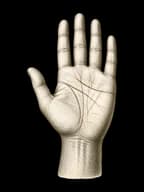
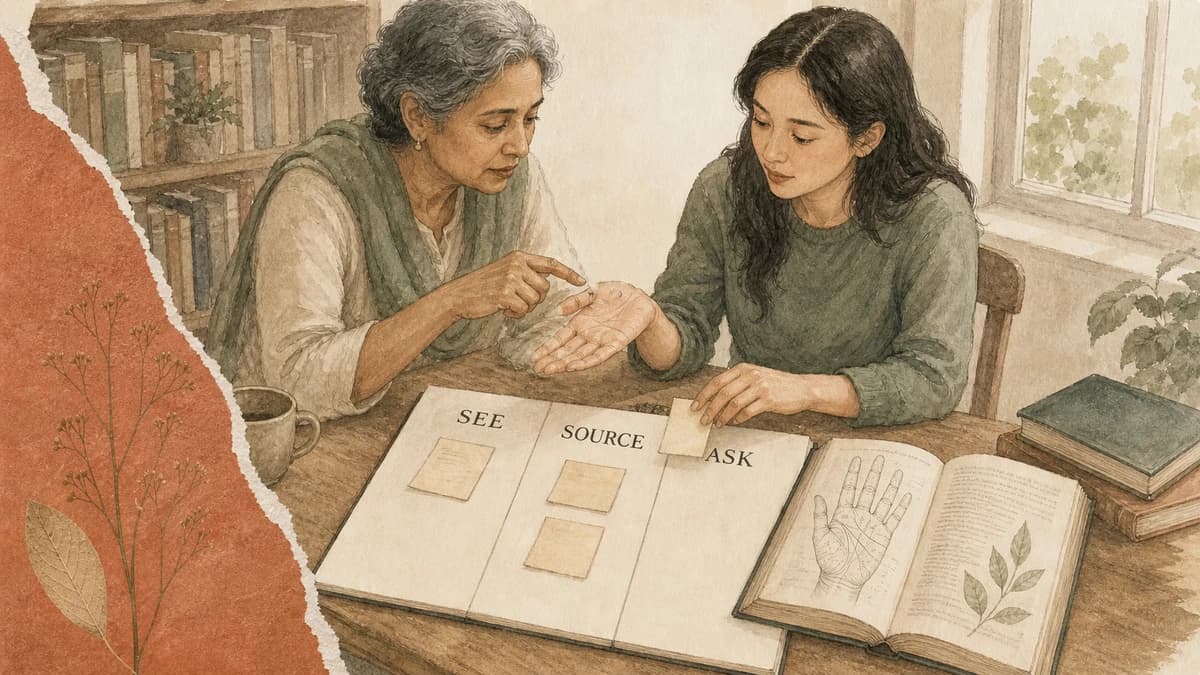
Start palm reading by learning a few names, not by trying to predict anything. You can locate visible creases, find out what a particular historical author called them, and decide whether the symbolism interests you. Those are three different activities.
Palmistry does not give you a reliable diagnosis, personality score or forecast. A beginner does not need to believe otherwise to enjoy looking carefully at a hand.
For marks at the wrist rather than inside the palm, the bracelet-line counting guide shows how to keep clear creases separate from uncertain marks.
To continue with a source you can inspect, try choosing a beginner palmistry book.
Complete one reading note without making a prediction
A beginner's first useful result is a description they can explain. Choose one visible feature, name the historical convention you are consulting and keep your own response separate. You can do this privately without a camera upload or an app.
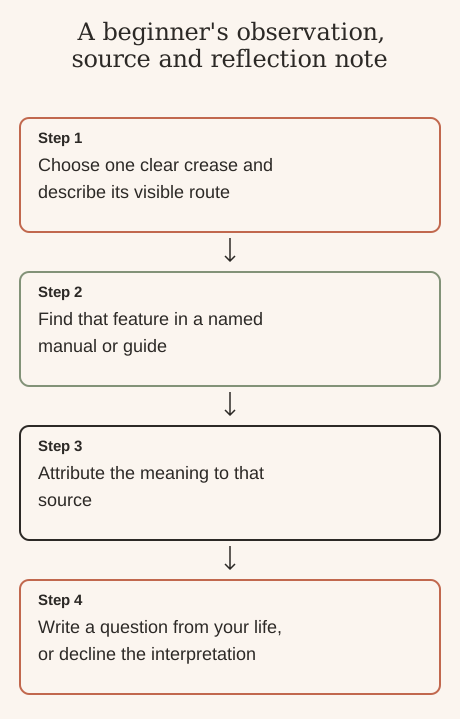
Move from a visible crease to a named source, its attributed meaning and an optional reflection.
- Choose one clear crease and describe its visible route.
- Find that feature in a named manual or guide.
- Attribute the meaning to that source.
- Write a question from your life, or decline the interpretation.
An example note could read: “I can follow an upper crease below the fingers. This guide calls it a heart line. Its traditional theme makes me wonder what helps me feel heard.” The first sentence records the hand, the second records vocabulary and the third is your chosen question. It does not mean the crease detected a relationship need. If the feature is unclear, practise on a clearer landmark instead of drawing it into the picture. One honest note is a complete first exercise.
For a closer look, trace the head-line route; find the upper heart line; follow the curve around the thumb.
Want to see yours?
Scan your palm for a full interpretive reading.
Place your palms here
Both palms, please: your left on the left, your right on the right.
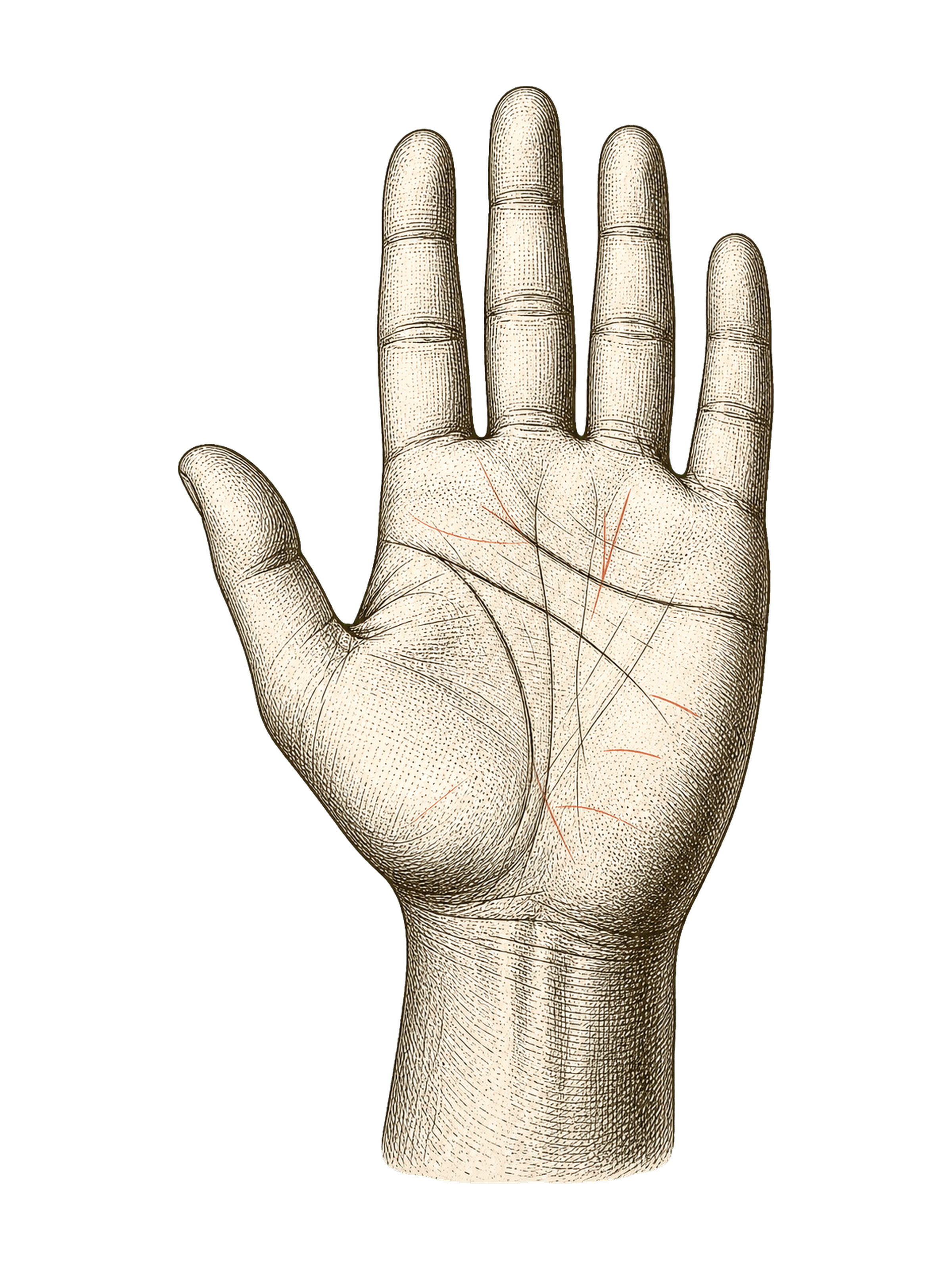
Tap to upload
Tap to upload
Required · 18 or older
Photo privacy · Refund terms ·Details
- Your photos are sent to our analysis provider to write your reading. This browser may temporarily keep pending photos for sign-in or recovery. Photos sent from your phone are kept temporarily for hand-off. See our privacy policy for details.
- When you press Read my palms, both photos go to our analysis provider for a clarity check before payment. This checks the photos, not the validity of a reading.
- Doesn't sound like you? Email us within 7 days of your first reading for a full refund, if you haven't used a second. If a photo can't be read, your credit is returned.
- Next: your reading uses one of your readings, or a short checkout if you have none.
Photo tips
 Photo tips
Keep your palm flat, fingers slightly apart and lines in focus. Use bright, even light, and photograph each palm the same way.
 ✓ Like this
 ✕ Too dark
 ✕ Fingers cut off
First, make the hand easy to see
Use a relaxed open palm and soft, even light. Keep the fingertips, palm and wrist in view. Do not stretch the skin to manufacture a line or zoom until a shadow becomes a symbol.
If a diagram names the finger's end rather than a crease, use our fingertip outline guide. It keeps that vocabulary separate from whole-hand shape and leaves ambiguous observations unnamed.
If you are looking at someone else's hand, ask first. They can decline a reading or any discussion of its meaning. There is no need to photograph another person's palm to try this exercise.
Learn three landmarks
| Palmistry name | Where to begin looking | What the name does not establish |
|---|---|---|
| Life line | The curve around the thumb pad | Lifespan, health or stamina |
| Head line | The crease crossing the middle of the palm | Intelligence or thinking style |
| Heart line | The upper crease beneath the fingers | Attachment style or romantic future |
Real hands do not always resemble an ideal diagram. Creases can be faint, intersect or follow a different arrangement. Leave a feature unidentified if you cannot distinguish it clearly.
For closer help, see the life-line guide, head-line guide and mount map.
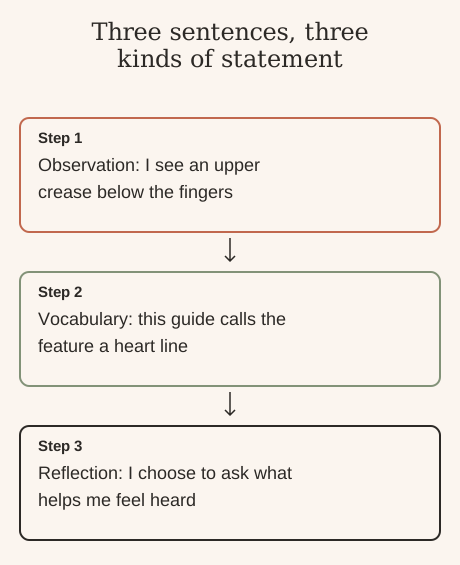
Three sentences, three kinds of statement.
Keep three columns, not one conclusion
A simple notebook format makes the boundaries visible:
Observation: "I can see a curve around the thumb pad."
Historical interpretation: "This author calls it the life line and makes claims about longevity."
Optional reflection: "What do I want to make time for this month?"
The third sentence is your question, not something the first sentence proved. You can reject the historical interpretation and still answer it. You can also skip the reflection entirely.
The smooth and knotty finger guide repairs a personality claim, the spaces-between-fingers example describes a chosen pose, and the index and ring comparison states an observation's starting point. Each keeps the description separate from the author's belief.
Cheiro's Palmistry for All (1916) is one accessible primary source for a Western palmistry vocabulary. It also contains predictive, medical and prejudicial claims that should not be treated as facts. One book cannot represent every palm-reading tradition.
If the words themselves are confusing, the chirognomy and chiromancy comparison follows their different uses in the parts and preface of another historical text.
Do not turn "not predictive" into "scientifically psychological"
A guide may reject fortune-telling while still claiming that a crease reveals avoidance, overthinking or emotional instability. That is another unsupported assessment, not a safer discovery.
Likewise, a reading feeling familiar is not evidence that the hand revealed the information. Check an interesting description against your experience; you do not owe it agreement.
PalmMingle's role is limited too. It offers an AI-assisted interpretation from an uploaded photo. It is not a substitute for professional care or a validated personality questionnaire, and automated descriptions can be mistaken.
If you want to go beyond this observation exercise, our comparison of automated and human reading formats helps you choose a report or appointment without treating either as proof.
An observation exercise to try with a friend
Choose one clearly visible line. Each person describes only its location and route. Compare what you noticed before opening a reference book.
Then read one attributed interpretation and ask whether it raises a question worth discussing. "What would you like more time for?" is an invitation. "Your hand shows you cannot commit" is a verdict. Keep the invitation and leave the verdict behind.
Do not score each other's honesty, compatibility or willingness to participate.
If the conversation involves a PalmMingle card, our sharing checklist helps you distinguish the card from the full reading and decide whether to send it.
Beginner questions
Which hand should I read?
Look at both if you want to compare visible features. Traditions disagree about how to interpret left and right. Neither hand supplies objective proof of your potential or future.
Can a line be missing?
You may not be able to identify every line in a diagram. That does not imply a missing talent or personal deficiency.
Do the lines form because a baby clenches its fists?
That simple explanation is misleading. Kimura and Kitagawa's 1986 embryological study abstract reports that most observed creases appeared to develop independently of hand flexion. This is anatomical research, not support for palmistry meanings.
How do I try the app?
Read the scope of PalmMingle's interpretive reading and the current purchase terms. The reading flow requires sign-in and a reading credit. You can choose not to upload.
The beginner's skill worth practising is knowing which sentence describes a hand, which records a belief, and which is simply a question.
Palmistry is an interpretive tradition, not a diagnostic tool. PalmMingle frames palm readings as entertainment and self-reflection, not prediction.