

A short life line is not an expiry date. A break is not a forecast of illness or an accident. In palmistry, the name refers to the crease that curves around the thumb pad. Its length does not give you a reliable way to calculate how long you will live.
That is the boundary worth keeping. Replacing a frightening prediction with a flattering claim about resilience or a "social battery" does not make the reading factual. A crease cannot measure those things either.
An upright central route is a separate feature; the fate-line locating guide compares destinations without turning the crease into a career forecast.
Describe a short-looking line without a countdown
A short-looking life line needs a visibility check before a label. Find the curve around the thumb pad and follow what the image actually shows. Its endpoint is an observation, not an age marker, health score or deadline.
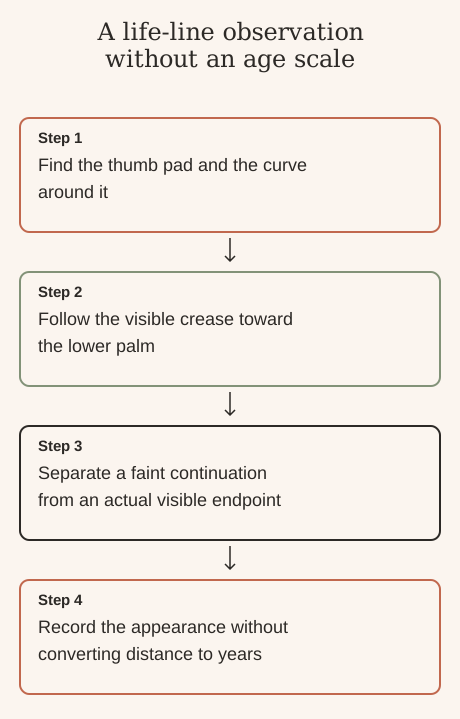
Follow the curve around the thumb pad without turning its length into a lifespan.
- Find the thumb pad and the curve around it.
- Follow the visible crease toward the lower palm.
- Separate a faint continuation from an actual visible endpoint.
- Record the appearance without converting distance to years.
Imagine the upper curve is clear but the lower part falls into shadow. “Lower route not visible” is more accurate than “short life line”. If it really appears to stop, record where it stops relative to the palm, without placing ages along it. A second nearby curve may deserve its own description rather than being joined to the first. Compare the same hand in comfortable, similar light if you want a clearer record; stop if the exercise is only increasing worry.
For a closer look, locate the separate wrist creases; compare the neighbouring head-line start; check what developmental studies establish.
Want to see yours?
Scan your palm for a full interpretive reading.


Place your palms here
Both palms, please: your left on the left, your right on the right.

Tap to upload


Tap to upload
Required · 18 or older
Photo privacy · Refund terms ·Details
- Your photos are sent to our analysis provider to write your reading. This browser may temporarily keep pending photos for sign-in or recovery. Photos sent from your phone are kept temporarily for hand-off. See our privacy policy for details.
- When you press Read my palms, both photos go to our analysis provider for a clarity check before payment. This checks the photos, not the validity of a reading.
- Doesn't sound like you? Email us within 7 days of your first reading for a full refund, if you haven't used a second. If a photo can't be read, your credit is returned.
- Next: your reading uses one of your readings, or a short checkout if you have none.
Photo tips
 Photo tips
Keep your palm flat, fingers slightly apart and lines in focus. Use bright, even light, and photograph each palm the same way.
 ✓ Like this
 ✕ Too dark
 ✕ Fingers cut off
Find the line before interpreting it
Relax your hand with the palm facing you. Look for the curved crease around the fleshy base of the thumb, rather than a line crossing straight beneath the fingers. Follow only the part you can see clearly. Do not extend it through a shadow or join unrelated wrinkles.
A useful description might be "a clear curve around the thumb pad, becoming faint near the wrist". That records appearance without turning the hand into a timetable. Compare the mount map if the thumb-pad boundary is unclear.
For a source-specific composite map, the Great Triangle example follows the Life, Head and Health boundaries without reading health or lifespan from the enclosed space.
The old books really did make lifespan claims
It would be reassuring to say that serious historical palmists never predicted death. It would also be wrong. Chapter III of Cheiro's 1916 Palmistry for All explicitly connects the life line with longevity and illness.
That establishes what Cheiro taught, not that his teaching was accurate. The same distinction applies to old claims about constitution, vitality and resistance to illness. Changing the vocabulary from "lifespan" to "energy" does not supply evidence.
You do not need to accept the predictions to study the book's names and diagrams.
Short, faint, interrupted and doubled are different observations
| What you notice | What you can honestly record | What it does not establish |
|---|---|---|
| A curve ending higher on the palm | Shorter visible extent in this view | An early death |
| A pale section | Difficult to distinguish from surrounding skin | Low stamina or burnout |
| A gap | An apparent interruption to check in better light | An accident or life crisis |
| A nearby parallel crease | Two visible paths in that area | Extra protection or extra years |
For a named-source comparison of inner paths, our Mars-line map separates position, visible start and connection without turning a second curve into protection.
These descriptions are not medical classifications. If a new mark, injury or symptom concerns you, ask a qualified healthcare professional. Palmistry cannot explain the cause.
Check the photograph before inventing a story
Use the same hand, a relaxed position and similar soft light when comparing images. A crease that seems to end under one shadow may be visible in another photograph. A scar or temporary pressure mark is not the same as a natural crease.
Our guide to palm lines changing over time separates underlying landmarks from surface appearance and photography. Do not infer a changed future from a changed picture.
A reflection exercise that does not need a verdict
If you enjoy the life-line metaphor, put the hand down before answering. Ask what currently makes your day sustainable, what you have agreed to do, and what you would like to change. Use your actual calendar and experiences.
The same questions are available to someone with a short line, a long line or no clearly visible line in a photograph. Their usefulness does not depend on the crease revealing an answer.
Questions people bring to this line
Which hand predicts lifespan?
Neither. Traditions assign different roles to the two hands, but that convention cannot turn a crease into a mortality forecast.
Does a broken life line mean I should change my plans?
Not because of the line. Make decisions from your circumstances, evidence and appropriate advice.
Can an app measure my energy from the line?
PalmMingle cannot measure energy, diagnose health or predict lifespan from a palm photo. It offers an optional interpretive palm reading. Read the scope before choosing to upload.
Your hand does not need a longer line to give you permission to make plans.
Palmistry is an interpretive tradition, not a diagnostic tool. PalmMingle frames palm readings as entertainment and self-reflection, not prediction.