


Palmistry finger tips in William Benham's system have four names: spatulate, square, conic and pointed. Spatulate describes a spreading, spatula-like end; square a squarer end; conic a taper; and pointed a more pronounced taper. These names concern the fingertip's outline, not the whole hand. They record a historical classification, not evidence of your personality or future.

You can learn the vocabulary without accepting the verdicts attached to it. Start by describing what you see. If a shape is ambiguous, leave it unnamed.
First decide what you are looking at
Look at the outline of the finger's end, rather than the shape cut into its nail. This guide uses one author's tip vocabulary. It does not classify palm proportions, number finger sections or identify the fine ridge patterns on skin. Keeping the subject small makes it easier to tell what a diagram is actually showing.
Benham's Chapter XII explicitly separates fingertips from whole-hand types. He also describes encountering different-looking tips on the same hand. There is no need to pick one label for all your fingers just to finish the exercise.
For broader proportions, use the whole-hand shape guide. The thumb guide covers a separate set of palmistry questions. Neither is a shortcut to identifying a fingertip.
Rest the hand comfortably. Do not force a spread, squeeze the tip or reshape the nail to match a picture. If using a photograph, our palm-photo guide helps with visibility. A clearer picture still does not validate an interpretation.
Want to see yours?
Scan your palm for a full interpretive reading.


Place your palms here
Both palms, please: your left on the left, your right on the right.

Tap to upload


Tap to upload
Required · 18 or older
Photo privacy · Refund terms ·Details
- Your photos are sent to our analysis provider to write your reading. This browser may temporarily keep pending photos for sign-in or recovery. Photos sent from your phone are kept temporarily for hand-off. See our privacy policy for details.
- When you press Read my palms, both photos go to our analysis provider for a clarity check before payment. This checks the photos, not the validity of a reading.
- Doesn't sound like you? Email us within 7 days of your first reading for a full refund, if you haven't used a second. If a photo can't be read, your credit is returned.
- Next: your reading uses one of your readings, or a short checkout if you have none.
Photo tips
 Photo tips
Keep your palm flat, fingers slightly apart and lines in focus. Use bright, even light, and photograph each palm the same way.
 ✓ Like this
 ✕ Too dark
 ✕ Fingers cut off
Four labels in one historical system
Benham names spatulate, square, conic and pointed tips. The diagram below is our conceptual comparison of those descriptions, not a reproduction of his illustrations or a set of anatomical standards. The outlines are deliberately simplified. Use the flesh outline as the comparison, not the little fingernail drawn inside each example.
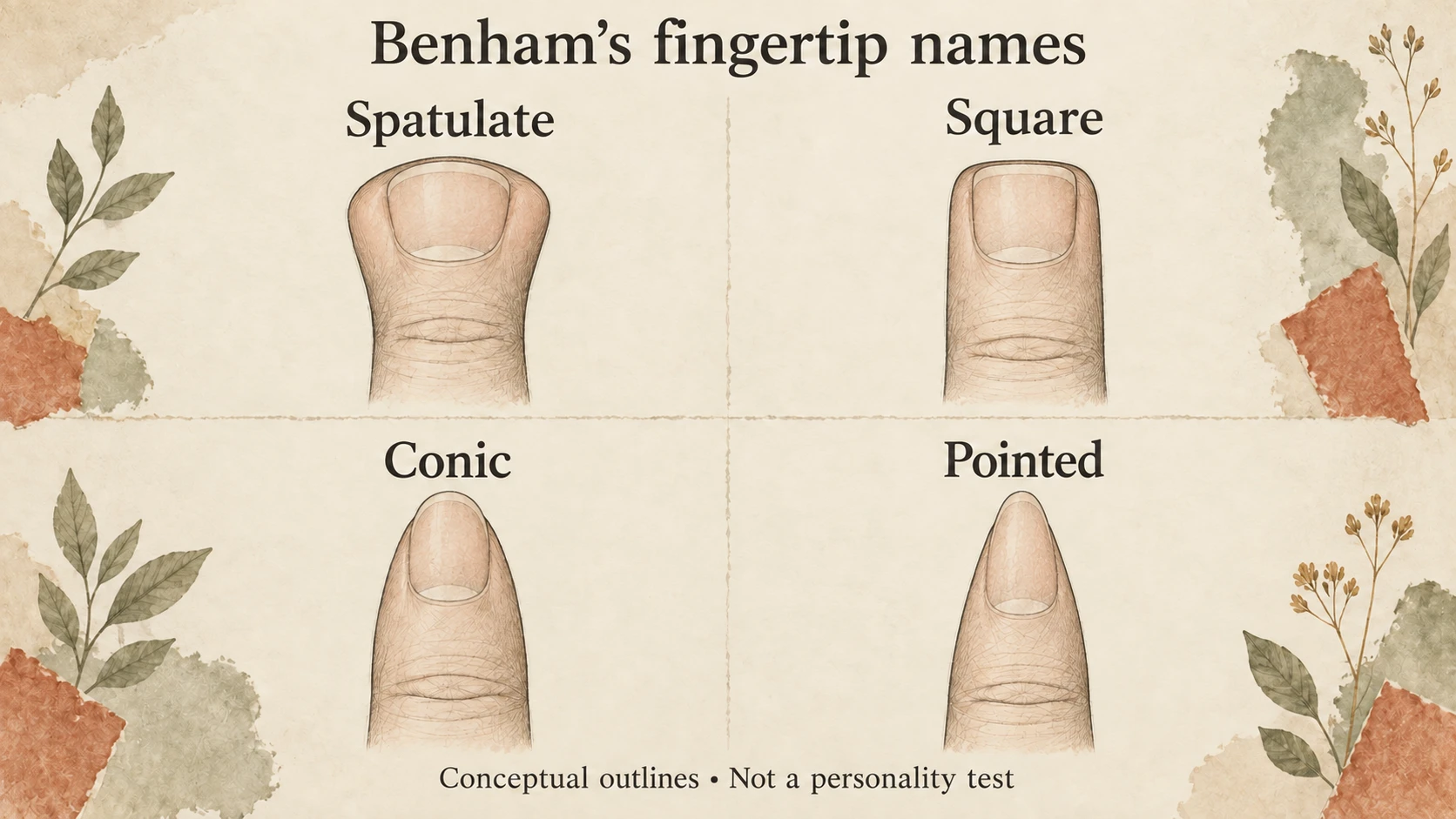
Conceptual outlines in Benham's vocabulary, not measured categories or a personality test. The same comparison is described in the table:
| Label in this guide | Outline to compare | What would remain uncertain |
|---|---|---|
| Spatulate | An end that broadens outward, like the working end of a spatula | Whether a slight widening is distinct enough to name |
| Square | More nearly parallel sides and a flatter-looking end | Where to put an outline with soft corners or a slight taper |
| Conic | A gentler narrowing towards the end | How much taper separates it from an intermediate outline |
| Pointed | A longer, narrower taper than the conic example | Where one degree of taper becomes another |
These are approximate reading aids, not width ratios. A rounded corner does not disqualify a square-looking outline, and no sharp physical point is required to consider the pointed illustration. The distinction between conic and pointed follows Benham's continuation, which treats pointed as a more extreme form of conic.
Two comparisons worth slowing down for
For square versus spatulate, compare the sides before looking only at the top. The question is whether the end appears to spread beyond a narrower shaft or stays closer to parallel. For conic versus pointed, compare degrees of narrowing. Neither comparison supplies a precise cutoff, so an in-between observation is a useful answer.
Try saying, "The sides seem fairly parallel, with a soft curve at the end." That is more informative than rushing to "square" and then defending it. If you see a widening near the end, describe that widening before choosing the spatulate label.
For taper, "It narrows, but I cannot distinguish the two examples confidently" is enough. This guide does not offer a measurement that turns uncertainty into certainty.
If two friends disagree, keep both descriptions beside the same finger name. Do not settle the disagreement by asking which person seems more artistic or practical. A personality story cannot verify an outline. You are comparing an illustration with an observation, not checking whether a person deserves a category.
Try a description before a label
Use a short worksheet with a place for the finger, the visible outline and the uncertainty. Write the description first, then add a label only if it helps. Leave the uncertainty column filled even when you choose a name. That stops the name replacing the observation you actually made.
Here is a fictional example, not a reader's result:
| Finger being observed | Description before a label | Uncertainty to keep |
|---|---|---|
| Index finger | Sides look nearly parallel; end looks flatter | Soft corners do not closely match the drawing |
| Middle finger | End narrows gradually | Unsure whether "conic" adds anything to "tapers" |
| Ring finger | Outline looks different from the neighbour | No label chosen |
To copy the exercise, write:
- Finger and hand: which one am I describing?
- Outline: what can I see without a character word?
- Uncertainty: which detail can I not distinguish?
You can stop there. If another person participates, ask permission before discussing their hand or making a photograph. They do not have to supply a label, accept an interpretation or share the worksheet. A blank row is preferable to a confident description of something you cannot see.
Keep old meanings separate from your choices
Benham attaches action to spatulate tips and order to square tips; his continuation associates conic tips with art and pointed tips with idealism. These are his beliefs, not findings about people. Knowing the labels does not make those associations into a test, and you should not use them to decide someone's ability, occupation or relationships.
If you enjoy symbolism, choose your own question independently of the shape. "Would I like more order in this project?" can be useful whether your fingertip looks square, pointed or neither. There is no need to claim that a hand supplied the answer.
PalmMingle's interpretive reading offers saved symbolic writing and Mina follow-up questions for adults. It is not a verified fingertip classifier or personality assessment. You can inspect the labelled sample reading before deciding whether that different experience interests you. Current pricing, checked 16 October 2026, is three readings for $9.99, paid once. Generation requires sign-in and a reading credit.
You can also keep the worksheet and skip the upload. Describing a finger is the whole task here. It does not need to become a description of you.
Palmistry is an interpretive tradition, not a diagnostic tool. PalmMingle frames palm readings as entertainment and self-reflection, not prediction.