
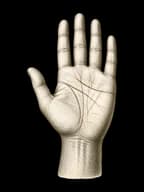
Thumb palmistry looks at the thumb's relative length, the two visible phalanges, its angle from the palm, and whether its joints appear firm or flexible. Historical readers linked those features with will, logic, affection, adaptability and self-control. Those are traditional associations—not a personality test, moral judgement, or health assessment.
Quick answer: Observe the thumb at rest. Compare it with the same hand, not an ideal diagram. Never force it backward to test flexibility, and never use its shape to label someone violent, dishonest, weak, or ill.
What palmists look at in the thumb
The traditional inspection usually has four parts:
- Relative length: how far the thumb reaches when held naturally beside the hand.
- Upper phalanx: the section from the tip to the interphalangeal joint.
- Lower visible phalanx: the section between that joint and the base of the thumb.
- Set and opening angle: where the thumb joins the palm and how far it rests away from the index-finger side.
Some systems call the padded base inside the life line a third thumb section, though anatomically it is the thenar area and overlaps palmistry's Mount of Venus. Naming conventions vary, so a diagram should state which one it uses.
Section names and fingertip names answer different questions. For one author's terminal-outline vocabulary, see the Benham fingertip comparison.
Want to see yours?
Scan your palm for a full interpretive reading.
Place your palms here
Both palms, please: your left on the left, your right on the right.
Tap to upload
Tap to upload
Required · 18 or older
Photo privacy · Refund terms ·Details
- Your photos are sent to our analysis provider to write your reading. This browser may temporarily keep pending photos for sign-in or recovery. Photos sent from your phone are kept temporarily for hand-off. See our privacy policy for details.
- When you press Read my palms, both photos go to our analysis provider for a clarity check before payment. This checks the photos, not the validity of a reading.
- Doesn't sound like you? Email us within 7 days of your first reading for a full refund, if you haven't used a second. If a photo can't be read, your credit is returned.
- Next: your reading uses one of your readings, or a short checkout if you have none.
Photo tips
 Photo tips
Keep your palm flat, fingers slightly apart and lines in focus. Use bright, even light, and photograph each palm the same way.
 ✓ Like this
 ✕ Too dark
 ✕ Fingers cut off
The old meanings of the thumb sections
Cheiro's 1916 Palmistry for All assigns “will” to the upper section, “logic” to the next, and “love” to the base. It then turns length, thickness and joint shape into confident character judgements.
Use that source as a record of the tradition, not a licence to repeat its worst labels. The text includes claims about criminality, anger, miserliness and moral worth based on thumb anatomy. Those claims are prejudicial and unsupported. PalmMingle rejects them.
A responsible translation replaces verdicts with prompts:
- Upper section / will: How do I persist when motivation fades?
- Lower section / reasoning: Do I plan before acting, or revise as I go?
- Base / attachment: How do closeness, comfort and appetite affect my choices?
No answer is visible in the thumb. The questions simply organise reflection.
Long, short, high-set and low-set thumbs
Traditional guides often associate a relatively long thumb with self-direction and a shorter one with impulse or reliance on others. A wider opening angle may be called independent or generous; a thumb held close may be called cautious or reserved. High and low set refer to where the thumb appears to join the side of the hand.
These descriptions are subjective. Hand proportions vary naturally, and perspective can distort them. Photographing from close range makes the nearer thumb look larger. Spreading the fingers changes the angle.
For the three openings between the other fingers, rather than the thumb's angle, see our finger-gap guide and its two explicitly chosen poses.
If you compare thumbs, use the same neutral position and camera distance. Phrase the result as “relatively long in this image,” not “strong-willed.” Observation and interpretation are different statements.
Flexible versus firm thumbs
Older palmistry contrasts “supple-jointed” with “firm-jointed” thumbs and associates them with adaptability versus consistency. Real joint mobility has anatomical causes and a wide normal range. It can also be relevant to hypermobility, injury, pain, or instability—none of which palmistry can assess.
Do not push the thumb backward to chase a category. The Ehlers-Danlos Society's guidance on assessing joint hypermobility shows that clinical assessment uses defined movements and wider context. A casual photograph is not that assessment.
If your thumb hurts, locks, feels unstable, or has changed after injury, seek appropriate medical advice. “Flexible personality” is not a diagnosis, and “stiff personality” is not an anatomical conclusion.
Thumb shape and harmful historical labels
Some old palmistry texts use terms such as “murderer's thumb” for a short, broad upper phalanx. Do not use that label. Anatomy does not prove violent intent, criminality, temper, or morality.
This matters beyond politeness. Appearance-based character judgements can stigmatise people and give a reader false confidence about safety. Assess behaviour from behaviour. Use safeguarding procedures, evidence and professional support where risk is real.
The same rule applies to every hand feature: palmistry can supply a metaphor, never a character certificate.
For a worked example of separating a shape label from a judgement, see our smooth versus knotty finger explanation. It keeps Benham's joint vocabulary separate from claims about how a person thinks.
A safe thumb-reading sequence
- Let the hand rest naturally.
- Describe relative length, the two visible sections and resting angle.
- Skip flexibility unless it is obvious in ordinary, pain-free movement.
- Introduce the historical theme with “palmists traditionally associate...”
- Turn the theme into one open question.
- Test the answer against choices and behaviour.
For a full-hand context, compare the four elemental hand shapes and mount map. Do not stack several symbolic features until they sound like scientific confirmation.
Frequently asked questions
What does a long thumb mean in palmistry?
It is traditionally associated with will or self-direction. It does not prove discipline, intelligence, leadership, or success.
What does a flexible thumb mean?
Palmists often associate it with adaptability. Anatomically, mobility varies; symptoms such as pain or instability need clinical context.
Which thumb should I read?
Observe both and note visible differences. Neither side provides a definitive personality result. See the which-hand palmistry guide.
Does PalmMingle assess thumb shape?
PalmMingle can include visible hand proportions in an interpretive reading when the photo supports them. It does not judge morality, diagnose joint conditions, or prove temperament. See the AI reading scope.
Sources and further reading
- Cheiro, Palmistry for All (1916), historical thumb chapters
- Wellcome Collection: A Manual of Cheirosophy (1885)
- The Ehlers-Danlos Society: Assessing joint hypermobility
Read the thumb as a piece of palmistry vocabulary if you enjoy it. Read the person through what they actually say and do.
Palmistry is an interpretive tradition, not a diagnostic tool. PalmMingle frames palm readings as entertainment and self-reflection, not prediction.