
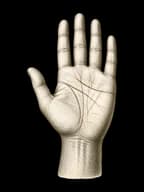
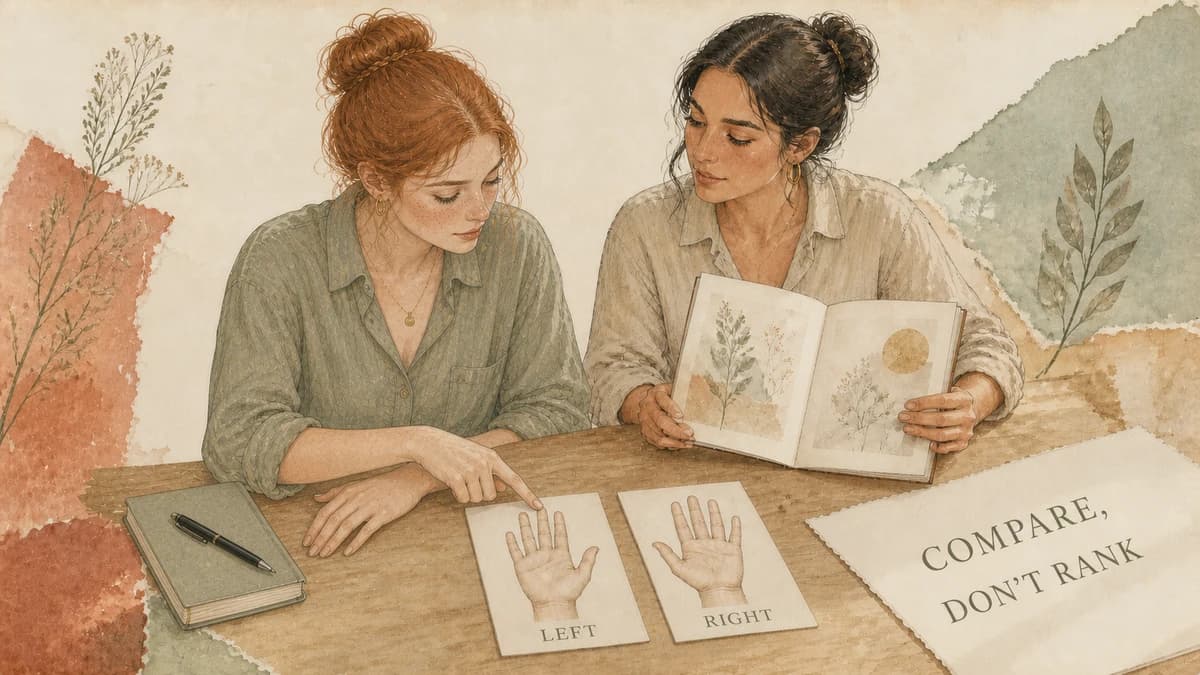
For a beginner, looking at both palms is a useful way to compare visible features. There is no scientifically established "correct hand" for predicting the future or assessing personality through palmistry.

The usual confusion comes from mixing up two different distinctions: left versus right, and dominant versus non-dominant. A writer may use one convention without using the other.
For one contemporary source's vocabulary, the Chinese palm-reading introduction keeps the account attributed rather than treating it as a universal hand-choice rule.
For a specific edge-mark example, the union-line observation guide records the photographed side without translating a line count into future relationships.
Label the hands before applying a convention
To avoid confusion about which hand to read, record physical side and habitual use separately. Left/right, dominant/non-dominant and mirrored/not mirrored answer different questions. A clear label makes a source's convention easier to follow; it does not validate what the convention claims.
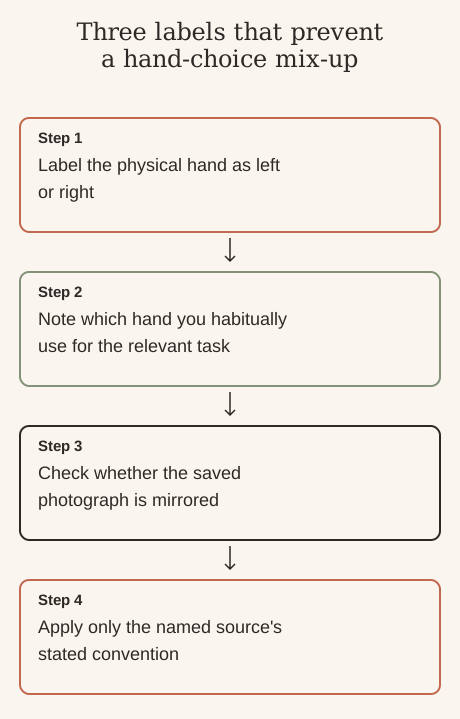
Name the hand, orientation and convention before comparing two palm photographs.
- Label the physical hand as left or right.
- Note which hand you habitually use for the relevant task.
- Check whether the saved photograph is mirrored.
- Apply only the named source's stated convention.
A left-handed person might write “physical left; writing hand; image not mirrored” and “physical right; used for the other task; image not mirrored”. Someone who uses different hands for different tasks can record that instead of forcing a single dominance label. If a guide says left and right, do not silently substitute dominant and non-dominant. Ask the reader which rule they use. Neither side provides a reliable photograph of your past or future.
For a closer look, prepare clear left and right photographs; learn the main landmarks; keep different source conventions distinct.
Want to see yours?
Scan your palm for a full interpretive reading.
Place your palms here
Both palms, please: your left on the left, your right on the right.
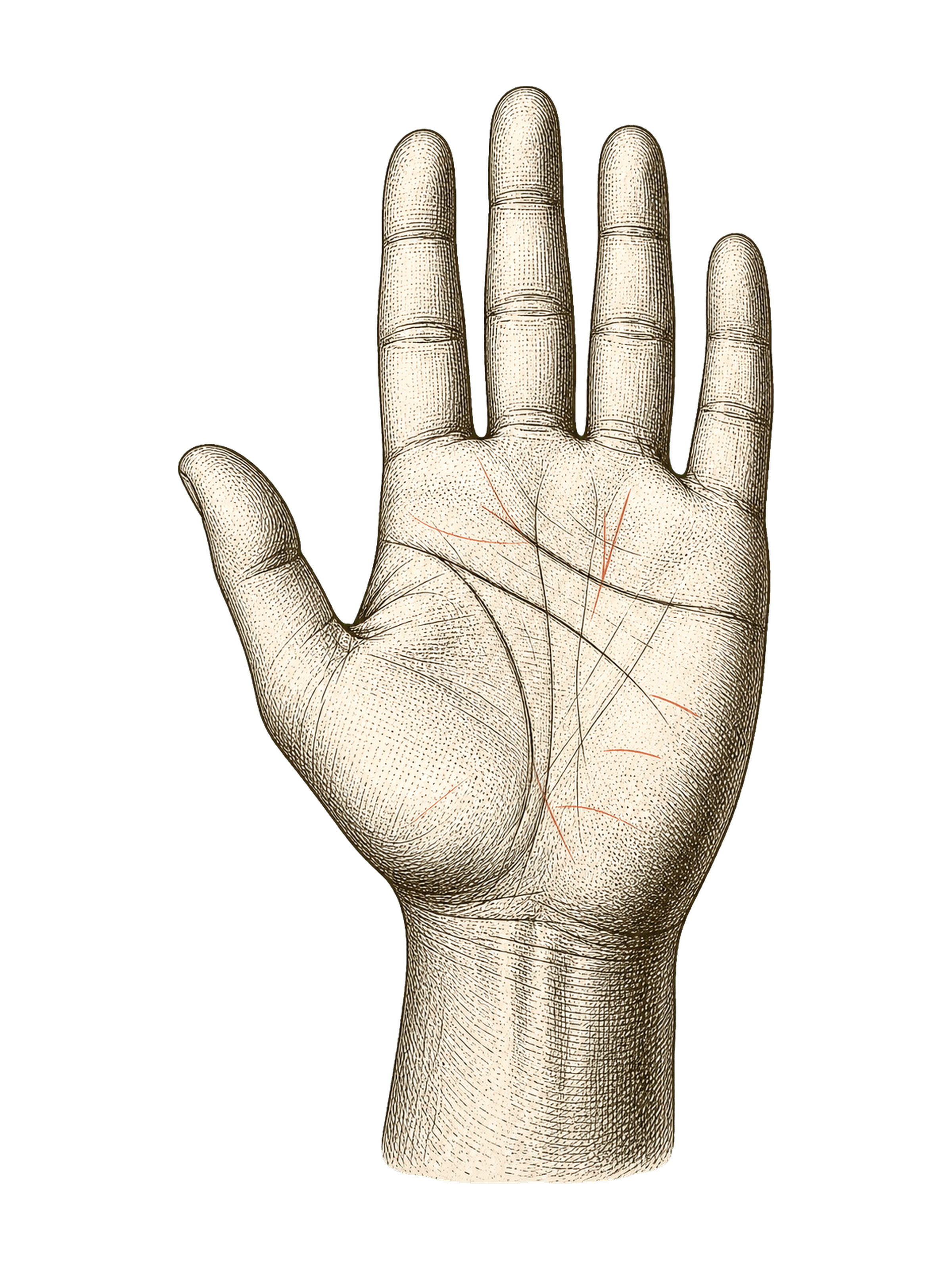
Tap to upload

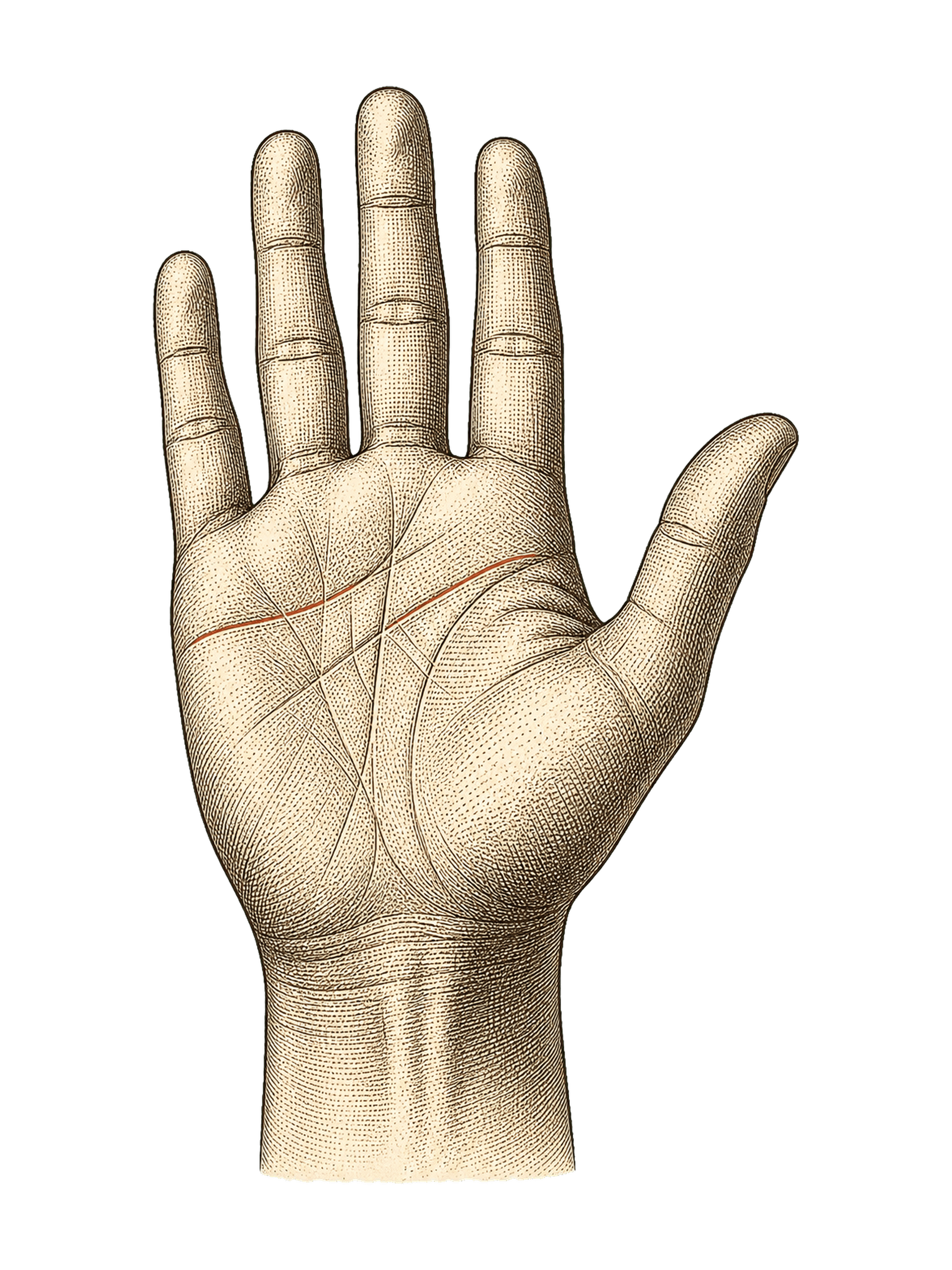
Tap to upload
Required · 18 or older
Photo privacy · Refund terms ·Details
- Your photos are sent to our analysis provider to write your reading. This browser may temporarily keep pending photos for sign-in or recovery. Photos sent from your phone are kept temporarily for hand-off. See our privacy policy for details.
- When you press Read my palms, both photos go to our analysis provider for a clarity check before payment. This checks the photos, not the validity of a reading.
- Doesn't sound like you? Email us within 7 days of your first reading for a full refund, if you haven't used a second. If a photo can't be read, your credit is returned.
- Next: your reading uses one of your readings, or a short checkout if you have none.
Photo tips
 Photo tips
Keep your palm flat, fingers slightly apart and lines in focus. Use bright, even light, and photograph each palm the same way.
 ✓ Like this
 ✕ Too dark
 ✕ Fingers cut off
Left is not a synonym for non-dominant
Your dominant hand is the one you prefer for a particular activity, such as writing. That is not automatically your right hand. Someone may also prefer different hands for different tasks.
When a guide says "read the right hand", do not silently translate that into "read whichever hand you write with". Check what the source actually means. If it does not explain the convention, its conclusion is hard to follow even on its own terms.
One historical example, not a universal rule
In the "Right and Left Hands" section of Cheiro's Palmistry for All (1916), he recommends examining both hands and assigns different significance to marks on the left and right. He connects the left with an inherited tendency and the right with its expression.
Those are historical claims, not demonstrated records of inherited traits or adult choices. That passage does not establish a universal dominant-hand rule for every palmistry tradition.
A hand that looks different from its partner does not prove that you overcame childhood conditioning. Similar hands do not show that you failed to grow. Those are narratives a reader has added.
A comparison you can actually make
Put both relaxed palms in similar light. Keep them at roughly the same distance and angle if photographing them. Then compare one feature at a time.
| Compare | Record | Leave out |
|---|---|---|
| A major crease | Its visible route on each hand | Which hand has a "better destiny" |
| An apparent branch | Whether it is clear in both views | A hidden talent or suppressed personality |
| A faint area | Whether lighting changes its visibility | A lost opportunity |
| The whole photograph | Posture, shadow and orientation | A before-and-after story about personal growth |
This is a visual exercise. It does not require the hands to match, or require you to explain every difference.
Our beginners' guide covers the main landmarks. The photo-comparison guide explains why changed appearance needs cautious interpretation.
What to ask a reader or app
Ask which convention is being used and whether the description is an observation or an interpretation. It should be possible to hear "the crease appears shorter here" without being told that your ambition has diminished.
PalmMingle provides an AI-assisted interpretive reading from uploaded hand photos. Follow the hand labels in its upload flow, but do not mistake those labels for scientific validation. A clearer comparison still cannot prove a psychological claim.
You can disagree with a reading. You can also decide that comparing palm photographs is not useful to you.
Questions about handedness
I am left-handed. Should I reverse every rule?
Only if the particular interpretive system explicitly uses dominance rather than left and right. Even then, the rule remains a convention, not a factual personality test.
What if I use both hands?
Describe how you use them if that context matters to the conversation. There is no need to force yourself into a category to make a reading work.
Can I read only one hand?
You can study the visible features of one hand. Looking at both adds a comparison, not an accuracy guarantee.
Which hand shows the future?
Neither provides a reliable forecast. Make consequential decisions using information about your actual circumstances.
Two palms can give you two observations. They do not give you a record of who you were meant to become.
Palmistry is an interpretive tradition, not a diagnostic tool. PalmMingle frames palm readings as entertainment and self-reflection, not prediction.