

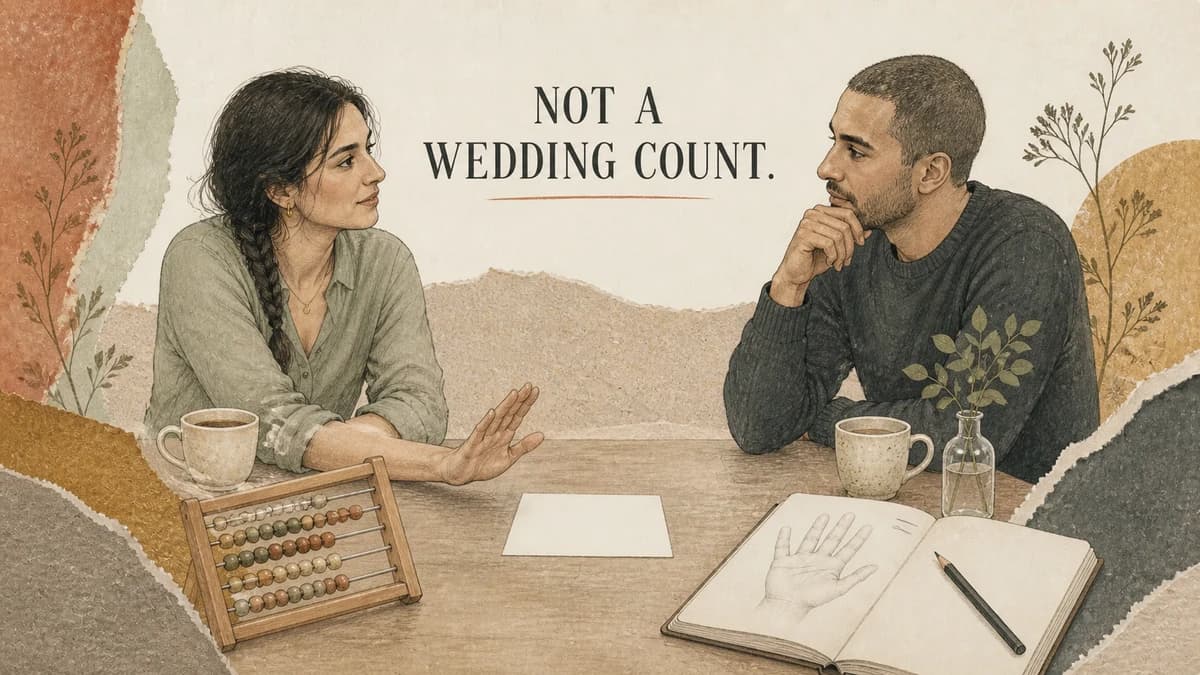
The "marriage lines" in palmistry are small creases on the little-finger edge of the hand, above the heart line. They cannot count your future weddings, predict divorce or measure your capacity to love.

Their historical names can make a small feature feel unusually consequential. Start by separating the place on the hand from the story attached to it.
Keep edge creases separate from the heart line
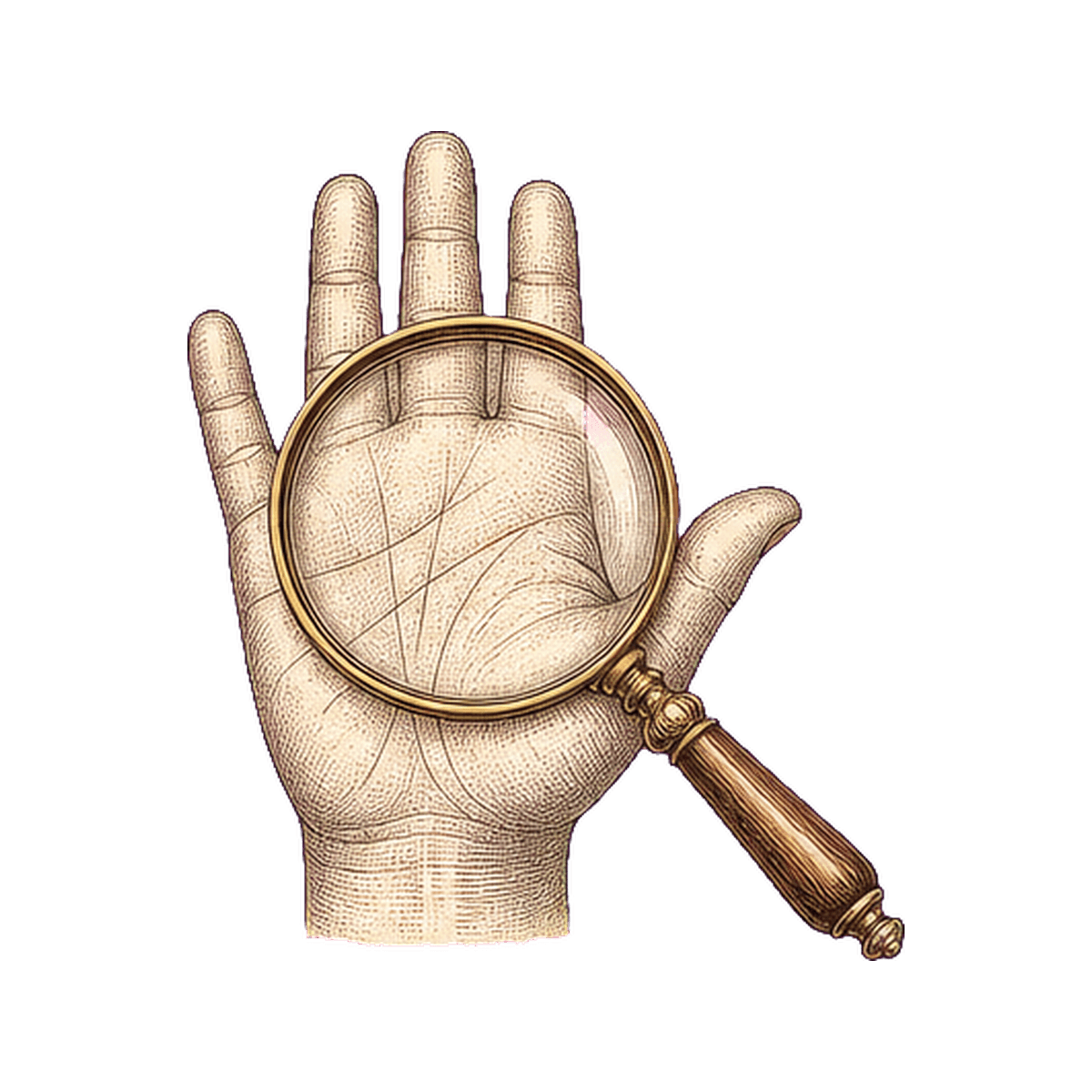
For the markings called marriage or union lines, check the little-finger edge of the palm above the heart-line area. A front-facing view may hide that edge. Record the view and the visible marks without converting their count into weddings or partners.
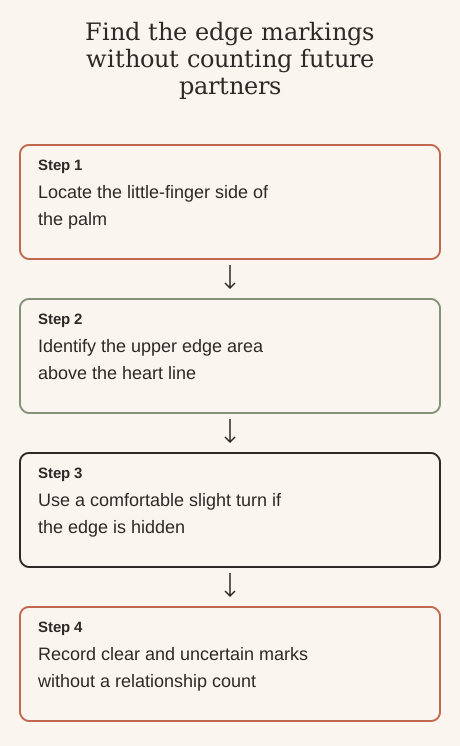
Inspect the little-finger edge and describe visible creases without counting future relationships.
- Locate the little-finger side of the palm.
- Identify the upper edge area above the heart line.
- Use a comfortable slight turn if the edge is hidden.
- Record clear and uncertain marks without a relationship count.
A useful note could be “One short edge crease visible; finer marks unclear in this photograph.” It does not mean one marriage. If turning the hand changes the apparent number, the record should mention the changed view rather than announcing a changed future. Do not squeeze or bend the area to manufacture more lines. For the larger upper-palm crease, use the heart-line overview rather than treating every horizontal mark as a union line.
For a closer look, locate the larger heart line; check an apparent interruption; record side and hand convention separately.
Want to see yours?
Scan your palm for a full interpretive reading.


Place your palms here
Both palms, please: your left on the left, your right on the right.

Tap to upload


Tap to upload
Required · 18 or older
Photo privacy · Refund terms ·Details
- Your photos are sent to our analysis provider to write your reading. This browser may temporarily keep pending photos for sign-in or recovery. Photos sent from your phone are kept temporarily for hand-off. See our privacy policy for details.
- When you press Read my palms, both photos go to our analysis provider for a clarity check before payment. This checks the photos, not the validity of a reading.
- Doesn't sound like you? Email us within 7 days of your first reading for a full refund, if you haven't used a second. If a photo can't be read, your credit is returned.
- Next: your reading uses one of your readings, or a short checkout if you have none.
Photo tips
 Photo tips
Keep your palm flat, fingers slightly apart and lines in focus. Use bright, even light, and photograph each palm the same way.
 ✓ Like this
 ✕ Too dark
 ✕ Fingers cut off
Where to look
Turn your relaxed hand slightly so you can see its outer edge below the little finger. Look between the finger base and the point where the heart line approaches that edge. You may see short horizontal marks extending inward.
Do not confuse these with the much longer heart line crossing the upper palm. Our heart-line guide explains nearby intersections and apparent gaps.
An edge crease can be difficult to photograph straight on. If you cannot distinguish two marks, record "unclear" rather than inventing a count.
What the historical source actually says
Chapter VIII of Cheiro's Palmistry for All (1916) calls these marks lines of marriage. It distinguishes clearer lines from shorter marks associated with affection or a contemplated marriage. It also makes explicit predictions about timing, separation and a partner's health.
That is a record of Cheiro's beliefs. It is not evidence that skin foretells those events. We should neither repeat the predictions as truth nor rewrite the historical book as if it only offered harmless modern reflection.
The alternative claim that line length measures "emotional stamina" is unsupported too. Replacing a wedding forecast with a personality verdict does not solve the evidence problem.
What a count can and cannot tell you
| Observation | Keep the description at this level | Do not infer |
|---|---|---|
| One clear mark | One mark visible in this view | One marriage or one soulmate |
| Several fine marks | Several creases in this area | Affairs, divorces or attachment capacity |
| A short mark | Limited visible length | Boredom or inability to commit |
| An apparent branch | A shape worth checking in even light | Separation or infidelity |
| No clear mark | Not identifiable in this view | A future without love |
These are neither a relationship test nor a medical examination. A person's commitments and behaviour cannot be read from the table.
Put the wedding counter down
If the symbolism interests you, use it to open a conversation that has no predetermined answer. Ask what commitment means to each person, what makes time together feel worthwhile, or which expectations you have not discussed.
Those questions do not require a hand reading. They also do not entitle anyone to another person's relationship history. Ask permission, allow a refusal and avoid using a supposed mark as an accusation.
For example, "Would you like to talk about what a long-term relationship means to you?" is an invitation. "Your fork means you will leave me" is an unsupported claim.
Common questions
Which hand gives the accurate marriage count?
Neither hand gives an accurate marriage count. Palmistry conventions about handedness do not validate the prediction. See our left-and-right-hand comparison.
Does an absent line mean I will stay single?
No. A missing or unclear crease cannot establish your future relationship status.
Can an app tell whether we are compatible?
PalmMingle's interpretive palm reading is not a compatibility guarantee or a validated assessment of attachment. An automated reading can misdescribe a feature as well.
Learn the historical label if you are curious. Let the people in the relationship, not a crease count, supply the meaning.
Palmistry is an interpretive tradition, not a diagnostic tool. PalmMingle frames palm readings as entertainment and self-reflection, not prediction.