


Bracelet lines in palmistry are the creases across the wrist, just below the palm. They are also called rascettes. You can describe how many you see, but their number is not a way to calculate your lifespan, assess fertility or forecast money. A wrist is not a countdown.

If you have found a chart assigning years to each line, start with a simpler question: which marks are you actually counting?
Keep a clear-count and uncertain-count record
A bracelet-line count is easier to explain when clear creases and doubtful marks stay separate. Use the same comfortable wrist position for each observation. The record below describes visibility; it does not score luck, health or years of life.
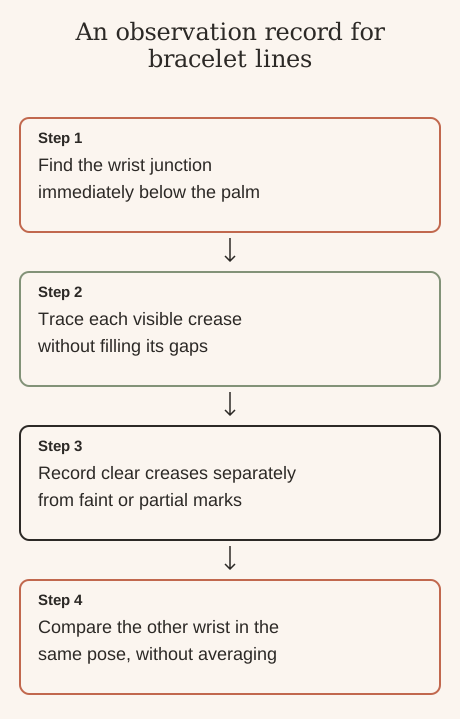
Keep the wrist position and lighting consistent before counting visible creases.
- Find the wrist junction immediately below the palm.
- Trace each visible crease without filling its gaps.
- Record clear creases separately from faint or partial marks.
- Compare the other wrist in the same pose, without averaging.
A useful entry could read: “Right wrist: two clear creases; one short mark visible only at the outer edge. Left wrist: two clear creases; lower detail unclear.” If another photo shows the short mark more strongly, keep both descriptions and note the changed light. You have improved the record without discovering an extra unit of lifespan. If a watch impression overlaps the area, leave that part unresolved until it is distinguishable. There is no need to force the entry into one, two, three or four.
For a closer look, distinguish the wrist creases from the life line; compare the same hand across photographs; start with the main palmistry landmarks.
Want to see yours?
Scan your palm for a full interpretive reading.


Place your palms here
Both palms, please: your left on the left, your right on the right.

Tap to upload


Tap to upload
Required · 18 or older
Photo privacy · Refund terms ·Details
- Your photos are sent to our analysis provider to write your reading. This browser may temporarily keep pending photos for sign-in or recovery. Photos sent from your phone are kept temporarily for hand-off. See our privacy policy for details.
- When you press Read my palms, both photos go to our analysis provider for a clarity check before payment. This checks the photos, not the validity of a reading.
- Doesn't sound like you? Email us within 7 days of your first reading for a full refund, if you haven't used a second. If a photo can't be read, your credit is returned.
- Next: your reading uses one of your readings, or a short checkout if you have none.
Photo tips
 Photo tips
Keep your palm flat, fingers slightly apart and lines in focus. Use bright, even light, and photograph each palm the same way.
 ✓ Like this
 ✕ Too dark
 ✕ Fingers cut off
Where to look for bracelet lines
Turn your hand palm-up and follow the palm down to the wrist. Look for creases running across that junction. These are separate from the life line, which curves inside the palm around the base of the thumb.
Katharine St. Hill uses the names “Bracelets” and “Rascettes” for wrist lines in The Grammar of Palmistry, printed page 68. That is a historical palmistry description, not a medical definition.
Keep your wrist comfortable rather than bending it hard to make extra folds appear. Use light that lets you see the surface without glare. The point is to describe what is visible, not to persuade your hand to resemble a diagram.
A count you can explain
Try this small observation exercise. It is a way to record a photograph, not a standardised palmistry test.
- Start with the crease nearest the palm.
- Follow it across the wrist. If it fades or stops, record that rather than joining it to a nearby mark.
- Move towards the forearm and look for another distinct crease.
- Keep uncertain marks separate from clear ones.
For example, you might write: “Two clear wrist creases; a short, faint third mark on the little-finger side.” That is more useful than calling it three because a website makes three sound fortunate.
Do not count the two sides of a broad shadow as two lines. If a watch strap leaves an indentation across the area, wait until you can distinguish that impression from the creases you wanted to observe.
A count can also remain uncertain. There is no prize for supplying an integer.
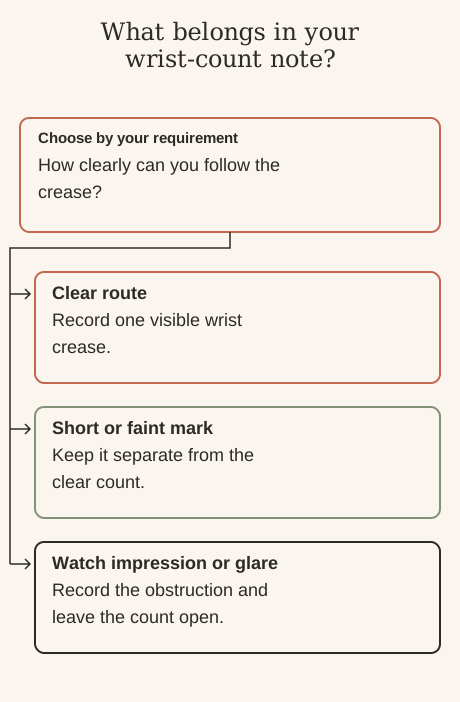
What belongs in your wrist-count note.
What do one, two, three or four lines mean?
St. Hill's manual connects bracelet counts and shapes with long life and good fortune. It also assigns meanings to chained, broken and branching forms on printed pages 68–69. These passages show what that writer claimed. They do not establish that a crease can predict an outcome.
Here is a more careful way to handle the same vocabulary:
| What you can describe | Palmistry vocabulary you may encounter | What the observation does not establish |
|---|---|---|
| One clearly visible crease | A single bracelet | A short life |
| Several separate creases | Multiple bracelets | Extra years or guaranteed prosperity |
| Small connected segments | A chained bracelet | Poor health or a difficult future |
| A crease that stops and resumes | A broken bracelet | A coming crisis |
| A short mark leaving a crease | A branch | An inheritance or journey |
You do not need to turn every old interpretation into a gentler personality claim, either. “This means you are resilient” is still an unsupported verdict if the only evidence is a wrist crease.
What if the two wrists look different?
Record each wrist separately. Do not average the counts, choose the more flattering one or label one wrist the “bad” hand.
If you compare photographs, use similar hand position, distance and lighting. Otherwise you may be comparing two ways of making a mark visible rather than a change in the mark itself. Our guide to whether palm lines change over time separates those questions.
A photo with faint detail also cannot settle whether a line is absent. “Not clear in this picture” is a perfectly complete answer.
Questions that tend to follow the count
Is there a lucky number of bracelet lines?
A palmistry book may assign lucky meanings to a count. That does not make the count a reliable measure of luck. You do not need another crease to qualify for a good life.
Can bracelet lines tell you about health or pregnancy?
Do not use them for either purpose. A palmistry interpretation is not a health assessment. If a symptom or pregnancy question is worrying you, take that question to an appropriate health professional, not a line-count chart.
Should I change my wrist lines?
There is no reason to alter your skin to match a palmistry ideal. Enjoy the symbolism if you like it; leave the skin alone.
Can an app count them for me?
Do not assume an app can reliably resolve every faint wrist crease. PalmMingle offers an interpretive palm reading, not a validated bracelet-count or lifespan test. If you choose to try a reading, check the current purchase terms first.
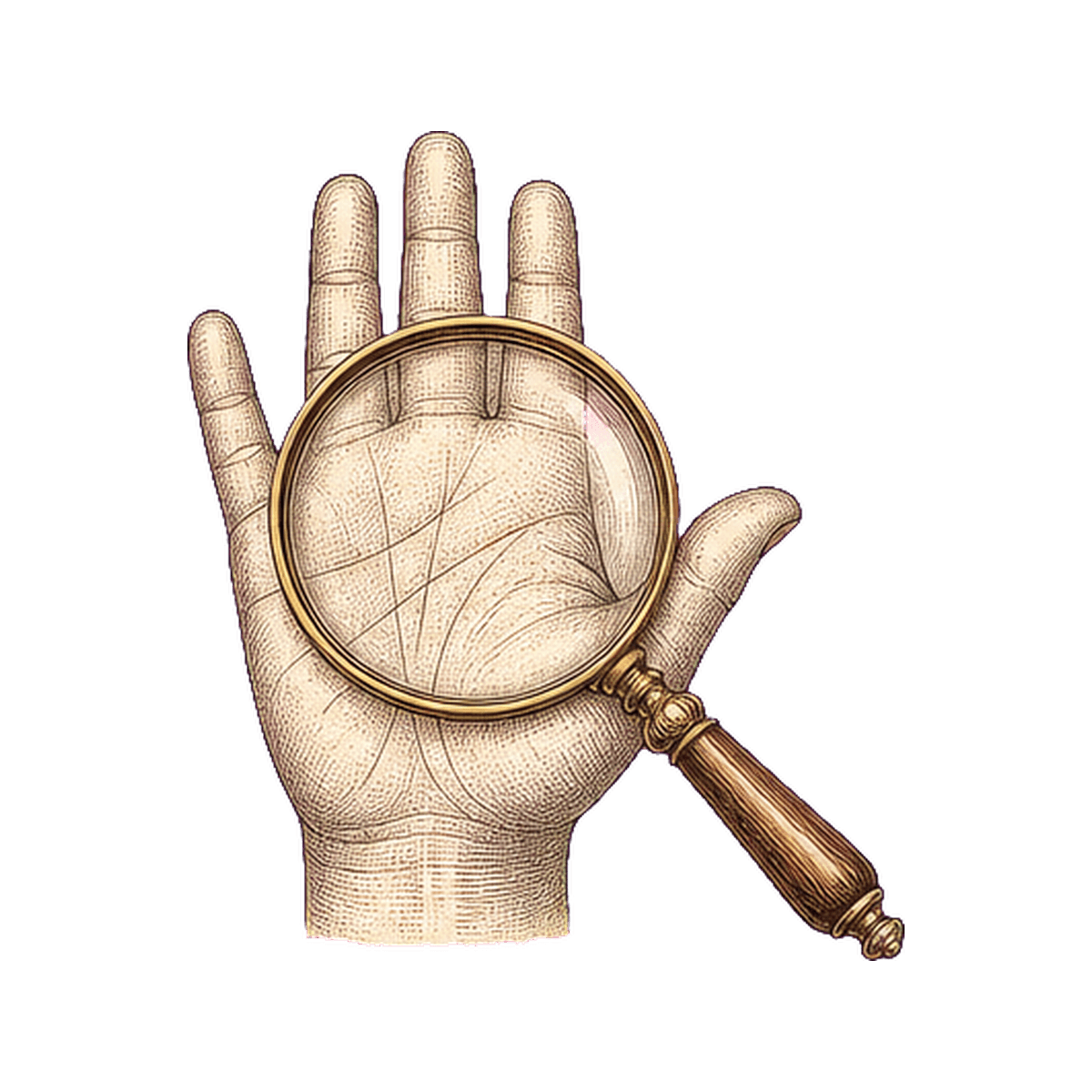
The hero is an editorial illustration, not a diagnostic chart.
Palmistry is an interpretive tradition, not a diagnostic tool. PalmMingle frames palm readings as entertainment and self-reflection, not prediction.