

In palmistry, the intuition line is usually described as a curved mark on the little-finger side of the palm, around the area called the Mount of the Moon. It is not the head line, and its presence is not a test of psychic ability. The name belongs to a palmistry tradition; it does not turn a hunch into evidence.

If you are searching for the curve, use the fingers to orient yourself. “Left side of the palm” can send you to the wrong place.
Check the curve without connecting unrelated marks
An intuition-line observation should explain where the curve lies and where it stops being visible. Begin on the little-finger side and compare the specific historical diagram cited below. Do not use a flattering interpretation to decide which wrinkles belong together.
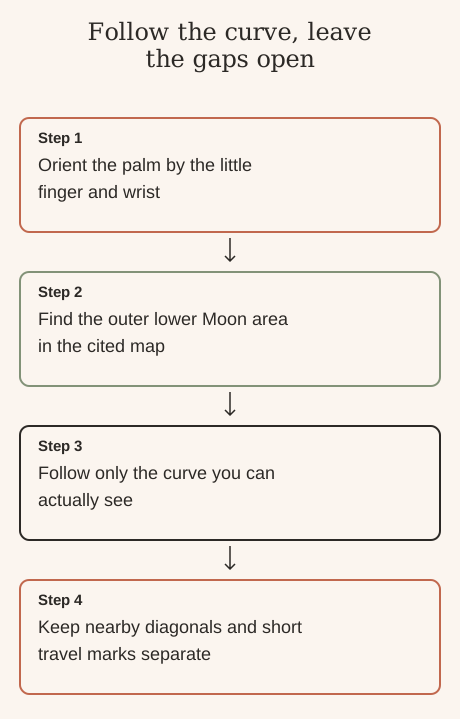
Locate the Moon-side curve and keep its visible path separate from claims about intuition.
- Orient the palm by the little finger and wrist.
- Find the outer lower Moon area in the cited map.
- Follow only the curve you can actually see.
- Keep nearby diagonals and short travel marks separate.
Suppose a photograph shows a short arc near the lower outer palm and a separate diagonal above it. Record two marks unless a connection is visible. Calling them one long intuition line would add information the picture does not supply. You can still explore the traditional meaning, but a missing connection does not make you less perceptive. When a hunch concerns another person, the useful follow-up is a proportionate question to that person, not another attempt to lengthen the crease in a photo.
For a closer look, compare the separate Mercury line; distinguish nearby travel markings; orient the Moon and Mercury areas.
Want to see yours?
Scan your palm for a full interpretive reading.


Place your palms here
Both palms, please: your left on the left, your right on the right.

Tap to upload


Tap to upload
Required · 18 or older
Photo privacy · Refund terms ·Details
- Your photos are sent to our analysis provider to write your reading. This browser may temporarily keep pending photos for sign-in or recovery. Photos sent from your phone are kept temporarily for hand-off. See our privacy policy for details.
- When you press Read my palms, both photos go to our analysis provider for a clarity check before payment. This checks the photos, not the validity of a reading.
- Doesn't sound like you? Email us within 7 days of your first reading for a full refund, if you haven't used a second. If a photo can't be read, your credit is returned.
- Next: your reading uses one of your readings, or a short checkout if you have none.
Photo tips
 Photo tips
Keep your palm flat, fingers slightly apart and lines in focus. Use bright, even light, and photograph each palm the same way.
 ✓ Like this
 ✕ Too dark
 ✕ Fingers cut off
Start on the little-finger side
Hold your hand palm-up. Find the little finger, then follow that outer side of the hand towards the wrist. Palmists call the lower padded area on this side the Moon mount; the Mercury mount sits higher, beneath the little finger.
In chapter XII of Palmistry for All, Cheiro describes a semicircular mark in the Moon/Mercury region, sometimes confined to the Moon area. He explicitly distinguishes it from the Hepatica, another name for the health line. Plate XX shows his intuition marking as number 5.
Use that particular description consistently when comparing your hand. It does not require drawing a diagonal from the thumb across the entire palm.
Three nearby marks, three different descriptions
The little-finger side can look busy in a photograph. These distinctions help you avoid naming the first available crease:
| Name in palmistry | Shape or direction to compare | Useful caution |
|---|---|---|
| Intuition line | A curve along the Moon/Mercury side in Cheiro's diagram | Do not substitute a straight diagonal because it is easier to see |
| Mercury or health line | A line heading towards the area below the little finger | A shared destination does not make it the same curve |
| Travel lines | Smaller lines associated with the Moon area in the tradition | Several short marks do not automatically form one long arc |
Our separate guides explain the Mercury line and travel lines. Their names are also interpretive: neither turns a photograph into a health assessment or a travel forecast.
A useful note might be: “One faint curve near the outer edge, with two unrelated short creases below it.” There is no need to join those marks into a more impressive pattern.
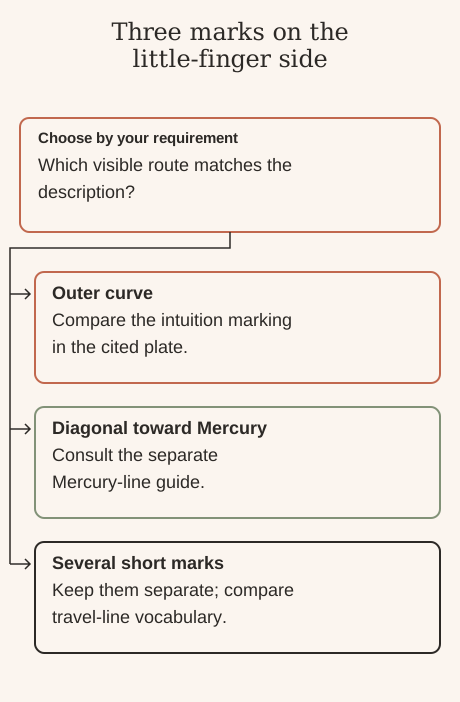
Three marks on the little-finger side.
What the historical meaning can—and cannot—tell you
Cheiro associated the intuition line with clairvoyance and vivid dreams. Those are his assertions, not demonstrations that the marking predicts unusual abilities.
A book can be a primary source for what its author believed while being a poor source for whether that belief is true. That distinction matters especially when the promised trait is flattering. “You notice things other people miss” is easy to enjoy and difficult to test if nobody says what would count as being wrong.
You can take an interest in the symbol without accepting the claim. You can also decide the symbol is not useful to you.
Try a hunch, evidence, action note
An invented reflection example:
- Hunch: “My friend seemed annoyed in that message.”
- Evidence I actually have: “The reply was short. I do not know what else was happening.”
- A proportionate next step: “Ask whether this is a good time to talk, instead of announcing that I know how they feel.”
The exercise does not tell you to ignore your impressions. It asks you to keep the impression separate from the observation and choose an action that leaves room for being mistaken.
Your palm does not decide whether the hunch was correct. A conversation may give you information the crease cannot.
What if the line is faint, broken or missing?
Use those words as descriptions, not personality grades.
A faint line may be difficult to identify in the photograph you have. A broken-looking mark may be several separate creases rather than one interrupted line. If nothing clearly matches the diagram, “no clear match” is enough.
None of those observations establishes weak intuition, emotional damage or a missing gift. Nor can this guide give a reliable percentage for how many people have the line: the cited manual does not provide a representative prevalence study.
If you keep retaking pictures to find a more flattering version, put the phone down for a moment. The interpretation should remain optional.
Is the intuition line different on the left and right hand?
The same finger-relative location works for either hand. A mirrored image changes which side of the screen the little finger occupies, not which finger it is. Record the hand you photographed and compare like with like.
For a broader exploration, PalmMingle offers an interpretive palm reading. Treat the output as material to consider, not evidence of hidden powers. A reading does not promise reliable detection of every faint minor line; check current purchase terms before trying one.
The hero is a conceptual illustration, not a psychic test or a scored hand diagram.
Palmistry is an interpretive tradition, not a diagnostic tool. PalmMingle frames palm readings as entertainment and self-reflection, not prediction.