
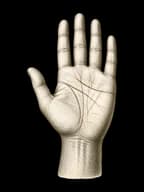
The Mercury line is an optional crease traditionally drawn from the lower palm toward the area beneath the little finger. Older palmistry books also call it the Health line or Hepatica. Those names are historical—not medical. A palm crease cannot diagnose heart, liver, lung, neurological, genetic, or any other health condition.

Safety answer: If a mark on your hand, a symptom, or a health fear worries you, speak to a qualified healthcare professional. Do not use palmistry or an AI palm reading to make a medical decision.
A curve on the outer lower side is a separate locating question: the intuition-line comparison keeps that arc distinct from the Mercury route.
Where is the Mercury or Health line?
Look beneath the little finger and trace downward. A candidate Mercury line usually runs vertically or diagonally from the lower outer palm toward that area. It may begin near the wrist, the life line, or partway up the palm. Many people will not see a single clear line, and that absence has no medical meaning.
The naming can be confusing because “Mercury” is also the name of the mount under the little finger. The mounts map separates that area from the other named pads. The line is identified primarily by the region it approaches. It is not the same as the short relationship lines at the outer edge of the hand, and it is not a second life line.
Use relaxed, even lighting if you are trying to identify it. Do not count every fine skin fold. A feature that appears only under hard side-light is uncertain.
Cheiro also used this line as one boundary of the Great Triangle; the worked map keeps an unclear third side open rather than inventing a connector.
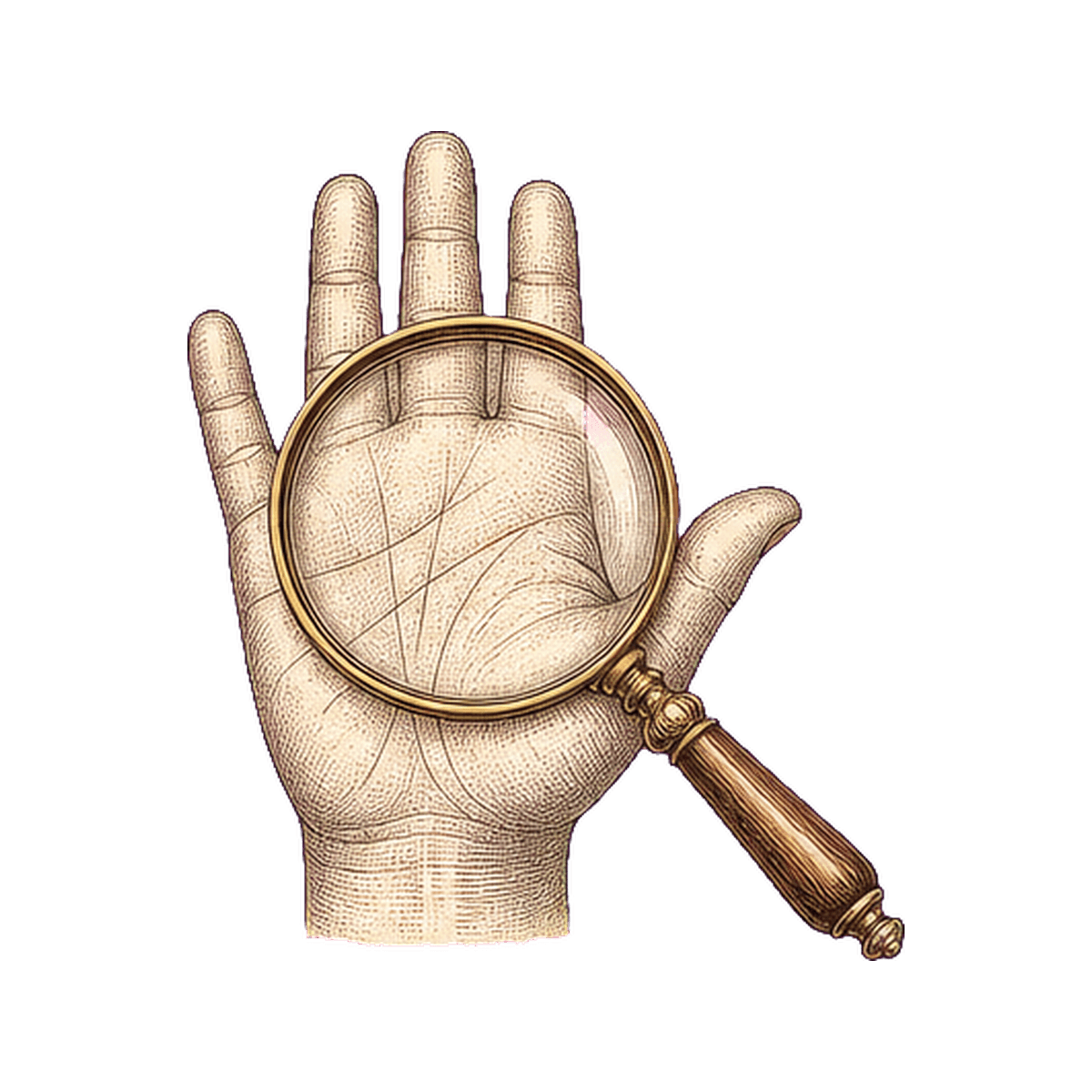
Want to see yours?
Scan your palm for a full interpretive reading.
Place your palms here
Both palms, please: your left on the left, your right on the right.
Tap to upload

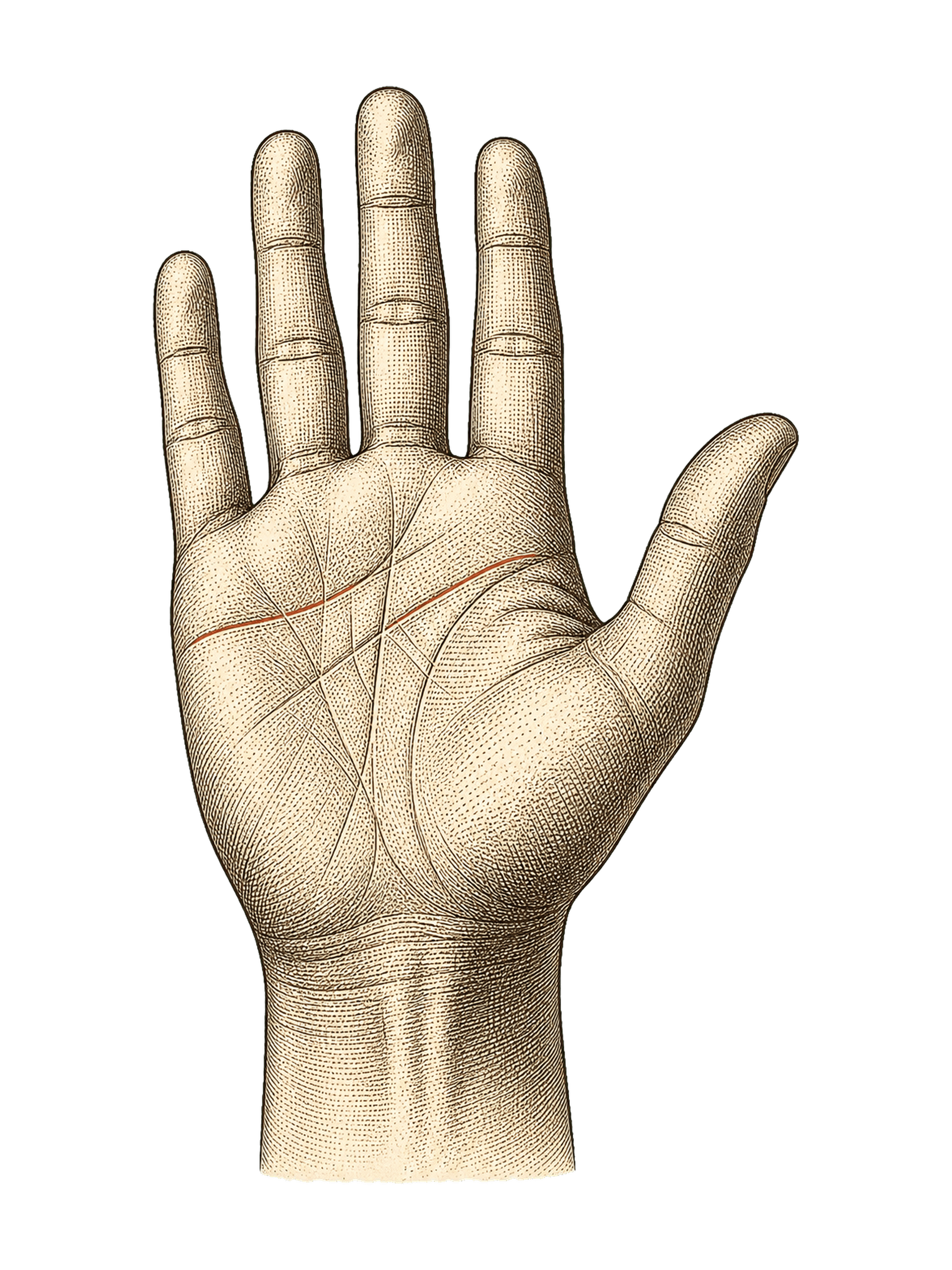
Tap to upload
Required · 18 or older
Photo privacy · Refund terms ·Details
- Your photos are sent to our analysis provider to write your reading. This browser may temporarily keep pending photos for sign-in or recovery. Photos sent from your phone are kept temporarily for hand-off. See our privacy policy for details.
- When you press Read my palms, both photos go to our analysis provider for a clarity check before payment. This checks the photos, not the validity of a reading.
- Doesn't sound like you? Email us within 7 days of your first reading for a full refund, if you haven't used a second. If a photo can't be read, your credit is returned.
- Next: your reading uses one of your readings, or a short checkout if you have none.
Photo tips
 Photo tips
Keep your palm flat, fingers slightly apart and lines in focus. Use bright, even light, and photograph each palm the same way.
 ✓ Like this
 ✕ Too dark
 ✕ Fingers cut off
Why is it called the Health line?
Historical Western palmists claimed that this line revealed health and the nervous or digestive system. Cheiro's 1916 Palmistry for All calls it the Line of Health and Line of Mercury, then makes specific predictions about disease from its colour, breaks, islands and relationship to other lines.
Those claims are a useful warning about the difference between a historical source and a reliable medical source. A book can establish what palmists believed without establishing that the belief works. Cheiro's disease predictions pre-date modern evidence standards and should not be used to assess anyone's health today.
Medical resources discuss palmar creases in anatomical and clinical context. For example, MedlinePlus's overview of a single palmar crease explains that crease patterns can be normal variations and that a clinician considers history, symptoms and other findings. It does not assign diagnoses by divinatory line meaning.
What can the Mercury line mean safely?
If you choose to use palmistry for reflection, rename the theme before reading it. “Health line” invites diagnosis. “Mercury line” keeps it inside the traditional symbolic map.
Mercury is commonly associated in palmistry with communication, exchange, practical skill and adaptability. You might use a visible line as a prompt to ask:
- How well do I explain what I need?
- Where am I improvising instead of preparing?
- Which routines help me stay steady under pressure?
- Am I treating rest as optional?
These are self-reflection questions. The answers come from your behaviour and circumstances, not from the line.
Even wellbeing language needs care. A reading can suggest considering your routines; it cannot say that a line shows burnout, anxiety, a “weak nervous system,” or an organ problem. Mental-health and physical-health labels require evidence beyond a palm image.
Claims a responsible reading should never make
A Mercury-line interpretation should not say:
- that a break predicts illness;
- that an island identifies a disease;
- that colour proves a liver, heart, lung, or circulation problem;
- that the point where two lines meet predicts death;
- that the line confirms anxiety or another mental-health condition;
- that its absence guarantees good health.
The old literature contains versions of all of these claims. Repeating them without correction can frighten people or delay proper care.
PalmMingle treats palmistry as an interpretive tradition. Its reading is not a diagnosis, clinical screen, or prediction. The same boundary applies whether the interpretation comes from a person, a book, or AI.
If you are worried after seeing a palmistry post
Stop searching for more line meanings. Write down the real concern: a symptom, a family history, a recent change, or fear triggered by something you read. Then choose an evidence-based next step.
In the UK, NHS guidance on health anxiety explains when persistent checking and reassurance-seeking may itself need support. For new or worrying physical symptoms, use the appropriate NHS, primary-care, urgent-care, or emergency route. Elsewhere, use your local health service.
The goal is not to shame curiosity. It is to prevent a symbolic practice from impersonating medicine.
How to read this line without crossing the boundary
- Identify a possible crease toward the little-finger mount.
- Call it the Mercury line, not evidence about health.
- Describe only what is visible: clear, faint, short, interrupted, or uncertain.
- Use communication or routine as the reflective theme.
- Keep every health conclusion outside the reading.
If you want an interpretive overview of your visible hand features, read what PalmMingle's AI does and does not do first. A clear scope matters more than a dramatic reading.
Frequently asked questions
Does everyone have a Mercury line?
No. It is an optional line in palmistry, and absence is common. It does not mean perfect health or poor communication.
Can a broken Health line mean illness?
No reliable diagnosis follows from a broken crease. Breaks can reflect ordinary crease variation, skin texture, scars, lighting, or an interpretive category in palmistry.
Can an AI detect disease from my palm photo?
PalmMingle cannot and does not diagnose disease from a hand photo. Do not submit an image expecting medical screening.
Is the Mercury line the same as the Sun line?
No. The Mercury line heads toward the little finger. The Sun line heads toward the ring finger.
Sources and further reading
- Cheiro, Palmistry for All (1916), historical “Line of Health” chapter
- MedlinePlus: Single palmar crease
- NHS: Health anxiety
Learn the historical name if you are curious. For your actual health, use actual healthcare.
Palmistry is an interpretive tradition, not a diagnostic tool. PalmMingle frames palm readings as entertainment and self-reflection, not prediction.