
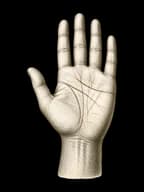
In palmistry, the Sun line is a roughly vertical line running toward the padded area below the ring finger. It is also called the Apollo line, line of success, or line of brilliance. Traditional readers connect it with creative expression and recognition. It does not guarantee fame, money, awards, or a successful career—and many hands do not show one clearly at all.

Quick answer: Look beneath the ring finger. A Sun line may rise from the lower palm, the middle of the palm, or another major line. It can be short, faint, broken, multiple, or absent.
The adjacent upright route toward the middle finger has a separate name; compare the fate-line locating guide before joining two nearby creases into one path.
Where is the Sun line on the palm?
Start at the ring finger and trace downward rather than searching from the wrist upward. Any vertical line that clearly aims toward the mount below that finger may be classified as a Sun line in Western palmistry.
That direction is more important than a fixed starting point. In the chapter titled “The Line of the Sun,” Cheiro's Palmistry for All lists several possible origins: the life line, fate line, Plain of Mars, Mount of the Moon, head line, heart line, or the Sun mount itself. The old text presents predictive claims as fact; we cite it as evidence of the tradition, not evidence that those claims are true.
A short line directly beneath the ring finger can still receive the name. A vertical crease beneath the middle finger is more likely to be classified as a fate line. Direction and endpoint keep the two concepts separate.
Want to see yours?
Scan your palm for a full interpretive reading.
Place your palms here
Both palms, please: your left on the left, your right on the right.
Tap to upload

Tap to upload
Required · 18 or older
Photo privacy · Refund terms ·Details
- Your photos are sent to our analysis provider to write your reading. This browser may temporarily keep pending photos for sign-in or recovery. Photos sent from your phone are kept temporarily for hand-off. See our privacy policy for details.
- When you press Read my palms, both photos go to our analysis provider for a clarity check before payment. This checks the photos, not the validity of a reading.
- Doesn't sound like you? Email us within 7 days of your first reading for a full refund, if you haven't used a second. If a photo can't be read, your credit is returned.
- Next: your reading uses one of your readings, or a short checkout if you have none.
Photo tips
 Photo tips
Keep your palm flat, fingers slightly apart and lines in focus. Use bright, even light, and photograph each palm the same way.
 ✓ Like this
 ✕ Too dark
 ✕ Fingers cut off
Sun line versus fate line
The simplest distinction is destination:
- The Sun line heads toward the ring finger and is traditionally associated with expression or recognition.
- The fate line normally heads toward the middle finger and is traditionally associated with direction, duty, or work.
Both may appear together, cross, or share part of a route. Neither is required. A crease does not know what your job is, and no line establishes whether your work will be recognised.
The distinction is still useful inside the symbolic system. A fate-line question is “What gives my path structure?” A Sun-line question is “What do I want to make visible or share?” Those are prompts you can answer from your actual life rather than predictions you need to obey.
What does the Apollo line mean in palmistry?
Historical palmists used unusually grand language for this line. Cheiro associated it with happiness, magnetism, recognition, reward, riches and honours. Modern social posts often compress that into “you will be famous.” That leap is exactly where an interpretive tradition becomes a false promise.
A safer reading treats the Sun line as a metaphor for your relationship with expression and acknowledgement:
- A clear line can prompt: Where do I seek recognition, and from whom?
- A faint line can prompt: Which work matters even when nobody applauds it?
- Several fine lines can prompt: Am I dividing creative attention across too many outlets?
- A line beginning high in the palm can prompt: Did a public or creative priority become important later?
These questions may be useful. The line itself cannot answer them.
What if there is no Sun line?
An absent Sun line is not bad luck. It does not mean that you lack talent, joy, creativity or the ability to be seen. It means only that you cannot identify this optional crease clearly.
Even within traditional palmistry, not every line appears on every hand. Treating absence as a deficit encourages readers to invent a faint mark, especially from a noisy phone photo. If you need to zoom aggressively or rotate the image until a shadow becomes a line, mark it as unclear.
PalmMingle may ask you to retake an unclear photo. An automated reading can still miss or misinterpret a feature. If you take a photo, use soft even light, show the full palm, and keep the ring-finger area in focus. The AI palmistry guide explains the scope and limits before purchase.
Breaks, branches, and multiple lines
Traditional manuals assign a meaning to almost every variation. Breaks become interrupted recognition; branches become new channels; an island becomes a setback; parallel lines become multiple talents. None of those interpretations has been validated as a way to predict real outcomes.
Before interpreting a variation, check the boring explanations:
- Is the line truly continuous to the naked eye?
- Is a surface wrinkle crossing it?
- Does changing the light remove the apparent break?
- Are you looking at a crease, a scar, or a temporary skin mark?
Observation first, naming second, interpretation last.
How to use the Sun line as a reflection prompt
Try a reading that ends in an action you control:
- Identify whether a line clearly heads toward the ring finger.
- Describe it without judgement: long, short, faint, deep, straight, interrupted.
- Read the traditional theme as “expression and recognition,” not “fame.”
- Ask where you currently create, contribute, perform, teach, or publish.
- Choose one small way to make good work more visible.
That final step is not caused by your palm. It is simply a more useful response than waiting for a supposed success line to deliver results.
Frequently asked questions
Is the Sun line the same as the Apollo line?
Yes. Sun line, Apollo line, line of success and line of brilliance are common names for the same palmistry feature beneath the ring finger.
Which hand should I check?
Look at both. Palmistry traditions disagree about handedness, and comparison is more informative than forcing one hand to carry a verdict. Our which-hand guide compares those conventions without ranking the hands.
Does a long Sun line mean I will be famous?
No. Fame depends on talent, opportunity, work, networks, luck and social conditions—not a palm crease.
Is a broken Sun line unlucky?
No factual outcome follows from a break. Palmists may use it as a metaphor for changing priorities or interrupted visibility, but it is not evidence of future loss.
Sources and further reading
- Cheiro, Palmistry for All (1916), “The Line of the Sun”
- Open Library record for William G. Benham's The Laws of Scientific Hand Reading (1901)
The Apollo line can be an interesting prompt about visibility. Your work—not the crease—determines what happens next.
Palmistry is an interpretive tradition, not a diagnostic tool. PalmMingle frames palm readings as entertainment and self-reflection, not prediction.