

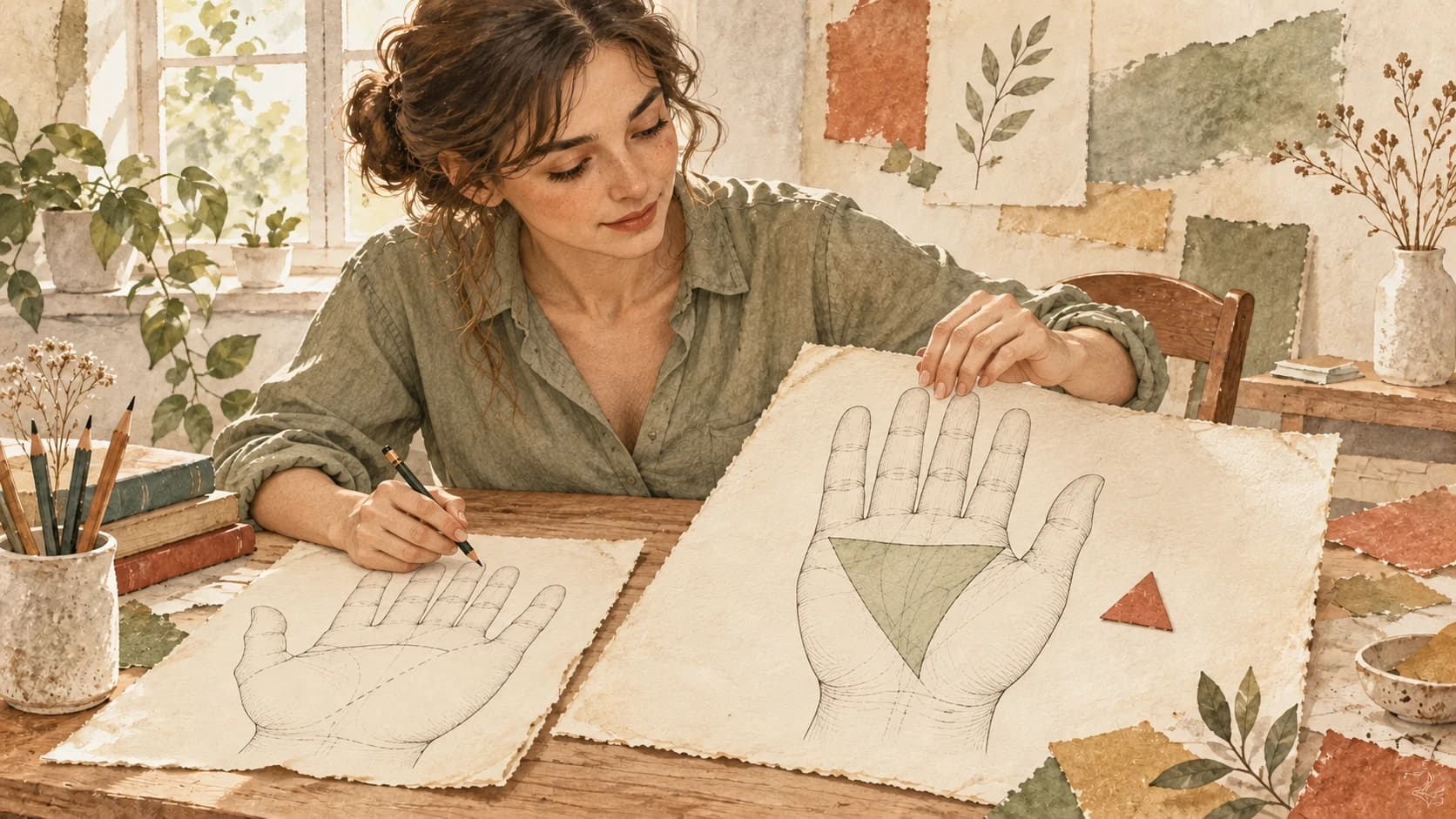
In Cheiro's palmistry, the Great Triangle is the region formed by the Head, Life and Health lines. It is a broad area between three named paths, not a small triangle-shaped mark. If you cannot follow one of those paths, you have an unresolved observation, not a result about your health or future.
The useful question is which three boundaries the author means. Start with that map before interpreting the word "triangle" as something special about you.
Which three lines form Cheiro's Great Triangle?
The Head line forms the upper side, the Life line follows the thumb-pad side, and the Health line closes the other side in the source's drawing. These names identify Cheiro's particular diagram. They do not turn a crease into evidence about thinking, lifespan or health, and this page does not treat one author's labels as a universal convention.
Chapter XVIII of Cheiro's Palmistry for All names those three boundaries. Plate XXV shows the resulting region below the Head line. Use the labels to understand what he drew, rather than importing the book's claims about what the region supposedly reveals.
For the third label, our Mercury or Health line guide explains the locating question and why the historical name cannot diagnose anything.
Want to see yours?
Scan your palm for a full interpretive reading.


Place your palms here
Both palms, please: your left on the left, your right on the right.

Tap to upload


Tap to upload
Required · 18 or older
Photo privacy · Refund terms ·Details
- Your photos are sent to our analysis provider to write your reading. This browser may temporarily keep pending photos for sign-in or recovery. Photos sent from your phone are kept temporarily for hand-off. See our privacy policy for details.
- When you press Read my palms, both photos go to our analysis provider for a clarity check before payment. This checks the photos, not the validity of a reading.
- Doesn't sound like you? Email us within 7 days of your first reading for a full refund, if you haven't used a second. If a photo can't be read, your credit is returned.
- Next: your reading uses one of your readings, or a short checkout if you have none.
Photo tips
 Photo tips
Keep your palm flat, fingers slightly apart and lines in focus. Use bright, even light, and photograph each palm the same way.
 ✓ Like this
 ✕ Too dark
 ✕ Fingers cut off
Trace the region, not a triangle-shaped sticker
Follow each boundary around the enclosed space. A region can have curved sides because its borders follow the named paths. Finding a small triangular mark somewhere on a palm answers a different question. The two imaginary maps below keep the hand outline and the Head and Life paths identical, so you can concentrate on what changes at the third side.
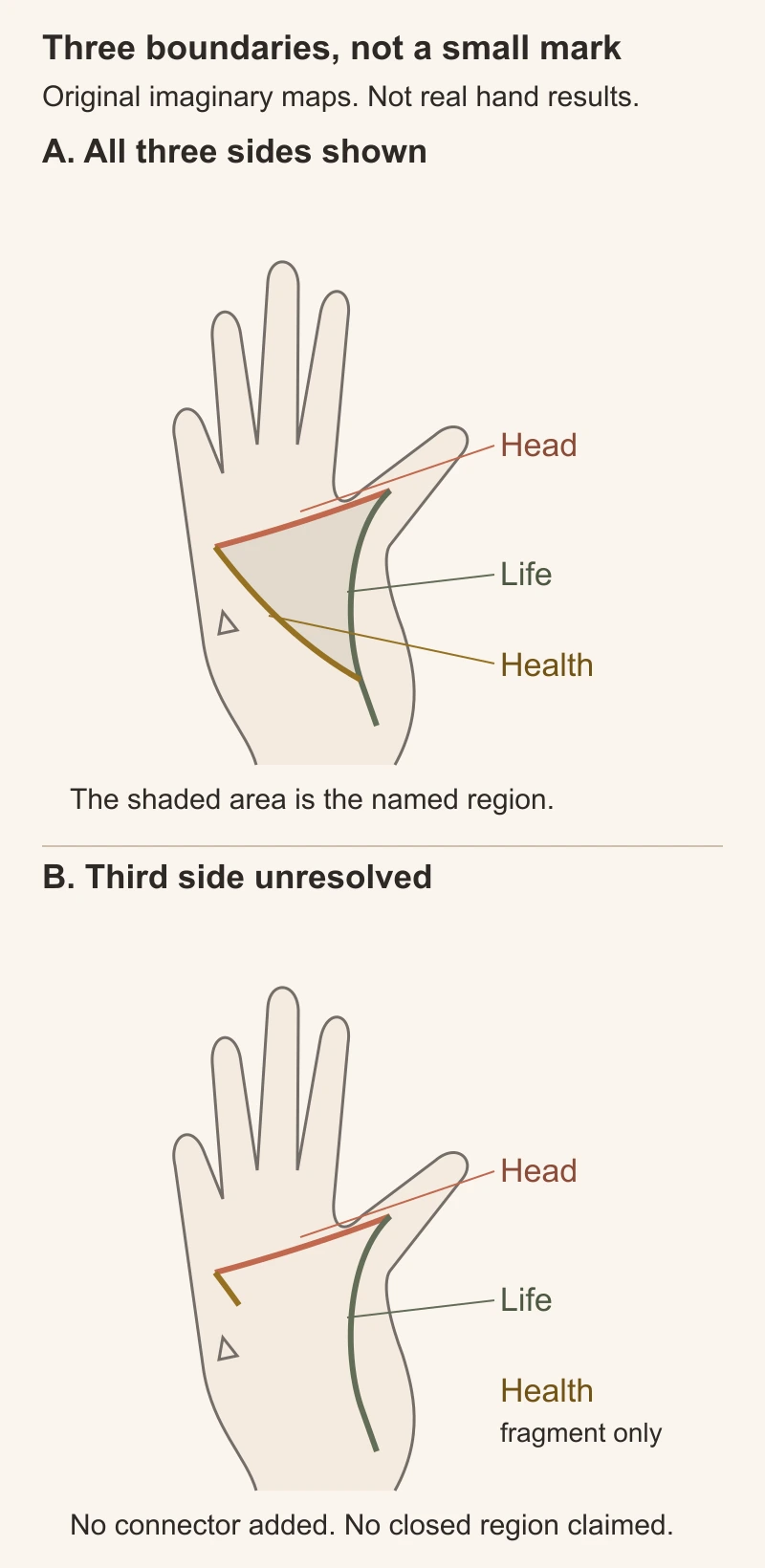
Original imaginary maps using the boundary arrangement in Cheiro's Plate XXV. They are not measured hands, product output or tests of palmistry. The incomplete case is our teaching example.
In A, begin where Head meets Life near the thumb side. Follow Head towards the outer side, then Health down to its meeting with Life. Follow Life back towards your starting point. The enclosed area is the object being named.
The small separate triangle is not a miniature version of that region. For local marks, use the palmistry symbols guide instead. That guide already distinguishes the two objects; this map adds the named three-boundary walk.
What if the third border is unclear?
Leave the third border unresolved. In B, a short fragment does not supply the missing route back to Life. Do not extend the fragment because a guide expects a triangle, join unrelated marks to close the gap, or substitute a different named line without checking the source. The source's complete drawing and your uncertain observation are separate things.
Here is a worked note for B. It describes only this invented example.
| Source boundary | Visible in B | Still uncertain |
|---|---|---|
| Head | Upper central path, meeting Life near the thumb side | No additional claim needed |
| Life | Curved thumb-pad boundary, unchanged from A | No additional claim needed |
| Health | Short outer-side fragment | Whether a continuous third boundary reaches Life |
Keep the useful part of the note: "I can follow two sides. I cannot follow the third." That is more precise than "I have a broken Great Triangle," which assumes a complete region before the observation has established one.
If the Life path itself is confusing, the Life-line guide addresses that separate landmark. It is not an invitation to read lifespan from the curve.
A source label is not a result about you
An observation note can name the source and stop at the unresolved side. For example: "Using Cheiro's Head, Life and Health map, I can trace the first two boundaries in this drawing. The third is incomplete, so I have not identified a closed region." Nothing in that note grades the person, diagnoses a condition or predicts an event.
You can finish this locating exercise without uploading a photograph or buying anything. If you want to consider a broader interpretive reading, PalmMingle's AI palmistry explanation describes its format and limits. It is for reflection and entertainment, not a certified way to identify this region or recover a faint boundary.
The optional worked-example sample shows the kind of written interpretation to expect. It is a specimen, not your reading or a customer's result. A source map can help you ask a clearer question; it cannot supply certainty that the image does not contain.
Palmistry is an interpretive tradition, not a diagnostic tool. PalmMingle frames palm readings as entertainment and self-reflection, not prediction.