
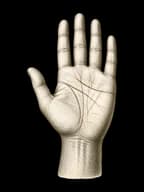
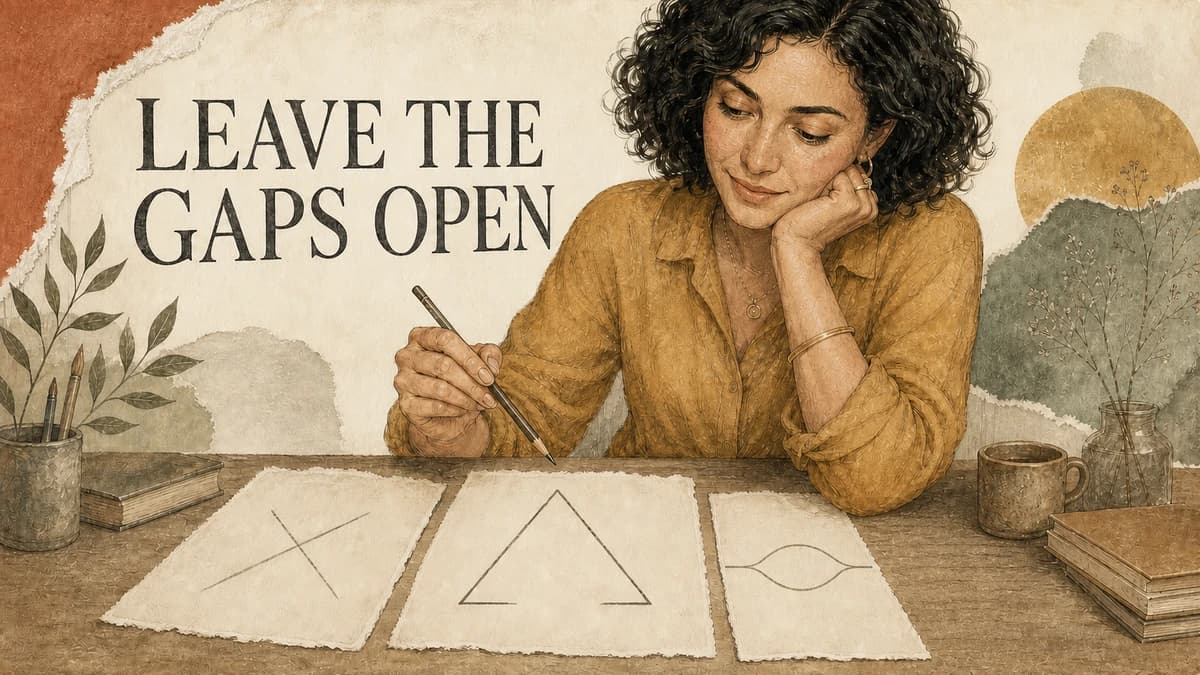
Palmistry symbols are small shapes made by fine creases crossing, enclosing, or running alongside a larger line. Common labels include star, cross, triangle, island, square and grille. Their meanings depend on location in the traditional system. Before interpreting one, make sure the shape is actually visible—phone-camera shadows and ordinary skin texture create convincing false symbols.
Quick answer: A star has several strokes meeting at one point; a cross has two; a triangle has three enclosed sides; an island is a narrow loop within a line; a square has four enclosed sides; and a grille is a small mesh of intersecting lines.
An arc is a different shape from an intersecting symbol; the guide to a possible Solomon arc shows why its position below the index finger matters.
For a loop with a possible tail, compare fishlike loops and their lookalikes.
For a larger triangular construction, check which three paths a money-triangle guide names.
For the specifically named Mystic Cross, locate a local X between Head and Heart.
How to identify a palm marking
Begin with shape, not meaning. Use soft light and look at the unedited palm. A symbol should be formed by visible creases at normal scale. Do not join gaps mentally, increase contrast until pores become lines, or count a temporary scratch.
Then record two pieces of context:
- Is the mark on a major line, beside it, or on a mount?
- Which line or mount of the palm is involved?
Traditional palmistry rarely gives one global meaning to a shape. A cross on the head line is read differently from a cross on the Jupiter mount. That flexibility is also why the system should not be treated as a test: interpretations can expand to fit almost any configuration.
Want to see yours?
Scan your palm for a full interpretive reading.
Place your palms here
Both palms, please: your left on the left, your right on the right.
Tap to upload
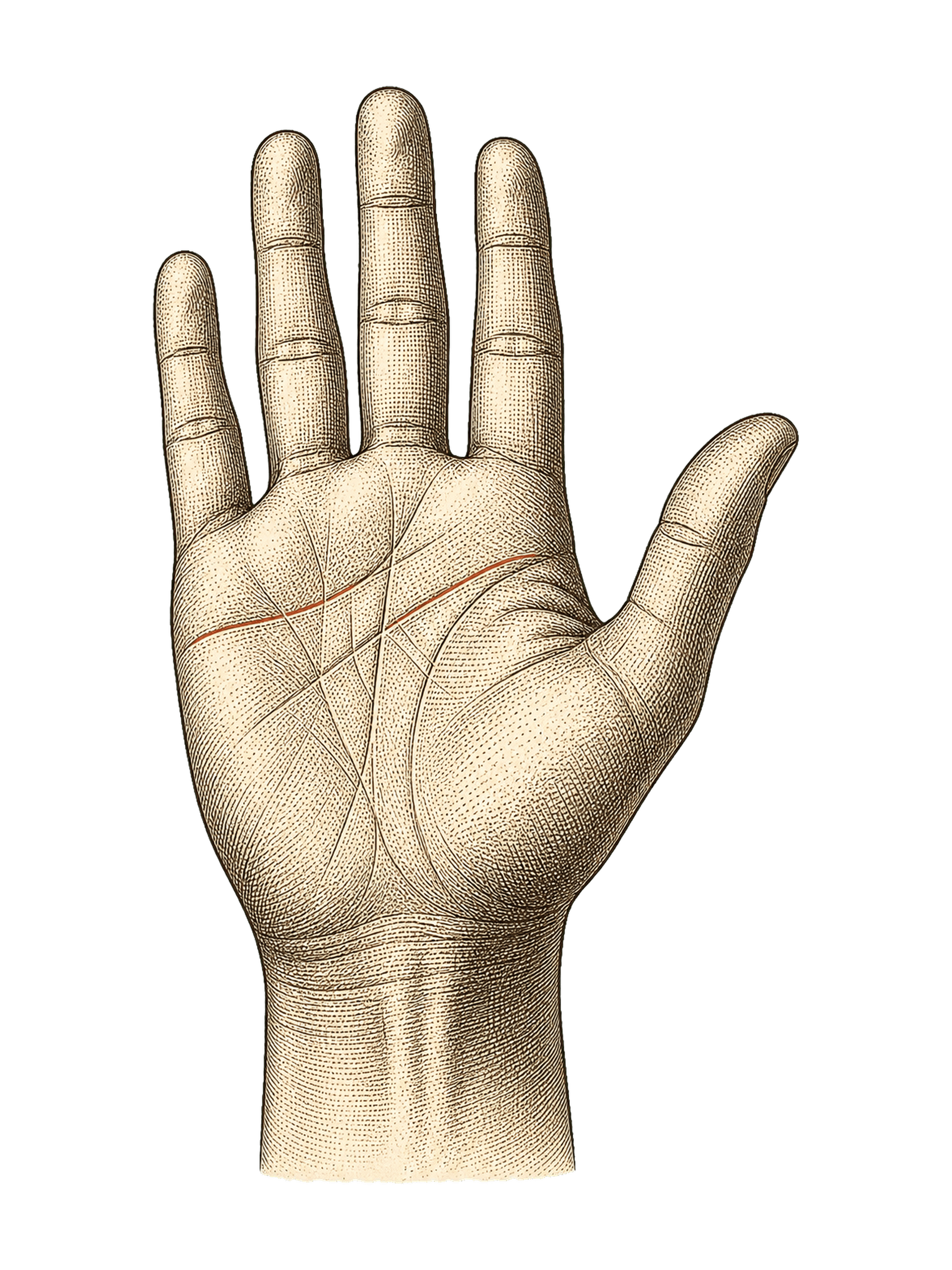
Tap to upload
Required · 18 or older
Photo privacy · Refund terms ·Details
- Your photos are sent to our analysis provider to write your reading. This browser may temporarily keep pending photos for sign-in or recovery. Photos sent from your phone are kept temporarily for hand-off. See our privacy policy for details.
- When you press Read my palms, both photos go to our analysis provider for a clarity check before payment. This checks the photos, not the validity of a reading.
- Doesn't sound like you? Email us within 7 days of your first reading for a full refund, if you haven't used a second. If a photo can't be read, your credit is returned.
- Next: your reading uses one of your readings, or a short checkout if you have none.
Photo tips
 Photo tips
Keep your palm flat, fingers slightly apart and lines in focus. Use bright, even light, and photograph each palm the same way.
 ✓ Like this
 ✕ Too dark
 ✕ Fingers cut off
Star
A palmistry star is usually three or more short lines meeting at a central point. Two crossing lines make a cross, not a star. Several unrelated creases that pass near one another do not automatically qualify.
Older manuals often treat stars as intensifiers. In Cheiro's Palmistry for All, a star's predicted result changes with the mount or line beneath it. We treat that as historical symbolism. A star cannot guarantee honour, wealth, danger, or any event.
Reflective prompt: What theme feels unusually concentrated in the part of life represented by this location?
Cross
A cross consists of two short lines intersecting at a clear angle. It should be distinguished from an ordinary branch coming off a larger crease.
The Mars-line comparison also distinguishes a visible join from a naming rule: Cheiro's own diagram shows a branch, so branching alone does not exclude his label.
Traditional interpretations vary wildly: obstruction on one line, special significance on a mount, or a named sign in a particular region. There is no evidence that a tiny intersection predicts an obstacle or confers a gift.
Reflective prompt: Where do two priorities currently conflict?
Triangle
A triangle requires three visible sides enclosing a space. It may be formed by independent fine lines or partly by a major line. Open angles are not closed triangles.
Naming a small triangle does not establish skill or analytical ability. It also should not be confused with the much larger area some manuals call the Great Triangle, bounded by major lines. Describe the actual size and location before consulting a source's interpretation.
For the larger region, our Great Triangle map follows Cheiro's three named boundaries and shows a separate case where the third side remains unresolved.
Reflective prompt: Which skill becomes useful only when several parts work together?
Island
An island is a narrow loop where one line appears to split and rejoin. It lies within the path of a line rather than floating as a separate oval elsewhere.
Historical palmistry frequently treats islands as periods of weakness, confusion or interruption. Do not turn that into a health, relationship, career, or timing prediction. A split-looking segment can also be ordinary crease variation or an image-quality problem.
Reflective prompt: Is the theme represented by this line currently divided or harder to read clearly?
Square
A square is a small four-sided enclosure. Natural creases rarely produce perfect geometry, so the name covers rough quadrilateral shapes.
Older readers often call the square protective, especially when it surrounds a break or another mark. “Protection” here is symbolic. It does not make an activity safe or cancel a real-world risk.
Reflective prompt: Which boundary or support would make this area of life safer in practice?
Grille
A grille is a cluster of short lines crossing into a mesh or lattice. It is not simply one star with extra strokes; the intersections spread across an area.
Traditional guides often describe a grille as scattered or obstructed energy on a mount. A more grounded prompt is to ask whether you are dividing attention across too many demands. The answer must come from your schedule and behaviour, not skin texture.
Why photo-based symbol reading needs restraint
Minor markings are where false precision becomes easiest. Harsh lighting deepens some creases and erases others. Dry skin adds short surface lines. Compression changes the palm. Image sharpening builds edges that were not clear in the original.
Use these rules:
- Prefer “not clear enough” to a dramatic guess.
- Check a mark in more than one neutral photo.
- Separate scars and temporary skin changes from natural creases.
- Never infer disease, danger, violence, fertility, pregnancy, or death.
- Never use a symbol to make medical, legal, financial, travel, or relationship decisions.
PalmMingle provides an interpretive reading of visible features, not certainty about tiny marks. Its AI palmistry page explains the image and safety limits.
What about the letter M?
The M sign on the palm is a large composite made by several major lines, not a minor local mark. Read the individual lines before the letter shape, and reject viral claims that it guarantees money or rare status.
Frequently asked questions
Which palmistry symbol is the luckiest?
Historical manuals rank some stars and squares as favourable, depending on location. No symbol has been shown to change luck or outcomes.
Can a scar become a palmistry symbol?
A scar is a real skin change, not the same thing as a natural crease. Some palmists interpret it, but its first meaning is anatomical: your skin healed. Seek clinical advice for a scar that concerns you.
Do symbols change over time?
Fine surface markings can look different with skin condition, use, ageing, injury and photography. That does not prove that destiny changed. See do palm lines change over time?.
Is an unclear mark a bad sign?
No. It is only unclear.
Sources and further reading
- Cheiro, Palmistry for All (1916), chapters on minor marks
- Project Gutenberg edition record and downloads
Good observation is quiet. Name the shape you can actually see, keep the traditional meaning provisional, and leave uncertainty intact.
Palmistry is an interpretive tradition, not a diagnostic tool. PalmMingle frames palm readings as entertainment and self-reflection, not prediction.