
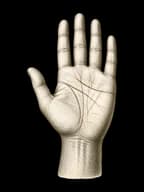
The M sign on a palm is not one special line. It is a letter-like shape created when several major creases—the heart, head, life, and usually fate lines—meet or align in a way that resembles a capital M. Popular posts link it with wealth, intuition, honesty and leadership. A visible M does not prove any of those traits or predict financial success.

Quick answer: The M is a composite pattern, not a separate anatomical feature. If you have to rotate the hand, trace very faint lines, or ignore gaps to make the letter appear, the honest classification is “unclear.”
Which palm lines form the letter M?
Most modern palmistry explanations use four components:
- The life line curves around the thumb pad and helps form the thumb-side portion.
- The head line crosses the middle of the palm.
- The heart line crosses higher up the palm.
- The fate line, when present, rises vertically through the centre and helps close the letter shape.
Because these lines vary in length and direction, the result may look like a clear M, a loose zigzag, or no letter at all. The fate line is optional, so not every hand can form the popular four-line version.
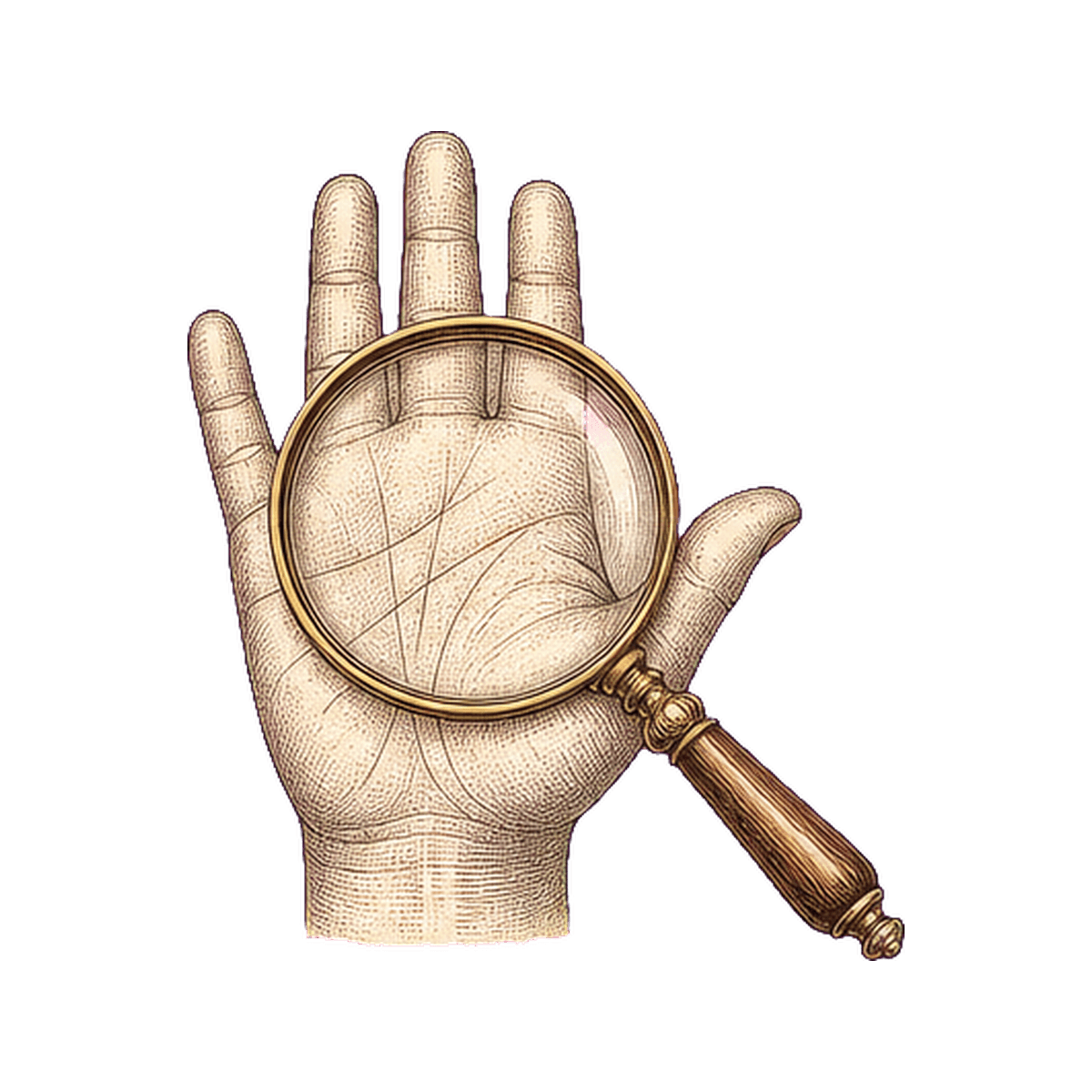
The mechanics matter: you are seeing the relationship between existing creases, not discovering an extra “M line.” Our beginner's palm guide can help you identify the component lines before you look for a composite shape.
Want to see yours?
Scan your palm for a full interpretive reading.
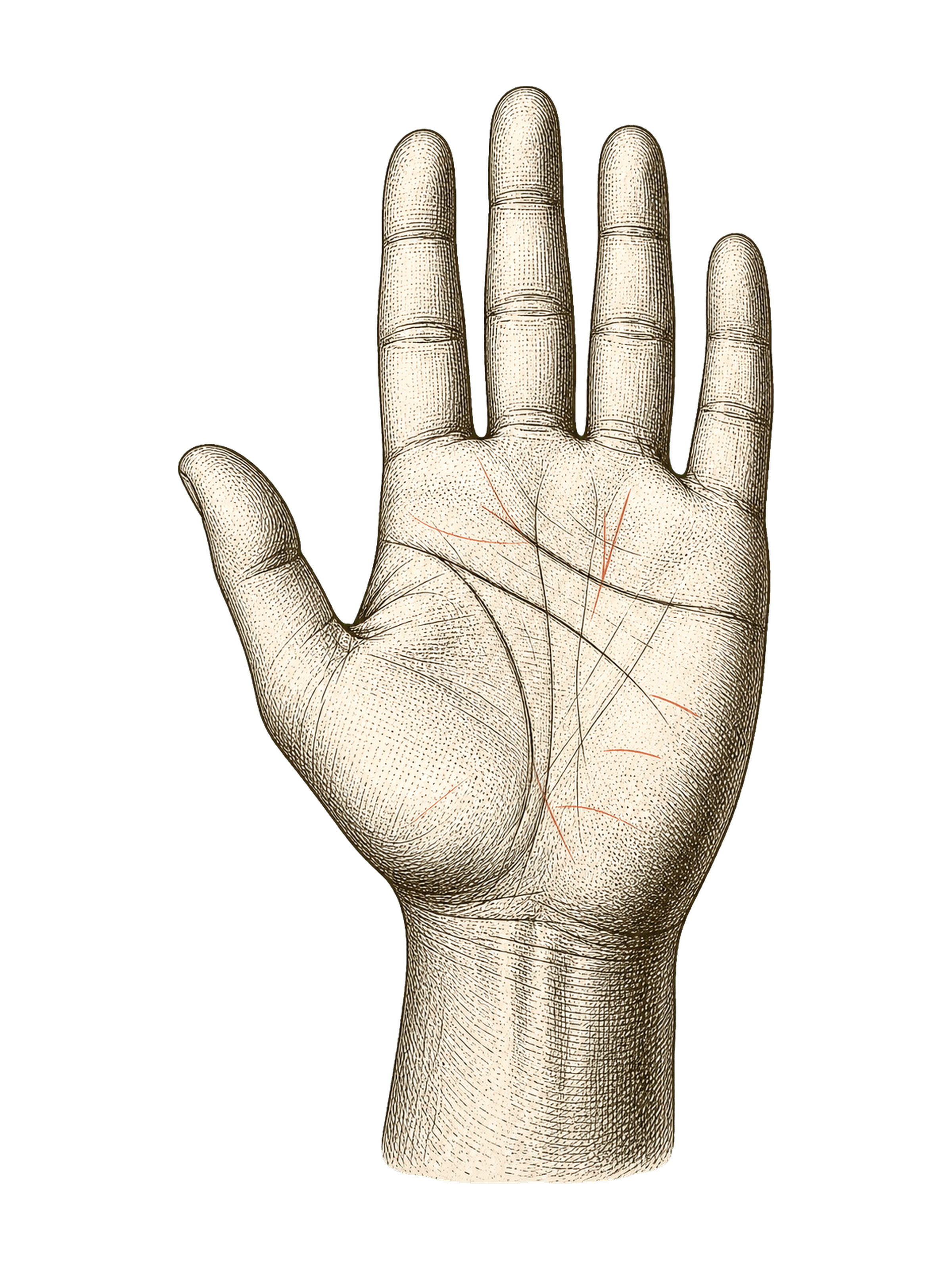
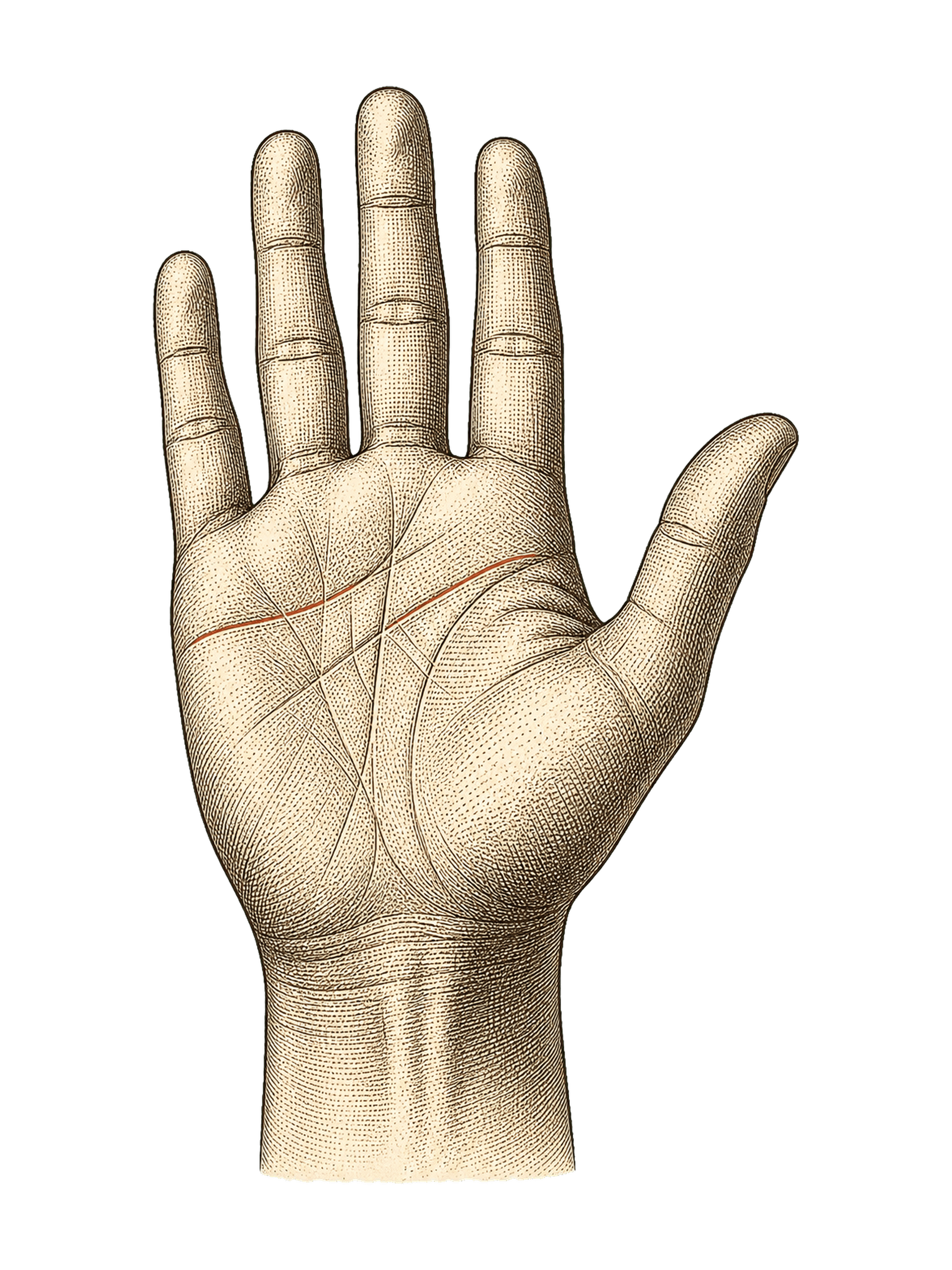
Place your palms here
Both palms, please: your left on the left, your right on the right.
Tap to upload

Tap to upload
Required · 18 or older
Photo privacy · Refund terms ·Details
- Your photos are sent to our analysis provider to write your reading. This browser may temporarily keep pending photos for sign-in or recovery. Photos sent from your phone are kept temporarily for hand-off. See our privacy policy for details.
- When you press Read my palms, both photos go to our analysis provider for a clarity check before payment. This checks the photos, not the validity of a reading.
- Doesn't sound like you? Email us within 7 days of your first reading for a full refund, if you haven't used a second. If a photo can't be read, your credit is returned.
- Next: your reading uses one of your readings, or a short checkout if you have none.
Photo tips
 Photo tips
Keep your palm flat, fingers slightly apart and lines in focus. Use bright, even light, and photograph each palm the same way.
 ✓ Like this
 ✕ Too dark
 ✕ Fingers cut off
Is the M a classical palmistry sign?
The M receives much more attention in modern search and social content than in foundational Western manuals. Cheiro's 1916 Palmistry for All has individual chapters for the heart, head, life and fate lines, plus named minor marks. Its contents do not present a dedicated M-sign doctrine.
A current review by Palmistry Path similarly describes the M as a modern popular framing of the four lines rather than a standalone classical marking. That does not make it forbidden to interpret. It means confident claims about an ancient, universally agreed M meaning need evidence that popular posts rarely provide.
Treat “M sign” as a convenient visual label. Read each component line first. The composite should never overrule the details it is made from.
What does the M traditionally mean online?
Common interpretations include:
- practical judgement balanced with intuition;
- leadership or entrepreneurial ability;
- honesty and an ability to detect deception;
- good fortune or financial success;
- a rare or specially protected destiny.
These are beliefs circulating in popular palmistry, not measured conclusions. A palm cannot verify honesty. It cannot establish leadership skill, and it cannot forecast money.
The safest reflective version is modest: the shape brings head, heart, life and direction into one visual pattern. You could use it to ask how your thinking, feelings, habits and chosen path interact. Then answer with examples from your life.
Is the M sign rare?
There is no reliable prevalence figure for the palmistry-defined M. The boundary is subjective: one reader counts a faint or broken fate line, another does not. Camera angle and contrast also change whether the pattern looks closed.
That makes viral numbers such as “only X percent of people have it” suspect unless they link to a study with a precise definition and representative sample. We found no such evidence, so PalmMingle does not attach a rarity percentage.
Calling the mark rare also creates pressure to see it. Humans are skilled at finding familiar forms in complicated visual material. Merriam-Webster defines pareidolia as perceiving a meaningful image in a random pattern. Noticing a letter in palm creases can be interesting without turning it into proof of destiny.
How to check your palm without forcing the pattern
- Use a straight-on view of a relaxed, well-lit palm.
- Identify the life, head, heart and fate lines separately.
- Do not extend a line across blank skin.
- Do not count shadows, scars, colour boundaries, or temporary marks as creases.
- Decide whether the lines naturally suggest an M at normal viewing distance.
If the answer is “sort of,” keep it as “sort of.” Interpretive systems become misleading when uncertainty is edited out.
M sign versus other palmistry symbols
A star, cross, triangle or square is usually classified as a small local intersection. The M covers a large part of the palm and is built from major lines. It belongs in a different visual category.
That is why our guide to stars, crosses, triangles, islands and squares does not repeat the M. Separating the intents keeps both guides clearer.
Frequently asked questions
Does an M on both palms mean more luck?
No evidence shows that an M on one or both palms changes luck. A palmist may compare the two patterns symbolically, but it is not a forecast.
Does the M mean I will be rich?
No. Financial outcomes depend on income, decisions, opportunity, risk, institutions and chance. Do not make a money decision from a palm reading.
Can PalmMingle detect the M from a photo?
PalmMingle can interpret visible palm features when the submitted image is readable. It cannot confirm a personality trait or future result from a letter-like pattern. Review the AI reading scope first.
What if I do not have an M?
Nothing is missing. The fate line can be faint or absent, and the major creases do not have to form letters.
Sources and further reading
- Cheiro, Palmistry for All (1916), full public-domain text
- Palmistry Path: “M Line in Palmistry: What the Marking Does and Does Not Mean”
- Merriam-Webster: Pareidolia
The M can be a satisfying pattern to find. It is not a financial plan, character certificate, or promise from the future.
Palmistry is an interpretive tradition, not a diagnostic tool. PalmMingle frames palm readings as entertainment and self-reflection, not prediction.