
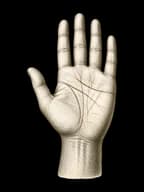
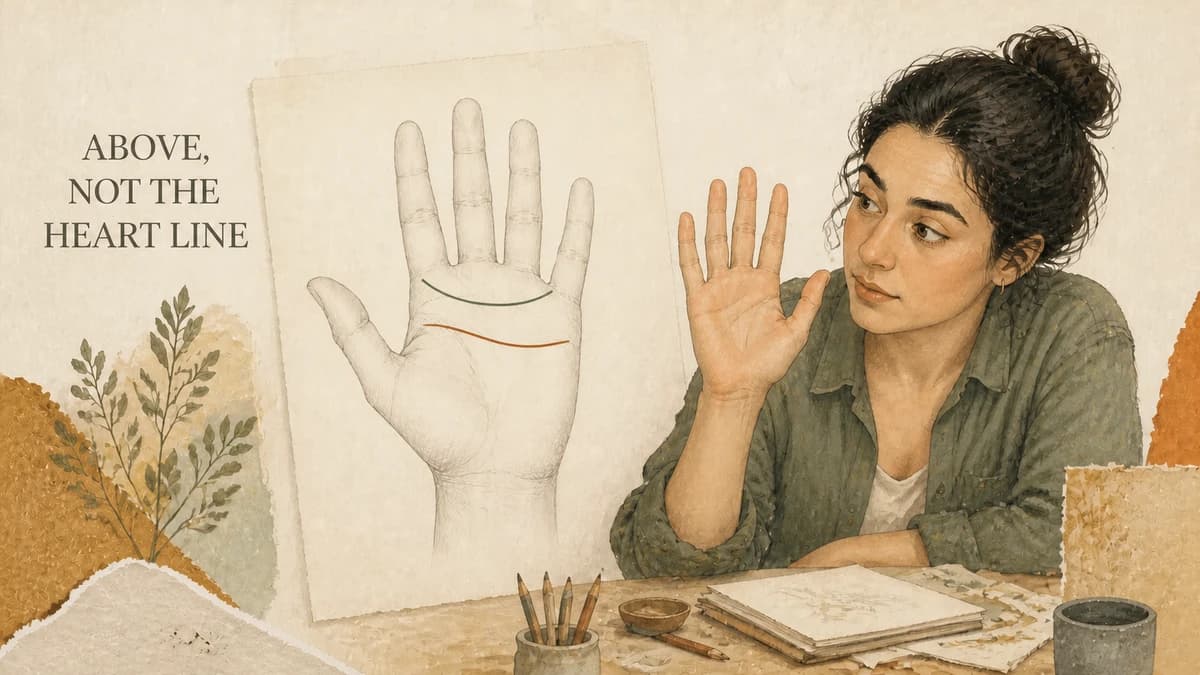
The Girdle of Venus is a curved or broken arc high on the palm, usually beginning between the index and middle fingers and ending between the ring and little fingers. It sits above the heart line, closer to the finger bases. Palmists traditionally associate it with emotional or sensory sensitivity. It is not evidence of a mental-health condition, relationship problem, or “hysterical” personality.

Quick answer: Heart line below; Girdle of Venus above. The heart line crosses the upper palm as a major crease. The Girdle is an optional, shallower arc that partially encircles the bases of the middle and ring fingers.
For a much smaller arc below the index finger, use the Solomon-ring location guide and check both the finger and the curvature before naming it.
Despite the shared name, the Girdle arc occupies a different location from the Venus mount at the thumb base.
Where is the Girdle of Venus?
Hold your palm up in soft, even light. First find the heart line, the upper major transverse crease running below the finger mounts. Then look in the narrower space between that line and the finger bases.
A Girdle of Venus may appear as:
- one shallow curved line;
- two or more broken segments that suggest an arc;
- a partial arc on only one side;
- several fine, overlapping curves.
It may also be absent. Do not manufacture it by joining unrelated skin folds. The Merriam-Webster entry for Girdle of Venus describes an arc whose ends fall between the index and middle fingers and between the ring and little fingers. The enclosed area is beneath the middle and ring fingers.
Want to see yours?
Scan your palm for a full interpretive reading.
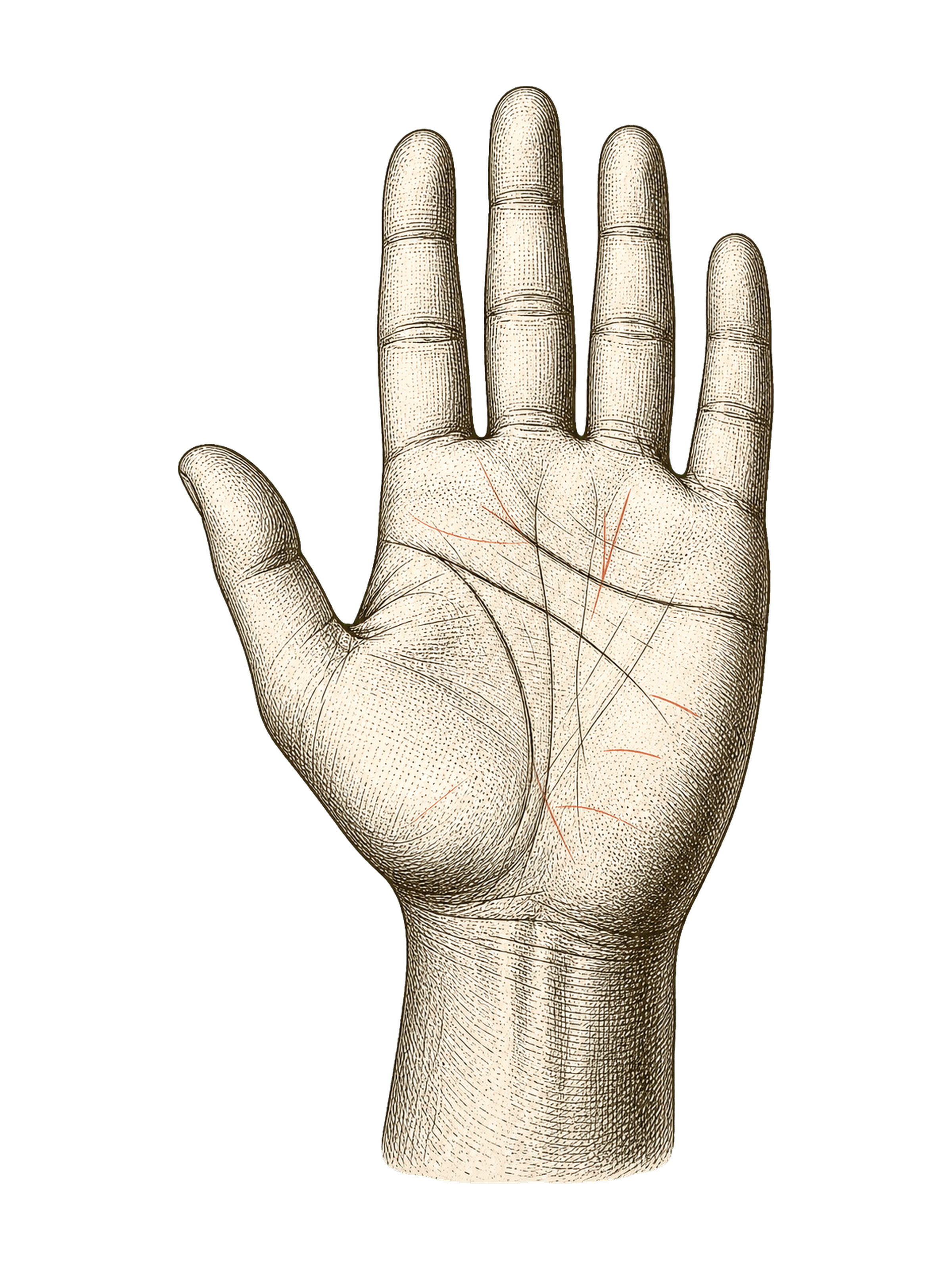
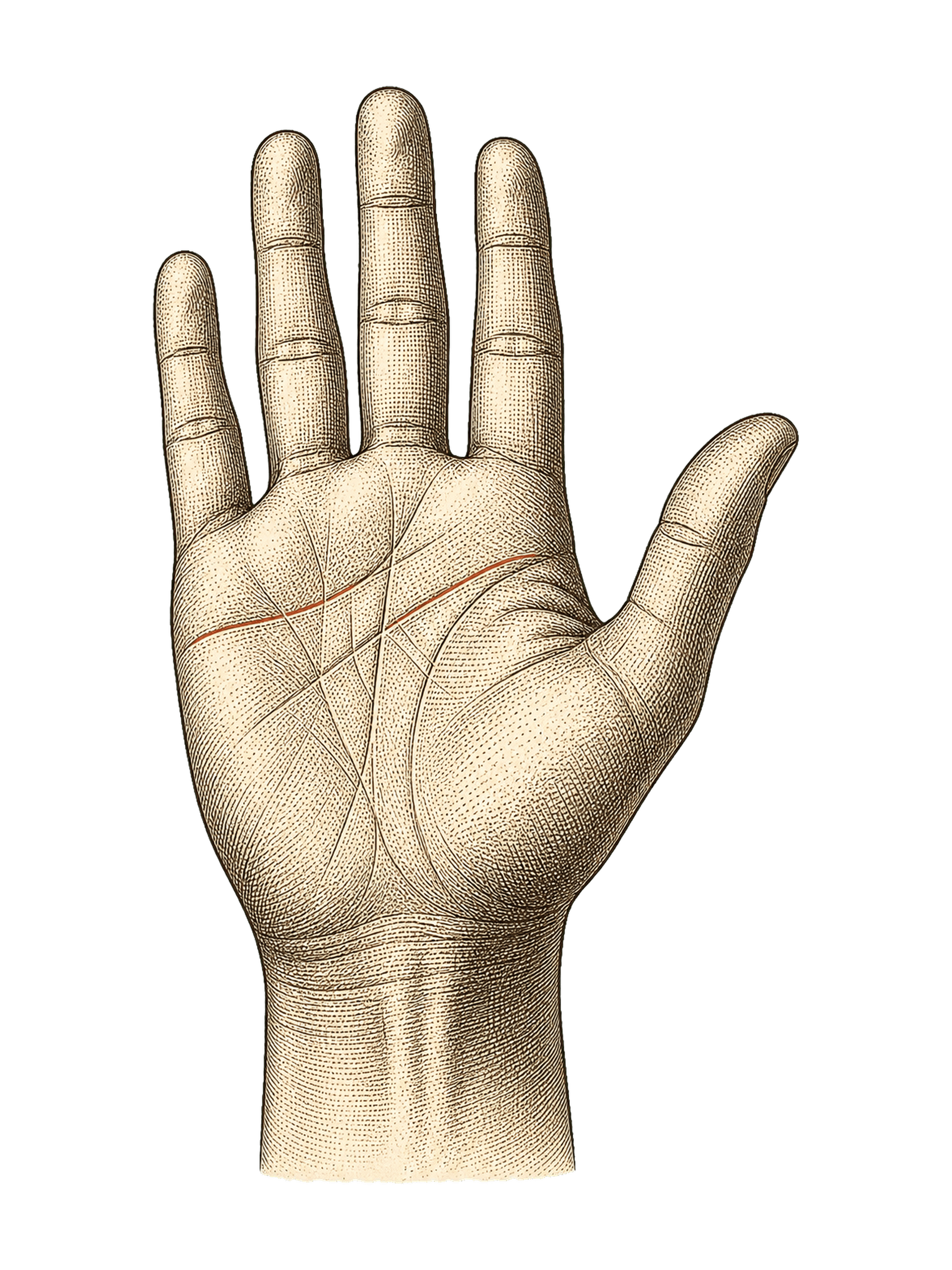
Place your palms here
Both palms, please: your left on the left, your right on the right.
Tap to upload

Tap to upload
Required · 18 or older
Photo privacy · Refund terms ·Details
- Your photos are sent to our analysis provider to write your reading. This browser may temporarily keep pending photos for sign-in or recovery. Photos sent from your phone are kept temporarily for hand-off. See our privacy policy for details.
- When you press Read my palms, both photos go to our analysis provider for a clarity check before payment. This checks the photos, not the validity of a reading.
- Doesn't sound like you? Email us within 7 days of your first reading for a full refund, if you haven't used a second. If a photo can't be read, your credit is returned.
- Next: your reading uses one of your readings, or a short checkout if you have none.
Photo tips
 Photo tips
Keep your palm flat, fingers slightly apart and lines in focus. Use bright, even light, and photograph each palm the same way.
 ✓ Like this
 ✕ Too dark
 ✕ Fingers cut off
Girdle of Venus versus heart line
These two features are confused because both curve across the upper palm. Use three checks:
| Check | Heart line | Girdle of Venus |
|---|---|---|
| Position | Lower, across the upper palm | Higher, close to the finger bases |
| Structure | Usually one major crease | Often shallow, segmented, or doubled |
| Presence | A normal major flexion crease | Optional palmistry marking |
The heart line normally begins from the little-finger side and travels across much of the palm. The Girdle tends to sit above its central section like a loose arch. If the line you see is deep, continuous and clearly the main upper crease, it is probably the heart line.
You can compare it with our heart-line guide, but avoid treating a stylised diagram as an exact template. Real crease patterns vary.
What does the Girdle of Venus mean in palmistry?
In older Western palmistry, the Girdle is associated with heightened emotion, sensitivity, imagination, sensuality and fluctuating moods. Cheiro's Palmistry for All places it above the heart line and describes it as relating to the “mental side” of Venus symbolism.
The same chapter uses the word “hysterical” and makes sweeping claims about temperament and marriage. Those claims reflect the era and the author's beliefs. They are not diagnoses or reliable facts about a person with this crease.
A modern, safer interpretation turns the old verdict into questions:
- Which environments feel overstimulating to me?
- Do I express emotion immediately or process it privately?
- Where does sensitivity help my creativity or empathy?
- What boundaries keep intensity from becoming exhaustion?
You may find the questions useful whether the line is present or not. That is a clue that the value lies in reflection, not biological proof.
Broken, doubled, or absent girdles
Traditional readers often call a segmented Girdle “broken” and assign extra emotional volatility to it. A double arc may be described as intensifying the theme. An absent Girdle may be framed as a calmer or less sensitive temperament.
None of those descriptions should become a label. Fine lines break naturally, cross one another, and change appearance with dryness, pressure and lighting. A person without a visible Girdle can be deeply sensitive. A person with several arcs can be emotionally steady.
Describe the feature first: “I see two shallow curved segments beneath the middle and ring fingers.” Then add the tradition: “Palmistry may group those as a broken Girdle of Venus.” Stop before claiming that the image establishes somebody's emotional health.
Can a palm photo show it reliably?
Sometimes, but this is one of the easier features to over-read. The line is often finer than the main creases, and the finger-base area catches shadows.
For a clearer image:
- Keep the hand relaxed and fingers naturally separated.
- Photograph the full palm straight on.
- Use indirect daylight or another soft light source.
- Keep the upper palm sharply focused.
- Do not edit contrast until faint shadows become dark lines.
If the arc cannot be distinguished from surface texture, “unclear” is the honest result. PalmMingle's image analysis is interpretive and should not invent a feature the photo does not support. See how the reading works for the full boundary.
Frequently asked questions
Is the Girdle of Venus rare?
We could not find a reliable population study establishing its prevalence as palmists define it. Avoid precise rarity claims.
Does it mean I am overly emotional?
No. That is a traditional association, not an assessment of emotional regulation or mental health.
Can it cross or touch the heart line?
Fine segments can visually meet other creases. Palmists may interpret the combination, but the intersection has no proven psychological or predictive meaning.
Is it connected to the Mount of Venus?
They share a mythological name, but they occupy different places. The Mount of Venus is the thumb pad. The Girdle is high beneath the fingers.
Sources and further reading
Use the Girdle as a name for a visible arc and, if you like, a prompt about sensitivity. Do not use it as a label for a person.
Palmistry is an interpretive tradition, not a diagnostic tool. PalmMingle frames palm readings as entertainment and self-reflection, not prediction.