

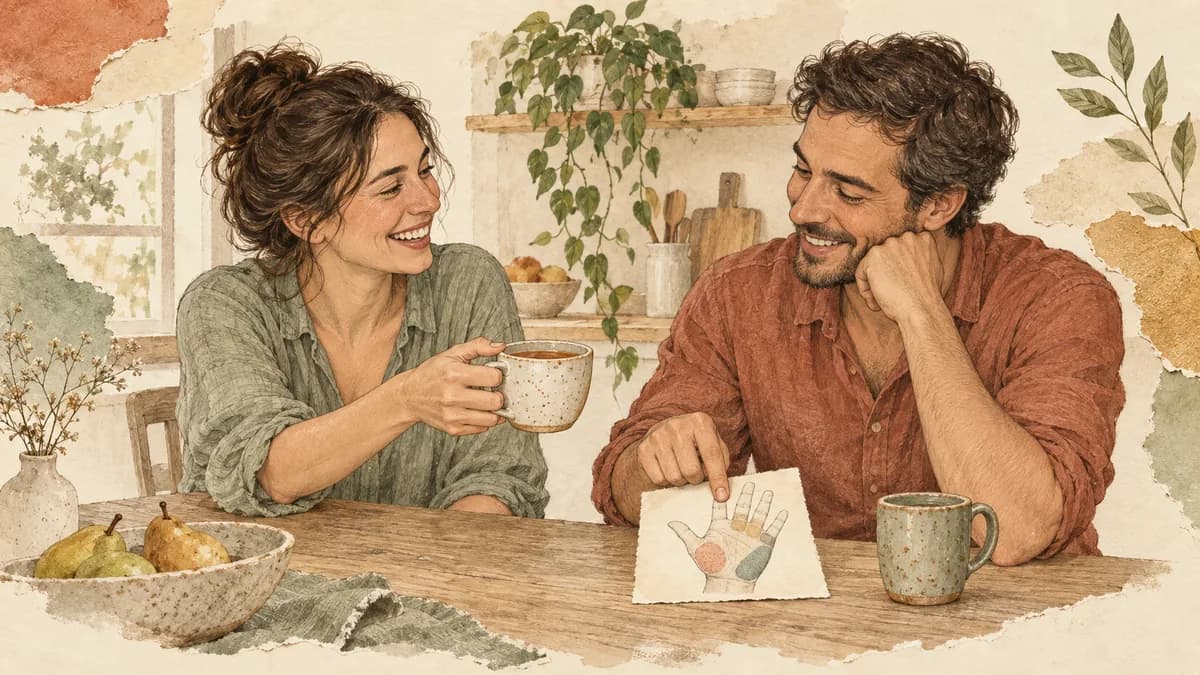
The Mount of Venus is palmistry's name for the fleshy area at the base of the thumb, inside the Life-line curve. In Cheiro's historical system it represents affection and companionship.

The most useful first distinction is between the pad, the line around it, and the small creases crossing its surface. A guide can discuss all three under the word Venus, although they are different things to observe.
Find the pad before following a line
Look below your thumb and identify the broad padded area on that side of the palm. The Life line curves around its central-palm edge; the area inside that curve is what Cheiro calls Venus. The thumb itself is a separate feature, and a short line crossing the pad is not the mount's border.
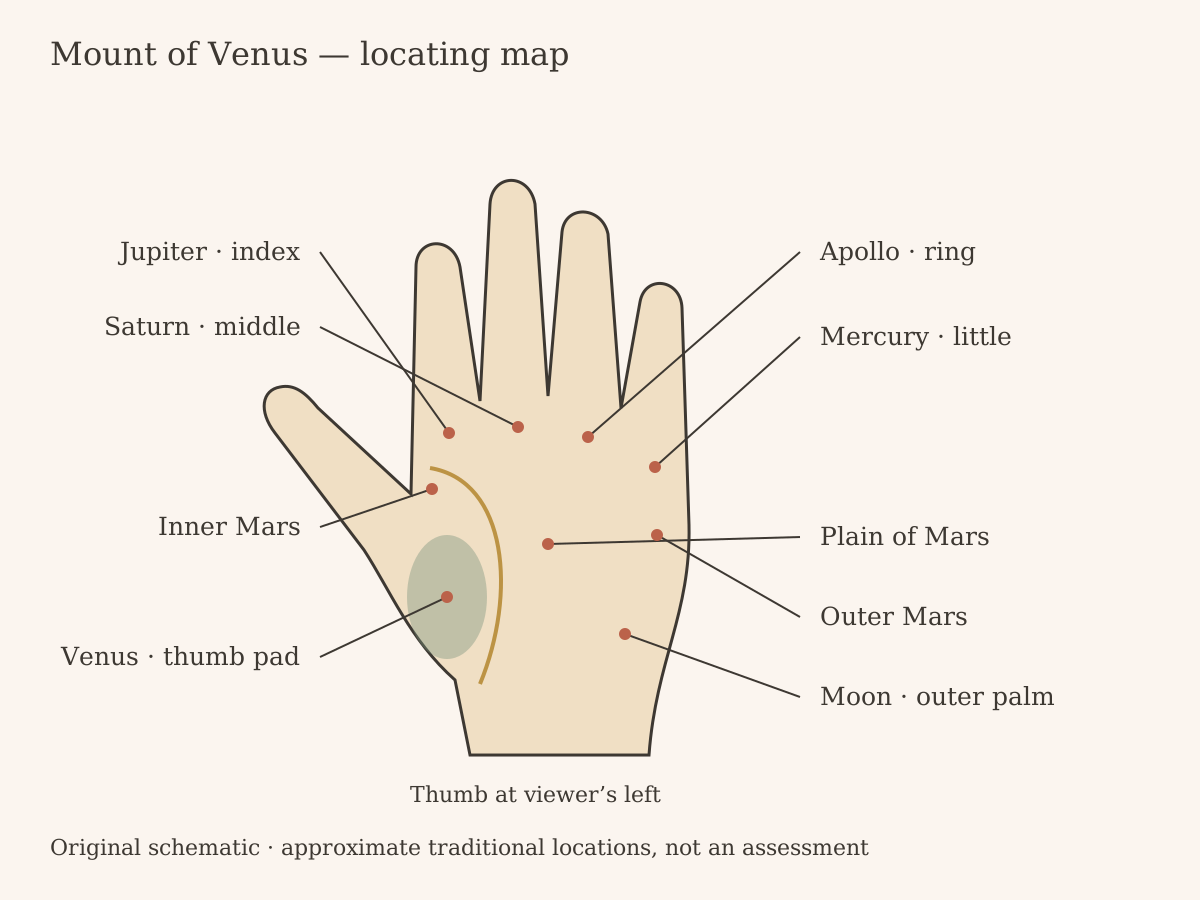
Schematic palmistry location map. Boundaries are approximate; this is not a measured hand.
This placement comes from the Venus chapter in Cheiro's Palmistry for All. The book supplies the region’s name and historical symbolism.
If you are still finding the enclosing curve, the Life-line locating guide is the better next step. It also explains why that historical name is not a lifespan measurement.

Want to see yours?
Scan your palm for a full interpretive reading.


Place your palms here
Both palms, please: your left on the left, your right on the right.

Tap to upload


Tap to upload
Required · 18 or older
Photo privacy · Refund terms ·Details
- Your photos are sent to our analysis provider to write your reading. This browser may temporarily keep pending photos for sign-in or recovery. Photos sent from your phone are kept temporarily for hand-off. See our privacy policy for details.
- When you press Read my palms, both photos go to our analysis provider for a clarity check before payment. This checks the photos, not the validity of a reading.
- Doesn't sound like you? Email us within 7 days of your first reading for a full refund, if you haven't used a second. If a photo can't be read, your credit is returned.
- Next: your reading uses one of your readings, or a short checkout if you have none.
Photo tips
 Photo tips
Keep your palm flat, fingers slightly apart and lines in focus. Use bright, even light, and photograph each palm the same way.
 ✓ Like this
 ✕ Too dark
 ✕ Fingers cut off
Three Venus observations that mean different things
Calling a mount prominent describes apparent fullness. Calling its surface lined describes visible creases. Calling the Life line wide describes the enclosing curve. Those descriptions refer to different properties.
| What you notice | A precise note | Unsupported inference |
|---|---|---|
| The thumb pad looks raised | The pad appears fuller than neighbouring areas in this view | More affection or stronger health |
| Several fine creases cross the pad | Multiple small paths are visible inside the Life curve | A count of partners or emotional burdens |
| The Life curve encloses a broad area | The named boundary follows a wide arc | Greater capacity for love |
In a fictional example, Rowan first writes that their Venus mount is large because there are many lines on it. On looking again, they can describe only the lines, not relative fullness. The revised note loses a dramatic label but gains a clear object: several fine creases inside the Life curve.
That distinction is the point of this exercise. You do not need to decide whether the pad is ideally developed before moving on.
What affection means in the historical reading
Cheiro associates a well-formed Venus area with love, companionship and appreciation of beauty. He also attaches much stronger judgments to the same area. Those are the author’s beliefs about bodies. Read the original Venus chapter with that distinction in mind.
You can use companionship as an optional theme without accepting the bodily claim. Ask what kind of company you have actually wanted recently: a crowded evening, a quiet walk, a practical favour, or time alone. Your answer comes from your experience. It is not being recovered from the pad.
An observation can lead to a question without becoming a verdict.
Compare location before apparent fullness
Lighting, camera angle and how firmly the hand is held can change the appearance of the pad. Record the view you have rather than choosing an ideal size.
For the surrounding names, use the whole-palm mount map. For a different object on the same side of the hand, the thumb guide keeps thumb shape separate from character judgments.
Finish with something you can actually describe
Write one location sentence and leave unknowns visible: the pad at the thumb base lies inside this curve; I can see several surface creases; I have not measured its fullness. That is a complete observation. A prediction about relationships is not needed to make it useful.
If you enjoy symbolic interpretation, PalmMingle's AI palmistry explanation describes an optional reading for entertainment and reflection. You can keep your observation and finish here without uploading anything.
Palmistry is an interpretive tradition, not a diagnostic tool. PalmMingle frames palm readings as entertainment and self-reflection, not prediction.