


The Mount of Mars can refer to more than one region in palmistry. Maps commonly distinguish an inner or lower Mars near the beginning of the Life line, an outer or upper Mars on the opposite side, and the central Plain of Mars. The Mars line is a separate curved path inside the Life line.

Follow a map's locations before trusting its numbering. Different labels can describe similar regions, while the same Mars name can point to an area or a line.
Why Mars seems to appear more than once
Cheiro describes two Mars positions: one near the upper part of the Life line and another on the opposite side between the Head and Heart lines. He then attaches different physical and mental characteristics to them. His map explains why Mars can appear twice without being a printing error; those character claims are not validated by the placement.
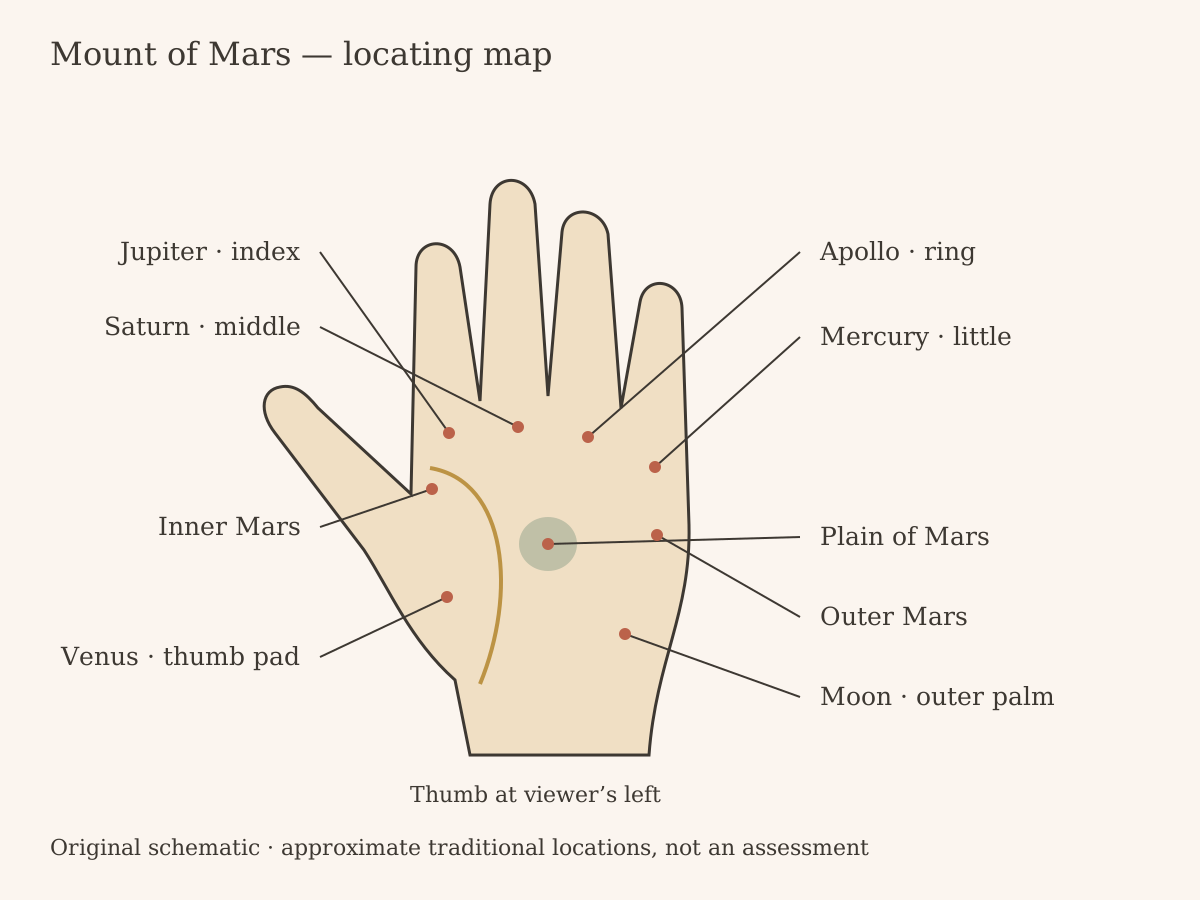
A locating schematic. Inner/outer is used alongside lower/upper to reduce naming confusion.
See the Mars chapter in Cheiro's Palmistry for All for his two-position account. The overall mount guide shows how the central Plain is also labelled in the wider vocabulary used on this site.
Want to see yours?
Scan your palm for a full interpretive reading.


Place your palms here
Both palms, please: your left on the left, your right on the right.

Tap to upload


Tap to upload
Required · 18 or older
Photo privacy · Refund terms ·Details
- Your photos are sent to our analysis provider to write your reading. This browser may temporarily keep pending photos for sign-in or recovery. Photos sent from your phone are kept temporarily for hand-off. See our privacy policy for details.
- When you press Read my palms, both photos go to our analysis provider for a clarity check before payment. This checks the photos, not the validity of a reading.
- Doesn't sound like you? Email us within 7 days of your first reading for a full refund, if you haven't used a second. If a photo can't be read, your credit is returned.
- Next: your reading uses one of your readings, or a short checkout if you have none.
Photo tips
 Photo tips
Keep your palm flat, fingers slightly apart and lines in focus. Use bright, even light, and photograph each palm the same way.
 ✓ Like this
 ✕ Too dark
 ✕ Fingers cut off
Reconcile four labels before interpreting anything
First decide whether the author means a thumb-side region, an outer-side region, a central space or a curved path. That object-and-location pair is more useful than assuming that Mars one, positive Mars and lower Mars are universally identical terms in every book.
| Label on this map | Location or object | Easy confusion |
|---|---|---|
| Inner / lower Mars | Near the Life-line beginning, towards the thumb side | Venus pad farther down inside the curve |
| Outer / upper Mars | Opposite middle edge between the major transverse lines | Moon region lower towards the wrist |
| Plain of Mars | Central palm region | Either of the side regions |
| Mars line | Separate path inside the Life curve | A region or the Life line itself |
When comparing books, write the labels beside the actual region they point to. If a source reverses a number or uses positive and negative differently, keep its convention attached to that source. Do not combine one book's label with another book's meaning and call the result settled.
The Mars line needs a different locating check
A Mars line is a path, not a padded area. Cheiro discusses it inside the Life-line curve; look for a distinct parallel path before calling a mark a Mars line. A dark boundary in a drawing can also be mistaken for a second line.
Our Mars-line comparison follows separate, shared and unclear starts in imaginary maps. It is the right next page if you are tracing a path around the thumb pad. This article answers the different question of how several Mars regions fit on one map.
If the enclosing boundary is the uncertain part, start with the Life-line locating guide before deciding that an extra inner path is present.
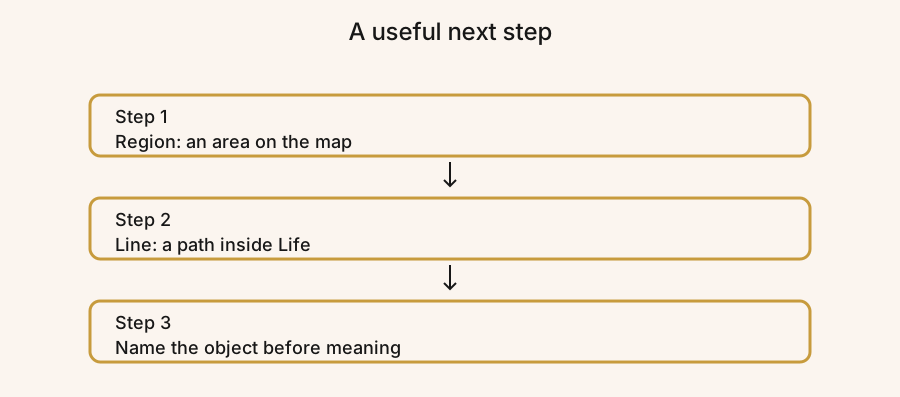
Area and path are different objects even when their names share a planet.
In a fictional note, Ren writes: inner region located; Life curve visible; no distinct parallel path identified. That is more precise than writing strong Mars and assuming both a mount and a line have been found.
Courage is symbolism, not an aggression test
Cheiro connects Mars with martial qualities and makes broad claims about fighting, resistance and temperament. His historical account documents that language. It does not establish whether a person is brave, violent, resilient or likely to argue. This article supplies no behavioural rating from the size of either region.
If you want a reflection question, use a recent disagreement. What did you ask for, what did you hear, and where could you have paused? That lets an actual event answer the question. A crease should not excuse harmful conduct or make you suspicious of someone whose hand looks different.
A useful note can stop at the map
Record the source's label, the region it points to and the nearby landmarks you can identify. Leave a missing or faint path unresolved. You do not need to decide that one Mars region is good and another bad before the exercise is complete.
For optional symbolic interpretation, PalmMingle describes its reading format. It is entertainment and reflection, not a temperament test or a guarantee of protection. The map is useful for learning vocabulary; real conflict decisions still belong to the people involved.
Palmistry is an interpretive tradition, not a diagnostic tool. PalmMingle frames palm readings as entertainment and self-reflection, not prediction.