

The Mount of Moon, also called Luna, is palmistry's name for the outer lower palm, on the little-finger side and opposite the thumb pad. Cheiro links it with imagination, romance and travel. It is an area of the hand, not a line that establishes intuition or predicts a journey.
The orientation matters: outer means away from the thumb, and lower means towards the wrist. A rotated hand photograph can make those directions much harder to follow.
Orient the thumb before looking for Luna
Find the thumb side first, then move across the palm towards its opposite edge. The lower portion on that outer side is the Moon region in the map used here. It is below the little-finger neighbourhood, not directly beneath the little-finger base, where Mercury is named.
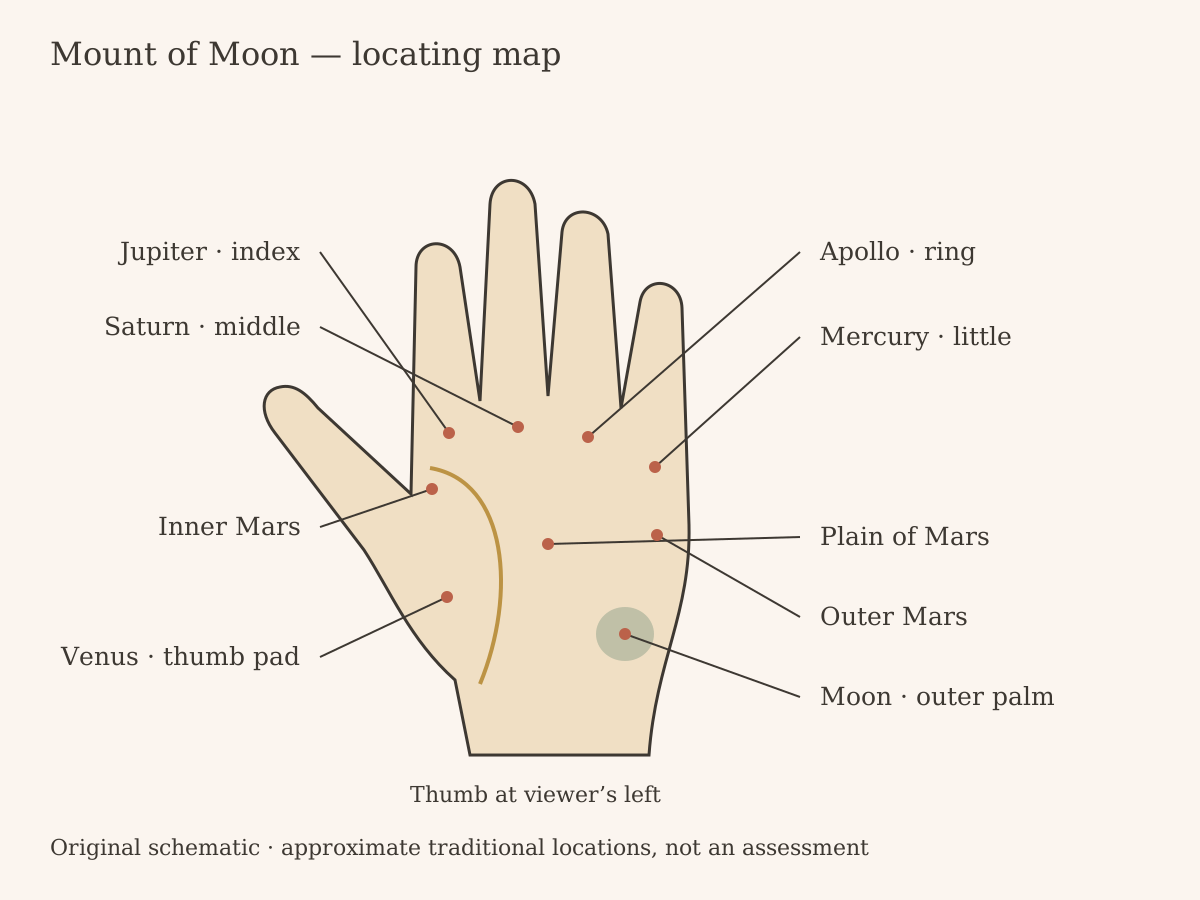
Approximate traditional regions on a schematic palm; no size or personality score is implied.
Cheiro's Palmistry for All, in its Moon chapter and mount diagram, supplies the Luna name and location. The text ties this region to imagination and changes of scenery. That is evidence of his interpretive system, not a demonstrated connection between a pad and a person's mental abilities.
The seven-mount map supplies the surrounding context. Use it to settle orientation before interpreting a tiny mark near the edge.
Want to see yours?
Scan your palm for a full interpretive reading.


Place your palms here
Both palms, please: your left on the left, your right on the right.

Tap to upload


Tap to upload
Required · 18 or older
Photo privacy · Refund terms ·Details
- Your photos are sent to our analysis provider to write your reading. This browser may temporarily keep pending photos for sign-in or recovery. Photos sent from your phone are kept temporarily for hand-off. See our privacy policy for details.
- When you press Read my palms, both photos go to our analysis provider for a clarity check before payment. This checks the photos, not the validity of a reading.
- Doesn't sound like you? Email us within 7 days of your first reading for a full refund, if you haven't used a second. If a photo can't be read, your credit is returned.
- Next: your reading uses one of your readings, or a short checkout if you have none.
Photo tips
 Photo tips
Keep your palm flat, fingers slightly apart and lines in focus. Use bright, even light, and photograph each palm the same way.
 ✓ Like this
 ✕ Too dark
 ✕ Fingers cut off
The area is not the same as a travel or intuition line
Moon is a region; travel lines and the intuition line name particular paths discussed in palmistry. Finding one small crease in the region does not establish that it belongs to either named group. You need its course and the source's definition, not just a promising location.
| What you are identifying | What to follow | What does not follow |
|---|---|---|
| Moon mount | Broad outer lower-palm region | A measure of imagination |
| Travel lines | Small paths described in a particular guide | A trip, move or visa outcome |
| Intuition line | A longer curved path in the cited system | Psychic ability or trustworthy instinct |
See the travel-line guide for its separate locating question, or the intuition-line comparison for the curved path. Do not extend a fragment just to make it fit one of those diagrams.
For example, fictional Noor can see two short edge creases but cannot follow a longer curve. The note should say exactly that. Calling the fragment intuition because it appears near Luna would skip the identification step.
What imagination means here
In Cheiro's account, Moon symbolism includes imagination, poetry, romance and travel. The chapter also contains sweeping personal and health judgments which are not adopted here. The source tells us what he associated with the area; it does not show that a full or flat-looking pad measures creativity, emotional stability or restlessness.
A wish to travel is something you can describe directly. A particular crease cannot establish whether a move is wise, affordable or likely to happen. Equally, not recognising a Luna area does not mean you lack imagination.
If the symbolism appeals, let it open a question: what change of scenery do I actually want, and what part of that wish could I try without turning my whole life upside down?
Separate a wish from a workable plan
Write the appealing idea first, then the decision it would require. Wanting a different rhythm might suggest a short local outing rather than a relocation. Wanting to write might suggest a page of notes rather than a claim that a hand reveals an artistic calling. These are original examples, not instructions produced by the mount.
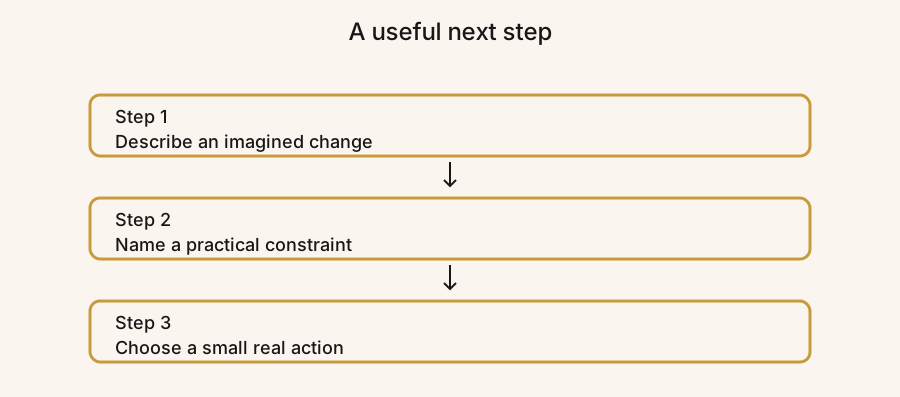
A wish can become a question or an action without becoming a forecast.
Noor's fictional note might be: I keep imagining a quieter place; I have not decided whether I want travel or a less crowded weekend; I can try a local walk first. The uncertainty is useful. It prevents a symbolic association from pretending that a decision has already been made.
What a reading can add
A reading can offer another interpretation to consider. It cannot verify a journey, tell you whether an instinct is correct, or turn a vague edge crease into evidence of psychic ability. Keep the original location note available so you can disagree with the interpretation.
If that kind of entertainment interests you, PalmMingle explains its AI-assisted palmistry format. You can also finish with the map and your own question. Neither reflection nor curiosity requires accepting a prediction.
Palmistry is an interpretive tradition, not a diagnostic tool. PalmMingle frames palm readings as entertainment and self-reflection, not prediction.