
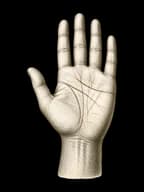
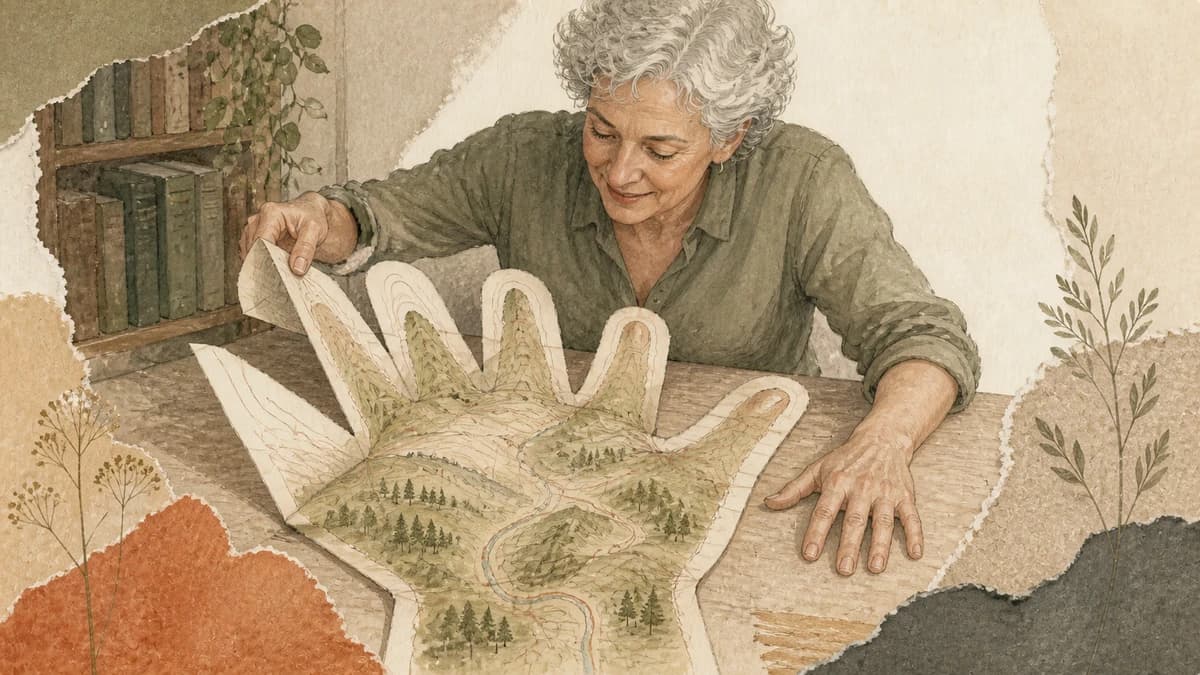
The mounts of the palm are the padded areas beneath the fingers and along the sides of the hand. Traditional Western palmistry names seven of them after the Sun, Moon and five planets visible to ancient observers: Jupiter, Saturn, Sun (Apollo), Mercury, Mars, Moon (Luna), and Venus. They are not separate organs, and their shape does not prove a personality trait. They are simply a location system palmists use to organise a reading.

Quick answer: Start under the four fingers: Jupiter sits below the index finger, Saturn below the middle finger, Sun below the ring finger, and Mercury below the little finger. Venus is the pad at the thumb, Moon is the outer lower palm, and Mars is traditionally divided across more than one area.
If a crease runs below the palm across the wrist, compare the rascette observation guide rather than treating it as another mount.
For a closer look at the finger-base regions, start with locating Jupiter beneath the index finger.
The neighbouring region has its own guide to the Saturn mount below the middle finger.
On the thumb side, compare Venus and the thumb pad.
Opposite the thumb, locate Moon on the outer lower palm.
For the name that spans several zones, distinguish the inner, outer and central Mars regions.
Use finger-relative addresses on either hand
A mount address should still make sense when a photograph is mirrored. Name the nearby finger or thumb rather than the left or right edge of a screen. Use the location key below alongside the seven-name table; boundaries in real hands are not cleanly drawn islands.
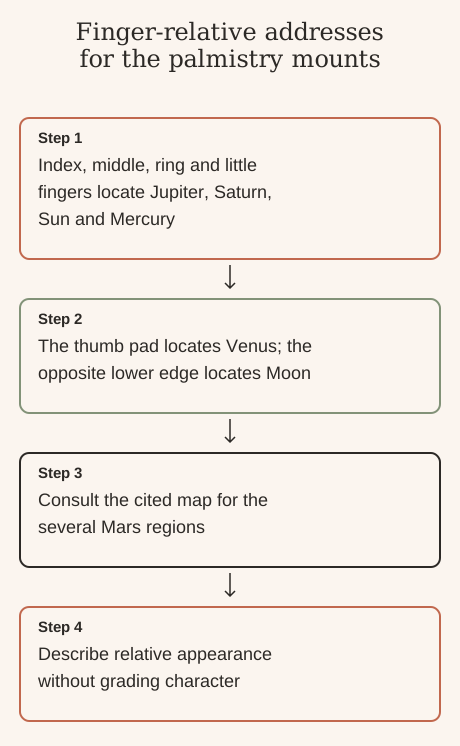
Use the nearby fingers, thumb pad and outer palm to locate the named regions.
- Index, middle, ring and little fingers locate Jupiter, Saturn, Sun and Mercury.
- The thumb pad locates Venus; the opposite lower edge locates Moon.
- Consult the cited map for the several Mars regions.
- Describe relative appearance without grading character.
For instance, “the padded region below the ring finger” identifies the Sun or Apollo area on either palm. “The bump on the right” may identify a different area when the camera flips the image. For Mars, record which region you mean instead of treating the central palm and both side regions as one spot. If a photograph does not show relief clearly, record the location alone. Neither a larger-looking pad nor a more detailed address establishes a trait or health finding.
For a closer look, locate a possible arc below Jupiter; separate whole-hand shape from palm regions; locate the curve on the Moon side.
Want to see yours?
Scan your palm for a full interpretive reading.
Place your palms here
Both palms, please: your left on the left, your right on the right.
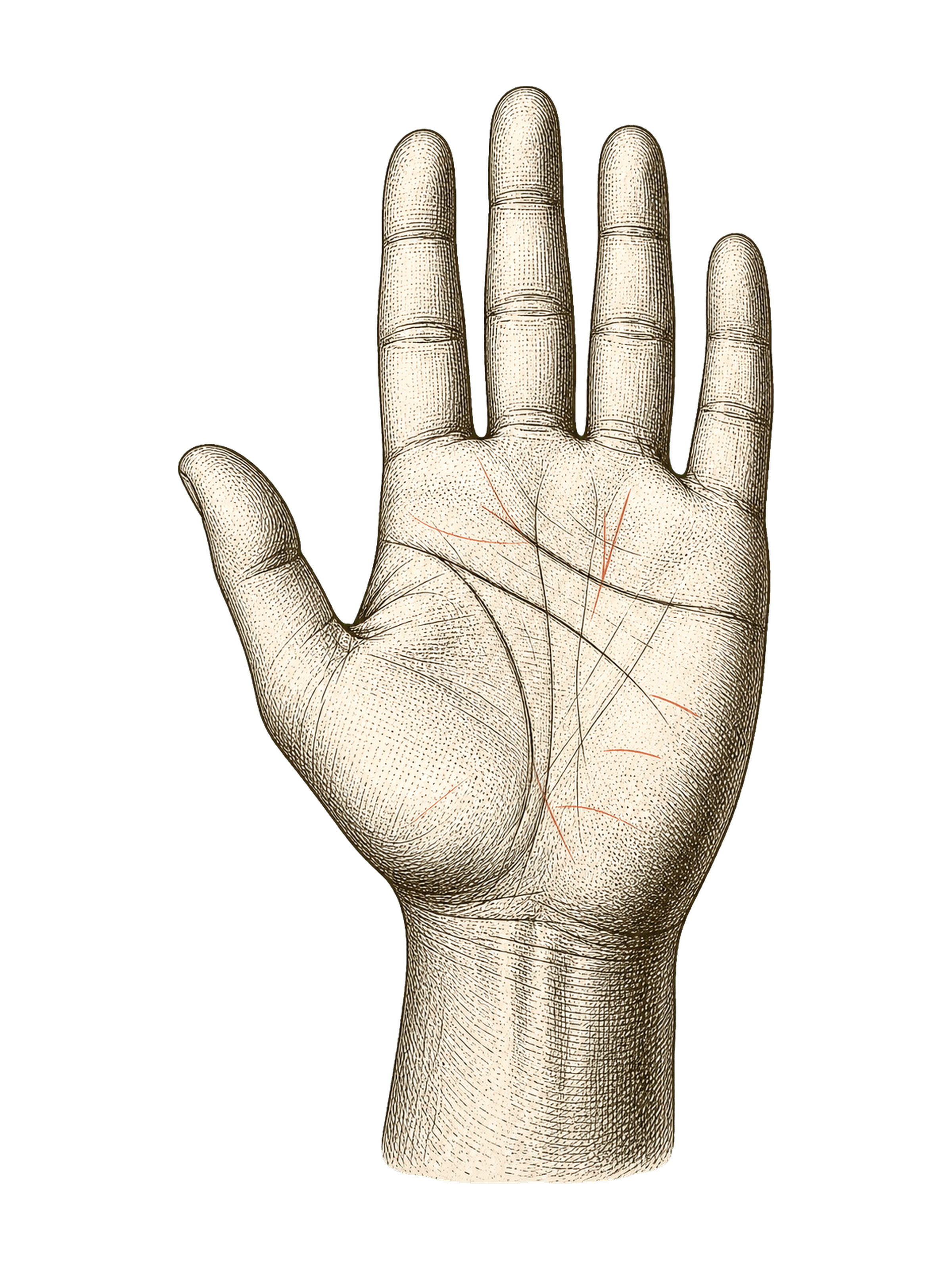
Tap to upload

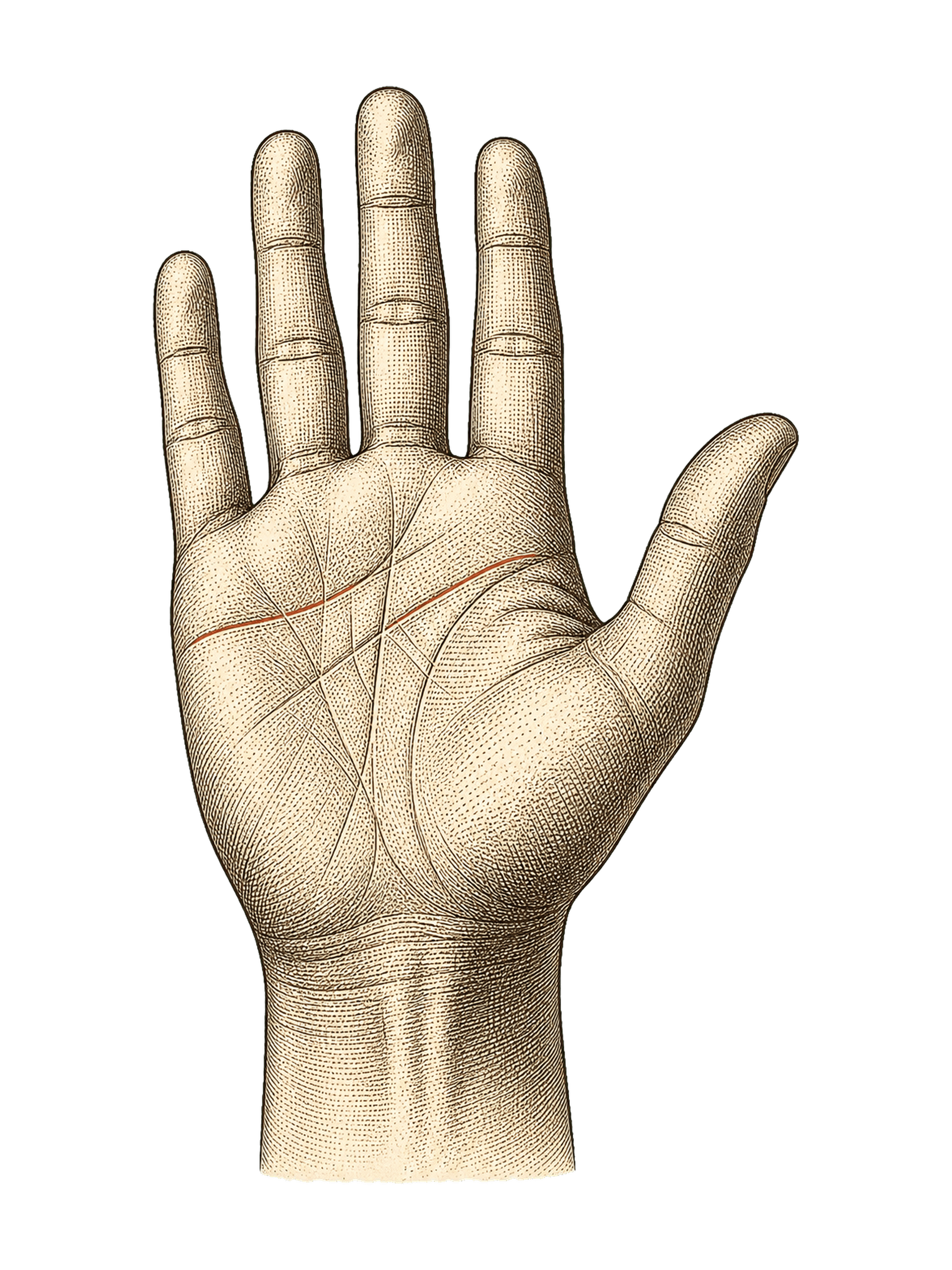
Tap to upload
Required · 18 or older
Photo privacy · Refund terms ·Details
- Your photos are sent to our analysis provider to write your reading. This browser may temporarily keep pending photos for sign-in or recovery. Photos sent from your phone are kept temporarily for hand-off. See our privacy policy for details.
- When you press Read my palms, both photos go to our analysis provider for a clarity check before payment. This checks the photos, not the validity of a reading.
- Doesn't sound like you? Email us within 7 days of your first reading for a full refund, if you haven't used a second. If a photo can't be read, your credit is returned.
- Next: your reading uses one of your readings, or a short checkout if you have none.
Photo tips
 Photo tips
Keep your palm flat, fingers slightly apart and lines in focus. Use bright, even light, and photograph each palm the same way.
 ✓ Like this
 ✕ Too dark
 ✕ Fingers cut off
How to find the mounts on your own palm
Relax your hand instead of stretching it flat. Look for broad padded zones, not perfectly bordered bumps. The old diagrams make each mount look like a tidy island; real hands do not. A mount can merge visually into the next one, and camera angle or pressure can make the same palm look fuller or flatter.
Use the fingers as landmarks:
- Jupiter: directly below the index finger.
- Saturn: directly below the middle finger.
- Sun or Apollo: directly below the ring finger.
- Mercury: directly below the little finger.
- Venus: the fleshy pad around the base of the thumb, inside the life-line curve.
- Moon or Luna: the outer lower edge of the palm, opposite Venus.
- Mars: a distributed set of regions rather than one simple mound. Many Western maps describe an inner Mars near the thumb side, an outer Mars on the opposite middle edge, and the Plain of Mars in the centre.
That last point explains why some diagrams appear to show eight or nine labels while the tradition still speaks of seven planetary names. Mars is one name applied to several zones.
A Mars region is not the same thing as the Mars line: Cheiro describes that path inside the Life curve, around Venus, and the worked comparison keeps an unclear start unresolved.
What the seven mounts mean in palmistry
In Cheiro's 1916 Palmistry for All, the mounts are linked with a traditional vocabulary: Jupiter with ambition, Saturn with seriousness, the Sun with expression and recognition, Mercury with communication and commerce, Mars with courage, the Moon with imagination, and Venus with affection and sensuality. That is a record of palmistry's symbolism, not scientific evidence that padded skin measures any of those qualities.
Here is the useful way to hold the map:
| Mount | Where to look | Traditional theme |
|---|---|---|
| Jupiter | Below index finger | aspiration, responsibility, confidence |
| Saturn | Below middle finger | reserve, duty, seriousness |
| Sun / Apollo | Below ring finger | expression, creativity, recognition |
| Mercury | Below little finger | communication, exchange, adaptability |
| Mars | Inner, outer, and central palm zones | assertion, stamina, response to conflict |
| Moon / Luna | Outer lower palm | imagination, change, inner life |
| Venus | Thumb pad | warmth, attachment, appetite for life |
The table is a translation key. It should give you questions, not verdicts. A reader might use the Venus area to ask how freely you show affection. They cannot look at it and establish how loving you are.
Jupiter and Sun also name fingers in Cheiro's book. Our index and ring finger comparison separates his meanings from the question of what a length observation compares.
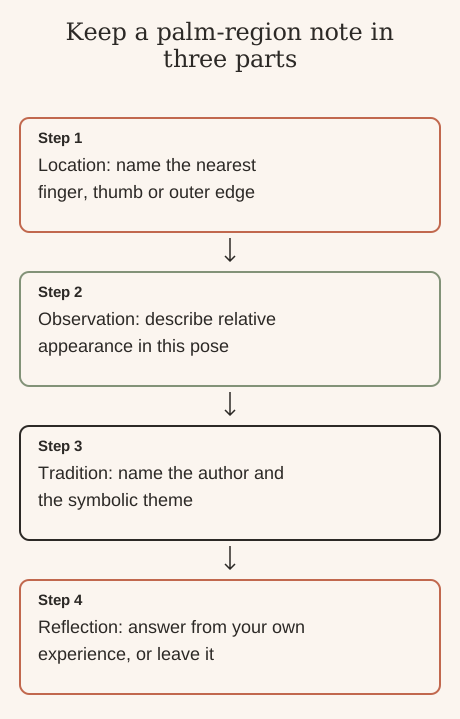
Keep a palm-region note in three parts.
Prominent, flat, and balanced mounts
Traditional readers compare mounts with the rest of the same hand. A relatively full area is called prominent or developed; a less raised area is called flat. “Balanced” usually means neither area dominates the overall hand.
The comparison matters because there is no universal millimetre threshold. Hand size, body composition, posture, lighting and lens perspective all affect appearance. Pressing your palm against a table spreads the tissue. Cupping it makes several areas look raised. If you compare photos, use the same relaxed pose and similar light.
Older manuals often turn prominence into absolute character judgements. We do not. Those texts are historical sources for the system's vocabulary, and some of their social and medical claims are plainly unsuitable today. A mount reading is safest when phrased as: “Tradition associates this area with X; does that theme give you anything useful to reflect on?”
Read mounts with lines, not in isolation
Palmistry normally combines a mount with the line that approaches it. A vertical line toward the Sun mount is called the Sun or Apollo line. A fate line ending toward Jupiter is traditionally read differently from one ending toward Saturn. Fine lines moving toward the Moon area are often called travel lines.
This does not make the interpretation factual. It does make it more internally coherent than declaring that one padded area determines your character. First identify the location, then notice any clear line, and only then consult the traditional symbolism.
Small marks need extra caution. Dry skin, shallow wrinkles and shadows can resemble stars or crosses in a photograph. Our guide to palmistry symbols explains why uncertain marks should stay uncertain.
A simple three-minute mount check
- Rest both hands naturally with palms up.
- Use the finger bases and thumb pad as landmarks.
- Compare areas within each hand rather than against an idealised diagram.
- Note one or two zones that look relatively full or flat.
- Turn the traditional theme into an open question about your current choices.
For example: “The Mercury area looks prominent” is an observation. “Palmists associate Mercury with communication” is tradition. “I am a persuasive person” is a hypothesis to test against your actual behaviour. Keeping those three statements separate is the difference between reflection and make-believe certainty.
Frequently asked questions
Are there seven or eight mounts in palmistry?
The Western naming system used in this guide has seven planetary names. Mars may be split into inner/lower Mars, outer/upper Mars and a central Plain of Mars, which creates more labelled regions without adding another planetary name.
What if my mounts look flat?
Nothing is wrong. “Flat” is a relative visual description inside a traditional system, not a medical finding or a personality deficit.
Can a mount show illness or fertility?
No reliable medical conclusion can be drawn from a palmistry mount. If you have a health concern, use a qualified clinician rather than a hand reading.
Can PalmMingle identify mounts from a photo?
PalmMingle provides an interpretive reading of visible hand features when the image is clear enough. The result is for reflection and entertainment; it is not a measurement of personality, health, or future events. See how the AI palm reading works before deciding whether to submit a photo.
Sources and further reading
- Cheiro, Palmistry for All (1916), full public-domain text
- Wellcome Collection record for Edward Heron-Allen's A Manual of Cheirosophy (1885)
Use the map to learn the language of palmistry. Keep the conclusions provisional—and keep your real decisions in the real world.
Palmistry is an interpretive tradition, not a diagnostic tool. PalmMingle frames palm readings as entertainment and self-reflection, not prediction.