

Earth, Air, Fire and Water are labels used in one palmistry hand-shape system. They describe combinations of palm and finger proportions, then attach symbolic meanings. The proportions do not establish your personality, coping style or mental health.

If you want to understand a diagram, learn its categories. You do not have to fit your life into them.
Make a proportion note before choosing an element
The four-element chart combines a palm-outline description with relative finger length. If either feature is unclear, your classification can remain mixed or unresolved. This is a vocabulary exercise within the named system, not a measurement of temperament.
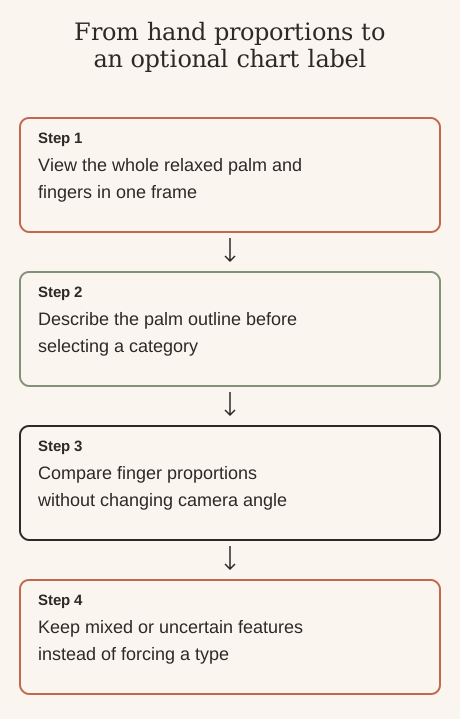
Record palm proportions and finger length before choosing an optional chart label.
- View the whole relaxed palm and fingers in one frame.
- Describe the palm outline before selecting a category.
- Compare finger proportions without changing camera angle.
- Keep mixed or uncertain features instead of forcing a type.
Suppose one photo makes your palm look broad and another makes it look elongated because it was taken at an angle. Do not choose the image that gives the more appealing element. Retake the view square to the palm or write “outline uncertain”. If the outline suggests one box while the fingers suggest another, retain both observations. Your next practical choice—how to spend an evening, resolve a disagreement or learn a skill—does not need a ruling on which box wins.
For a closer look, describe finger-joint contours separately; compare a different five-element vocabulary; locate the padded palm regions.
Want to see yours?
Scan your palm for a full interpretive reading.


Place your palms here
Both palms, please: your left on the left, your right on the right.

Tap to upload


Tap to upload
Required · 18 or older
Photo privacy · Refund terms ·Details
- Your photos are sent to our analysis provider to write your reading. This browser may temporarily keep pending photos for sign-in or recovery. Photos sent from your phone are kept temporarily for hand-off. See our privacy policy for details.
- When you press Read my palms, both photos go to our analysis provider for a clarity check before payment. This checks the photos, not the validity of a reading.
- Doesn't sound like you? Email us within 7 days of your first reading for a full refund, if you haven't used a second. If a photo can't be read, your credit is returned.
- Next: your reading uses one of your readings, or a short checkout if you have none.
Photo tips
 Photo tips
Keep your palm flat, fingers slightly apart and lines in focus. Use bright, even light, and photograph each palm the same way.
 ✓ Like this
 ✕ Too dark
 ✕ Fingers cut off
What the four labels describe
Contemporary practitioner Lawrence Rook's hand-elements guide presents this arrangement:
| Label | Palm description in that system | Finger description |
|---|---|---|
| Earth | Approximately square | Relatively short |
| Air | Approximately square | Relatively long |
| Fire | Narrower, longer than wide | Relatively short |
| Water | Narrower, longer than wide | Relatively long |
This table records a practitioner's classification, not a clinical standard. Rook also connects the categories with character traits. We do not treat those associations as validated facts about people.
Other hand-reading systems use different categories. For example, Cheiro's Palmistry for All (1916) discusses seven hand types. It is misleading to present the four-element table as the single unchanged system used by every historical palmist.
For a different naming question, our chirognomy versus chiromancy guide compares hand form, markings and broader usage within one named historical book.
Compare proportions, not worth
If you want to try the visual exercise, rest your hand naturally and keep the camera square to it. Look at the palm without the fingers first, then compare finger length with that palm.
Comparing two fingers is a different task. The index-versus-ring example uses imaginary paper strips to distinguish tip height from a length with a stated starting point.
Do not count the wrist as part of the palm or stretch the fingers apart to force a match. A steep camera angle can make proportions look different. There is no need to assign a precise category when the shape is between examples.
A diagram's neat boxes are a teaching device. Your hand is not obliged to follow them.
Fingertip names describe a different part of the hand. Our Benham fingertip guide compares terminal outlines without treating them as whole-hand types.
The leap from shape to character
Calling a square palm practical is an interpretation. Calling its owner stubborn, emotionally avoidant or incapable of change adds another unsupported interpretation.
The same problem appears in flattering claims. Long fingers cannot establish empathy, creativity or intellectual ability. A hand-shape label should not decide what work you pursue, who you date, or how you judge someone else's behaviour.
Historical books sometimes rank types in demeaning ways. Those hierarchies belong to the prejudices of the sources, not to a responsible description of hands.
Step outside the box
You can use an element as a creative prompt without treating it as your identity. Pick any one, regardless of your hand:
- Earth: What would make this plan more practical?
- Air: Which question have I not asked?
- Fire: What is one action I can take?
- Water: Whose perspective have I not heard?
These are original reflection prompts, not a personality instrument. The same person can ask all four. No answer needs to match a palm photograph.
If an interpretation feels restrictive, set it down. A category does not outrank your experience.
How shapes differ from mounts and lines
Hand shape concerns broad proportions. Mounts are the padded regions given names in palmistry. Lines are individual creases, introduced in our beginners' guide.
Finger features are separate questions: the smooth and knotty finger guide explains Benham's joint-outline labels, while spaces between fingers maps three gaps and distinguishes a chosen pose from Cheiro's associations.
Keep those levels separate when comparing references. A named mount does not turn an ambiguous whole-hand shape into a definite element.
Common questions
What if my hand does not fit a type?
Leave it unclassified or describe the proportions directly. A mixed-looking hand is not a mixed-up personality.
Is my element permanent?
Do not use a palmistry category as a lifelong identity. This guide does not establish that hand proportions are permanent or that a shape predicts how you will behave.
Can an app identify my true nature from the shape?
No such validated claim is made here. PalmMingle offers an optional interpretive palm reading, not a diagnostic or personality assessment.
The four boxes can help you understand a diagram. They should never become four boxes for people.
Palmistry is an interpretive tradition, not a diagnostic tool. PalmMingle frames palm readings as entertainment and self-reflection, not prediction.