

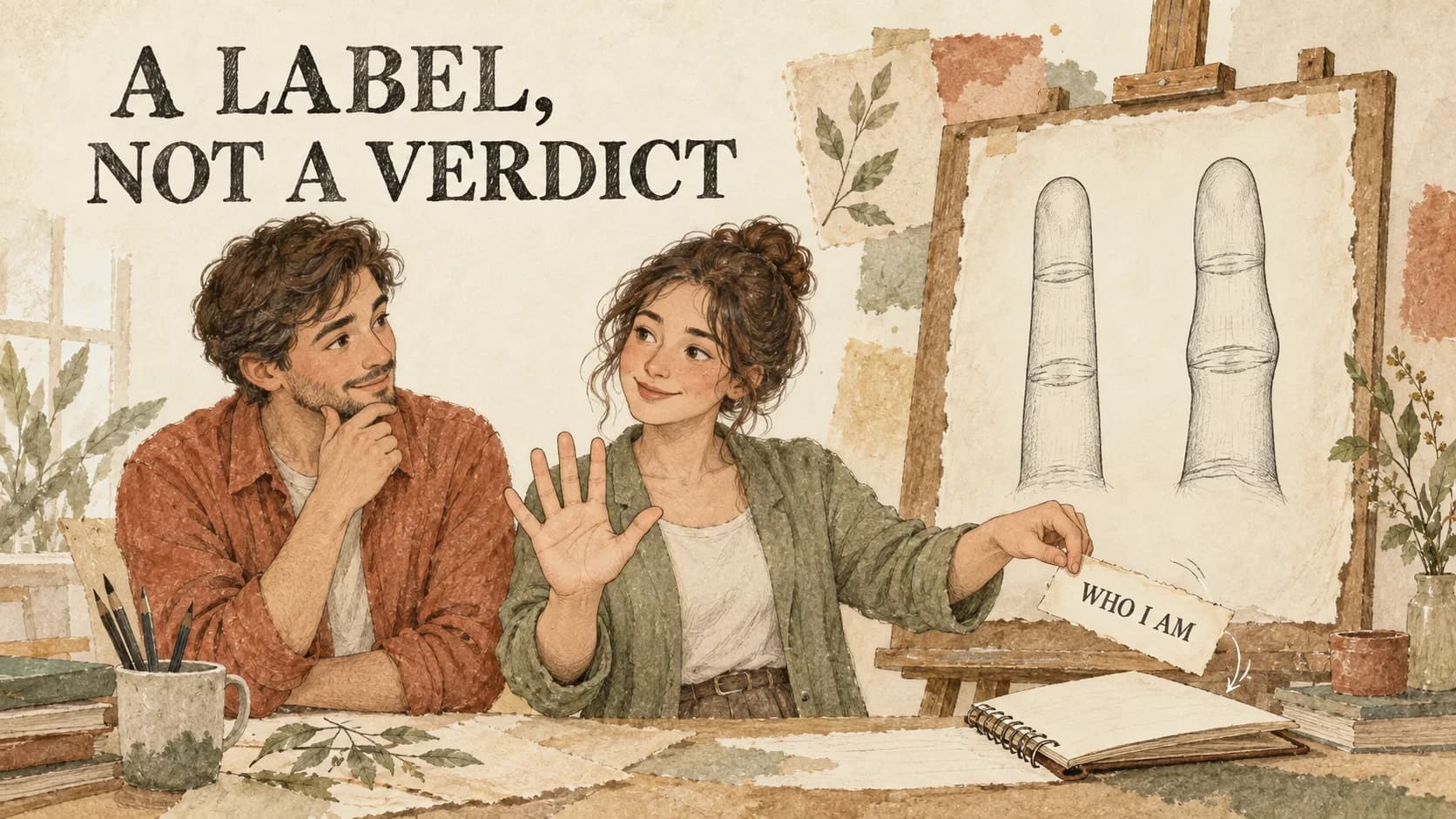
In William Benham's palmistry vocabulary, smooth versus knotty fingers compares the prominence of the joints along the finger's outline. It does not mean soft versus rough skin, or a particular fingertip shape. The personality meanings Benham attached to those shapes are historical beliefs, not findings about you.

“Knotted” is the wording you may have searched for; Benham's chapter calls them “knotty”. Here, we keep the feature and the author's interpretation separate. You can learn a label without wearing it as an identity.
A separate part of the hand has its own comparison guide to nail outlines and source-specific shape labels.
Compare the same joint before comparing descriptions
For a useful smooth-versus-knotted comparison, keep the joint and pose consistent. A bent finger in one photograph and a straight finger in another do not provide the same view. The goal is to understand an old descriptive label, not to explain a new physical symptom.
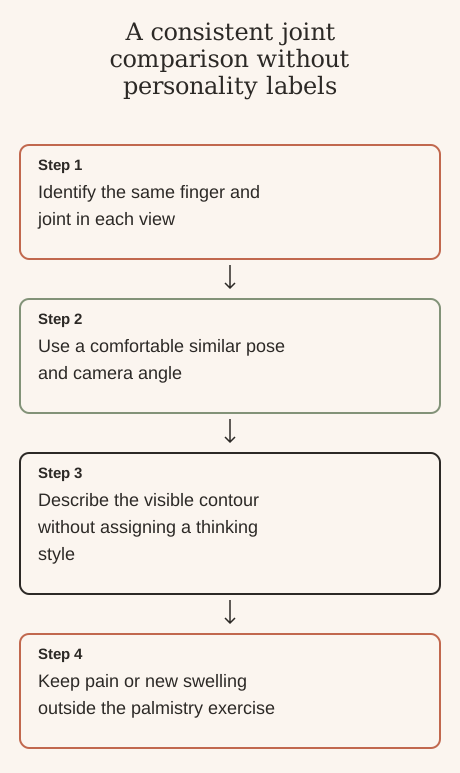
Compare the same joints in similar light before describing apparent prominence.
- Identify the same finger and joint in each view.
- Use a comfortable similar pose and camera angle.
- Describe the visible contour without assigning a thinking style.
- Keep pain or new swelling outside the palmistry exercise.
A suitable note is “The middle joint looks more prominent in this side view; the front view does not show its outline clearly.” It is not “I became more analytical between photographs.” The historical interpretation remains the author's claim even when the joint is easy to see. If a hand feels sore or its appearance has newly changed, do not keep comparing palmistry categories to explain it; use appropriate health information. You can leave the category blank and still complete the comparison.
For a closer look, compare overall palm and finger proportions; distinguish fingertips from joints; compare finger lengths as a separate observation.
Want to see yours?
Scan your palm for a full interpretive reading.


Place your palms here
Both palms, please: your left on the left, your right on the right.

Tap to upload


Tap to upload
Required · 18 or older
Photo privacy · Refund terms ·Details
- Your photos are sent to our analysis provider to write your reading. This browser may temporarily keep pending photos for sign-in or recovery. Photos sent from your phone are kept temporarily for hand-off. See our privacy policy for details.
- When you press Read my palms, both photos go to our analysis provider for a clarity check before payment. This checks the photos, not the validity of a reading.
- Doesn't sound like you? Email us within 7 days of your first reading for a full refund, if you haven't used a second. If a photo can't be read, your credit is returned.
- Next: your reading uses one of your readings, or a short checkout if you have none.
Photo tips
 Photo tips
Keep your palm flat, fingers slightly apart and lines in focus. Use bright, even light, and photograph each palm the same way.
 ✓ Like this
 ✕ Too dark
 ✕ Fingers cut off
Smooth and knotted: which feature is being named?
The feature in Benham's Chapter XIII is the outer profile at the joints. His knotty label requires conspicuous prominence there. Smooth is the contrasting description in that chapter. Neither label, used this way, reports how the skin feels or what a transverse crease means.
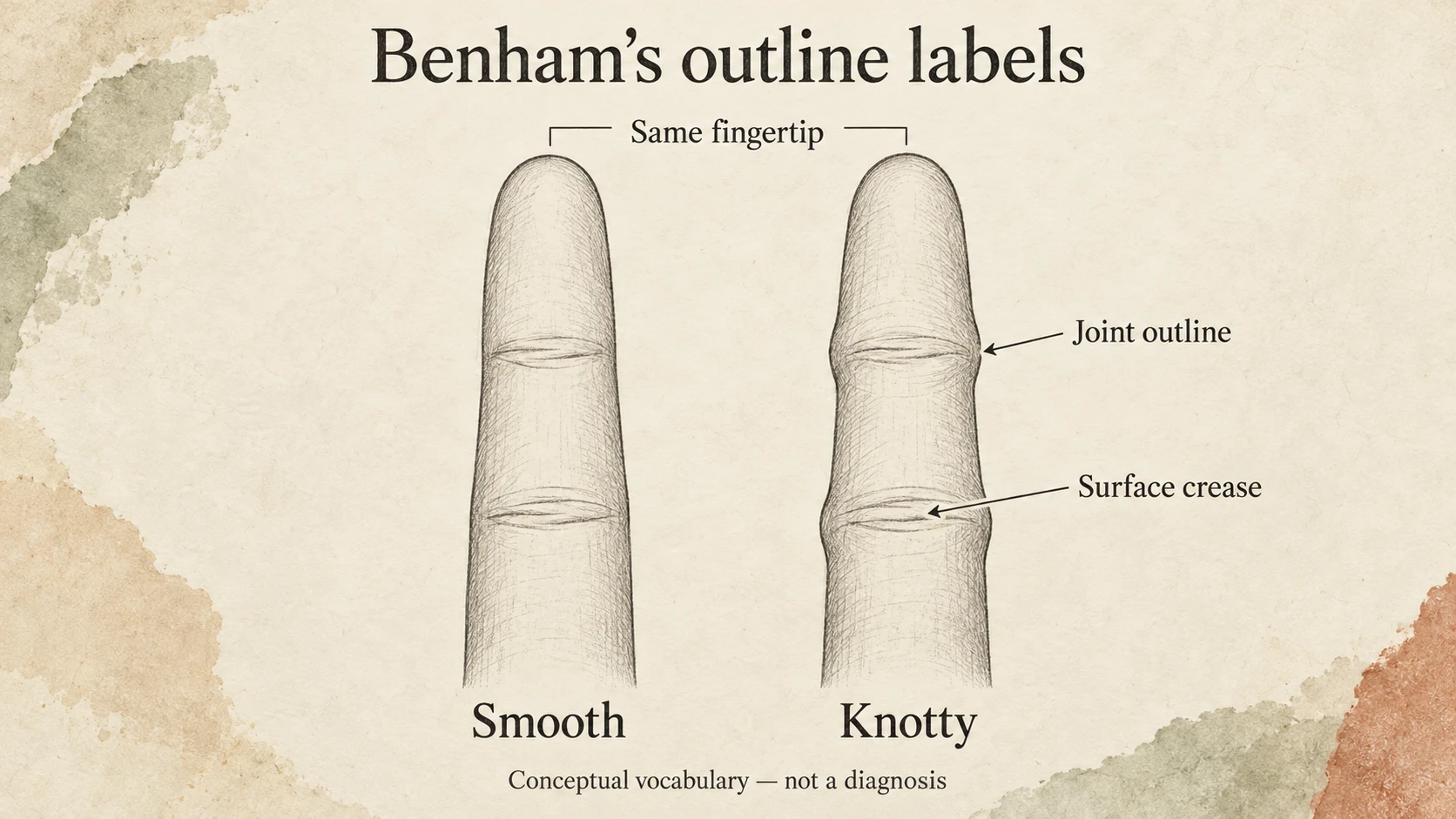
Teaching schematic of Benham's vocabulary, not a clinical diagram, measurement scale or personal assessment.
Read the schematic as three different questions. The outside edge beside a joint is the feature being compared. A short mark drawn across the inside represents a surface crease, not a change to that edge. The top of the finger is a fingertip question; both drawings deliberately keep that end alike.
Imagine tracing only the outside border of each drawing. The right border makes a more obvious detour at the joint positions. Erase the internal marks and that difference remains. Add more internal marks and you have not, by that act, changed the outline.
This is a vocabulary exercise, not a request to press, bend or measure your fingers. If a photograph leaves the outline unclear, you do not need to force a category. The palm-photo guide covers lighting and framing, not personality validation. For a different scale of observation, the whole-hand shape guide compares broader proportions. The thumb guide answers a separate set of questions.
What the old books added to the description
Benham's Chapter XIII did more than name a visible outline: he assigned symbolic meanings to it. He calls the first developed joint the “knot of mental order” and the second the “knot of material order”. Those are his interpretive names, not anatomical or psychological measurements.
Cheiro's Palmistry for All, Part II, Chapter III makes a similar leap. He associates smooth-jointed fingers with impulse and knotty joints with reflection and attention to detail. That passage tells us what Cheiro believed; it does not establish how a person thinks.
The important transition is easy to miss. A sentence begins with something drawn or seen, then ends with a judgement about a mind. Adding an old book's name makes the judgement traceable, but does not turn it into a tested conclusion. Nor do these two writers stand for every palmistry tradition.
Keep the vocabulary if it helps you understand the book. Leave its ranking of people behind.
Repair the sentence, not your hand
Separate the descriptive label from the personality conclusion in the sentence itself. You do not need to change your hand, prove the old author wrong about your character or substitute a more flattering label. The useful repair is to say which part comes from the source and which part needs evidence from life.
Consider this invented sentence, not a quotation or customer story:
“My joints are pronounced, so I am an analytical person.”
The first part describes an appearance. “So” quietly turns it into a cause or proof. The certainty leaves no room for the person's actual choices.
A repaired version is:
“Benham calls conspicuous joint prominence knotty. Whether I approach a decision analytically is a separate question about what I do.”
Now try the distinction with one ordinary decision. Before choosing an evening class, did you compare schedules, ask someone about the course, choose immediately or change your mind? Those are things you can discuss without consulting a finger shape. They need not settle a permanent personality type either.
The same repair works when the label feels flattering. A pleasant verdict is still a verdict; you are allowed to enjoy the metaphor and decline the conclusion.
A joint question is not a medical answer
Palmistry cannot tell you why a finger hurts or assess a concerning change. Do not use “smooth”, “knotty” or an illustration like this one to diagnose a cause, rule one out or decide that a joint is healthy. This page explains a passage in a book, not your body's condition.
The NHS finger-pain guidance specifically advises against diagnosing the cause yourself and explains when to seek care. If pain is the real question, follow appropriate healthcare guidance rather than a palmistry category. A photograph, a touch test or agreement with a historical drawing is not a substitute.
You can close the vocabulary question without resolving the medical one. They belong to different kinds of evidence.
Keep the choice yours
You can stop with the distinction: an outline label names a feature in a particular author's system, not a person's worth, thinking style or future. If the symbolism interests you, use it as a voluntary conversation prompt. Ask about a real decision rather than asking someone to fit a hand-based description.
If you want to see how PalmMingle presents an interpretation, inspect the labelled worked example. It is not a customer's reading or a free personalised result. Our AI palmistry explanation sets out the interpretive scope; it is not a validated joint classifier or personality assessment.
The current offer, checked 16 October 2026, is three readings for $9.99 paid once, with readings saved to your account and Mina follow-up questions. Generation uses both palm photos and requires adulthood, sign-in and a reading credit. Choose that format only if you would enjoy an optional symbolic reading, not to answer a medical question or obtain certainty about yourself.
No upload is needed to use this guide. The useful distinction is already yours.
Palmistry is an interpretive tradition, not a diagnostic tool. PalmMingle frames palm readings as entertainment and self-reflection, not prediction.