

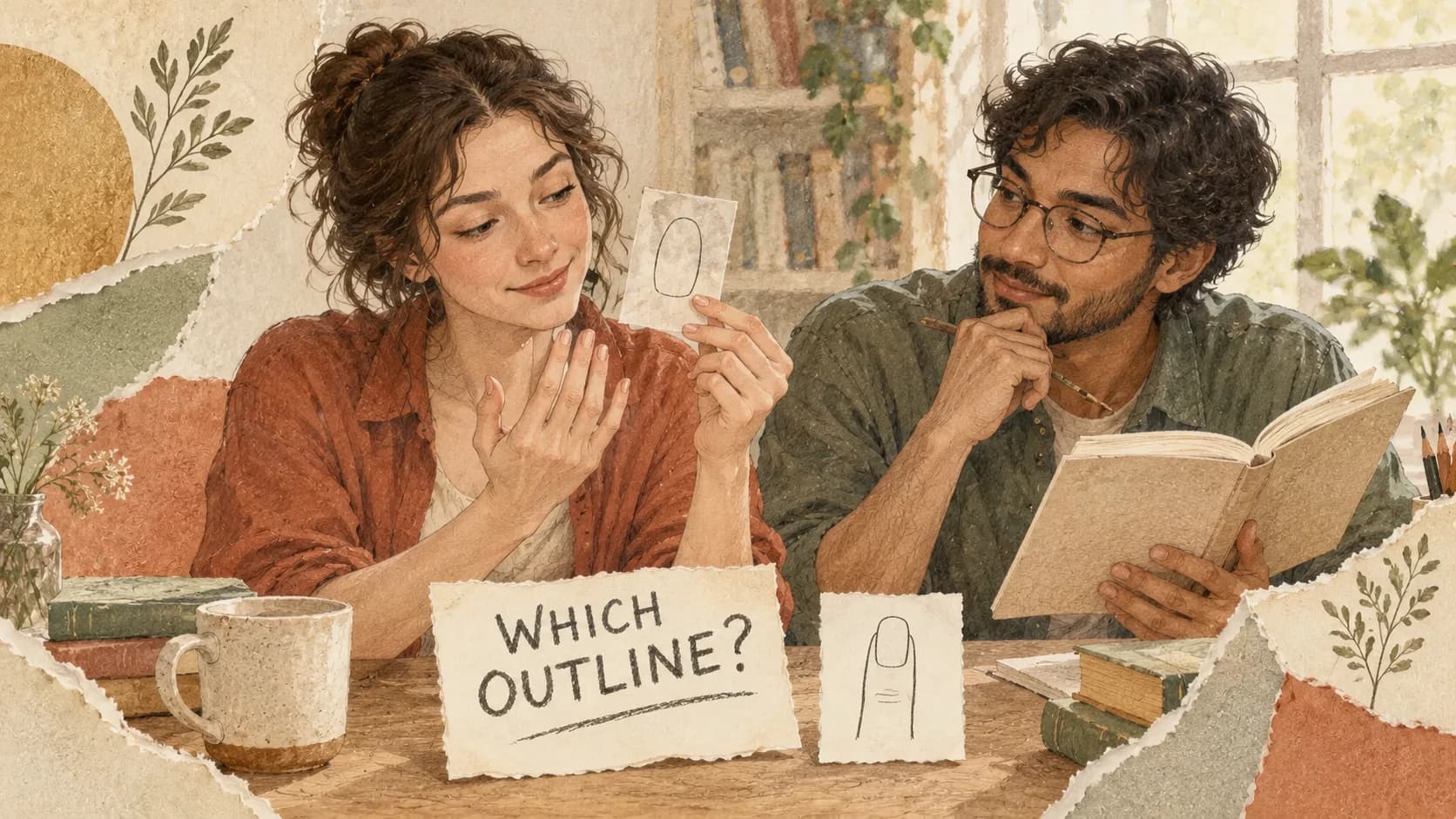
Nail shapes in palmistry use labels that depend on the source. Cheiro's Palmistry for All discusses long, short, broad and narrow nails, but a chart still needs to tell you which physical outline it means. Start by separating the nail plate, the bed beneath it and the projecting edge; then check the actual passage behind the interpretation.

A shape label does not establish personality or health. You can learn to read the chart without letting it read you.
Which outline does the chart mean?
The hard nail you see is the nail plate. The nail bed is the skin underneath it, not another name for its visible surface. The free edge is the projecting tip of the plate, so it belongs to the plate rather than forming a separate nail. These distinctions come from Cleveland Clinic's nail anatomy guide.
Evelina London's NHS leaflet likewise identifies the bed as skin directly below the fingernail. Calling a visible outline a "bed shape" can therefore leave the object unclear. Ask what the chart actually shows.
Use this key before choosing any shape label:
| Object | What the word refers to | Question to put beside the chart |
|---|---|---|
| Nail plate | The hard nail surface over the bed | Does the drawing show the plate's outline, including its tip? |
| Nail bed | Skin underneath the plate | Is the author naming an underlying part or mistakenly naming the visible plate? |
| Free edge | The projecting end, still part of the plate | Does the comparison include an edge that has been trimmed or filed? |
| Fingertip flesh | The fleshy end of the finger around and beneath the nail | Am I comparing the finger's outline instead of the nail's? |
| Skin crease | A fold or line in skin | Have I used a crease as an endpoint without the author saying to? |
The last two rows keep neighbouring features out of the nail comparison. They do not add two more nail parts. Our fingertip-shape guide follows one historical author's vocabulary for the flesh outline. The whole-hand shape guide concerns larger proportions, a separate comparison again.
If the chart never identifies its boundary, leave that question open. A tidy drawing is not an answer to a missing definition.
Want to see yours?
Scan your palm for a full interpretive reading.


Place your palms here
Both palms, please: your left on the left, your right on the right.

Tap to upload


Tap to upload
Required · 18 or older
Photo privacy · Refund terms ·Details
- Your photos are sent to our analysis provider to write your reading. This browser may temporarily keep pending photos for sign-in or recovery. Photos sent from your phone are kept temporarily for hand-off. See our privacy policy for details.
- When you press Read my palms, both photos go to our analysis provider for a clarity check before payment. This checks the photos, not the validity of a reading.
- Doesn't sound like you? Email us within 7 days of your first reading for a full refund, if you haven't used a second. If a photo can't be read, your credit is returned.
- Next: your reading uses one of your readings, or a short checkout if you have none.
Photo tips
 Photo tips
Keep your palm flat, fingers slightly apart and lines in focus. Use bright, even light, and photograph each palm the same way.
 ✓ Like this
 ✕ Too dark
 ✕ Fingers cut off
A filed tip leaves a narrower answer
You can describe the edge in front of you without claiming to have found an untouched or "natural" shape. Filing shapes nail tips, as the American Academy of Dermatology's nail guidance explains. That matters when a chart calls an outline round or square: you need to know whether it includes the shaped free edge.
Here is a fictional example. Jo sees a rounded projecting tip after filing. The plate's boundary near the skin is unclear, while the surrounding finger has its own curved outline. Jo's note reads: "Rounded free edge. Boundary near skin unclear. Fingertip flesh considered separately. No chart label chosen."
That note is finished, even without a category. There is no need to remove a manicure, reshape a nail or test whether it looks "normal" to satisfy a palmistry chart. Keep the uncertainty where it belongs, beside the observation.
Open the chapter before accepting the meaning
A book citation gives you somewhere to look, not permission to accept the attached claim. Check the named work and the actual chapter, then distinguish finding the statement from establishing its truth. In Cheiro's Palmistry for All, Part II, Chapter IV, printed pages 136 to 139, the nail vocabulary includes long, short, broad and narrow.
Now try a source-checking question prompted by a modern attribution: if an article credits Cheiro's 1916 book with linking long, narrow nails to artistic sensitivity and idealism, where is that passage? In the complete nails chapter inspected here, that association is not present. The finding is limited to this chapter. It does not establish that the words appear nowhere else in Cheiro's writing.
The chapter also makes explicit claims about disease. So a description saying that this historical nail reading never made medical assertions would miss what is on these pages. We are not repeating its disease-to-shape associations as instructions. A historical claim remains a historical claim, even when the author writes confidently.
For a health concern, use qualified care rather than a palmistry interpretation. The AAD guidance directs readers with nail changes to a dermatologist. This article supplies no symptom chart or diagnosis.
The useful result of the audit is small but firm: you know what this chapter contains and which proposed association you did not find there. The chirognomy and chiromancy guide shows another case where a word's scope depends on its place in a named book.
Keep an object note and a source note
Finish with two separate notes, one for the physical object and one for the cited statement. This keeps a word such as "narrow" from quietly becoming both an observation and a verdict about a person. Copy the card below. "Unclear" and "not found in this chapter" are useful entries, not failures to complete it.
-
Object note
- Finger and hand:
- Object named by the chart:
- Boundary or endpoints the author specifies:
- Projecting edge included, trimmed or filed:
- What I can describe:
- What remains unclear:
-
Source note
- Author and book:
- Edition or date:
- Chapter and printed pages:
- Exact claim I am checking:
- Passage found, not found here, or still unchecked:
- Limit of my check:
You do not need an upload or a reading to complete this exercise. If a different experience interests you, PalmMingle's interpretive palm-reading explanation describes its adult entertainment format. It is not a nail classifier, a source-verification service or a personality test.
Keep the card even if you skip the reading. You have identified a question the chart should answer, and a passage the citation should support. That is more useful than a flattering label with nowhere to check it.
Palmistry is an interpretive tradition, not a diagnostic tool. PalmMingle frames palm readings as entertainment and self-reflection, not prediction.