

In Frith and Heron Allen's Chiromancy, chirognomy concerns the hand's outward form, while the section called chiromancy concerns its markings. But the same book's preface uses chiromancy more broadly, including chirognomy within it. The distinction depends on where you are reading, not on two scientifically established branches.
That qualification matters. A neat “shape versus lines” definition can help you remember the labels, yet miss how this particular book uses them. You do not need to choose one term as the correct name for every palm-reading tradition.
A distinction inside one book
Frith and Heron Allen divide their book into two parts. Part I, headed Chirognomy, opens with the shape and outward appearance of hands. Part II, headed Chiromancy, opens with the hand and its markings. Its contents also include the mounds of the hand, so “lines only” would be too narrow a description of that part.
Here is the useful comparison, including the exception. The locations refer to the printed pages and contents of the digitised book, rather than a universal dictionary definition.
| Location in the book | Label used there | Scope in that location |
|---|---|---|
| Part I, Chapter I, page 31 | Chirognomy | Outward hand form and appearance |
| Part II, Chapter I, page 75, and its contents | Chiromancy | Hand markings, with later chapters on mounds and lines |
| Opening of the preface, page 11 | Chiromancy | A broader subject that includes chirognomy |
The table tells you how to read these authors' vocabulary. It does not tell you that a hand's shape establishes character, or that its markings reveal a future event. Those would be different claims requiring different evidence.
If your question is instead about the actual features, the whole-hand shape guide and beginner's palm-reading tour cover those separate jobs.
Want to see yours?
Scan your palm for a full interpretive reading.


Place your palms here
Both palms, please: your left on the left, your right on the right.

Tap to upload


Tap to upload
Required · 18 or older
Photo privacy · Refund terms ·Details
- Your photos are sent to our analysis provider to write your reading. This browser may temporarily keep pending photos for sign-in or recovery. Photos sent from your phone are kept temporarily for hand-off. See our privacy policy for details.
- When you press Read my palms, both photos go to our analysis provider for a clarity check before payment. This checks the photos, not the validity of a reading.
- Doesn't sound like you? Email us within 7 days of your first reading for a full refund, if you haven't used a second. If a photo can't be read, your credit is returned.
- Next: your reading uses one of your readings, or a short checkout if you have none.
Photo tips
 Photo tips
Keep your palm flat, fingers slightly apart and lines in focus. Use bright, even light, and photograph each palm the same way.
 ✓ Like this
 ✕ Too dark
 ✕ Fingers cut off
Why chiromancy can also include both
In the preface, chiromancy names the broader subject the authors intend to discuss, with chirognomy included. In Part II, the same word labels the narrower section about markings. The authors' opening usage and their division into parts coexist. You cannot preserve both by saying that chiromancy always excludes hand form.
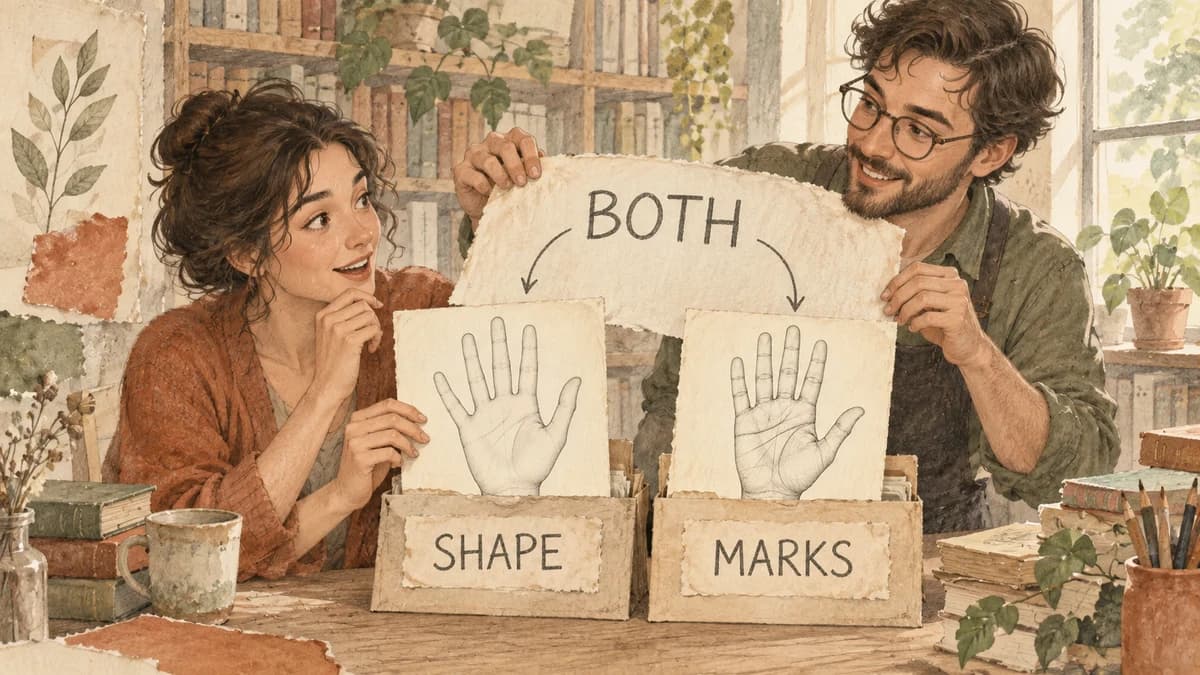
Think of the imagined bookshop scene above. Two boxes keep SHAPE and MARKS apart for sorting. A larger sheet marked BOTH can cover the two groups without changing what is inside either box. This is a metaphor for scope, not a historical illustration or an additional palmistry system.
Now put that distinction back into the book. When you encounter chiromancy in the preface, the broader meaning fits. When you encounter it as the heading of Part II, read it as that part's subject. The section heading has not cancelled the preface.
This is why the tidy comparison needs a source attached. It is useful shorthand for the book's two parts, not permission to assume every author uses the same division. Our comparison of named palmistry sources asks a related but different question about vocabulary across selected texts.
Use the words without adopting the verdicts
Understanding these labels does not require accepting the book's claims about people. Its title calls palmistry a science, and its text links appearance with character and prediction. A title, an organised contents page and specialised vocabulary do not establish that those conclusions are valid. Keep the word question separate from the truth of an interpretation.
The practical answer is therefore source-specific: chirognomy for outward form in Part I; chiromancy for markings in Part II; chiromancy including both in the preface. You can use that distinction to follow the text without turning a chapter heading into a judgement about yourself or someone else.
If you are curious about a modern interpretive reading, PalmMingle's approach explains the limits. The labelled worked sample shows the format, not your personal reading or a customer's result. Current pricing offers three saved readings for $9.99 paid once, with Mina follow-up questions. Generation requires sign-in and a reading credit.
PalmMingle does not settle historical terminology or validate a personality assessment. You can finish the comparison without uploading or buying anything. The useful question is smaller: what does this author mean by this word, here?
Palmistry is an interpretive tradition, not a diagnostic tool. PalmMingle frames palm readings as entertainment and self-reflection, not prediction.