

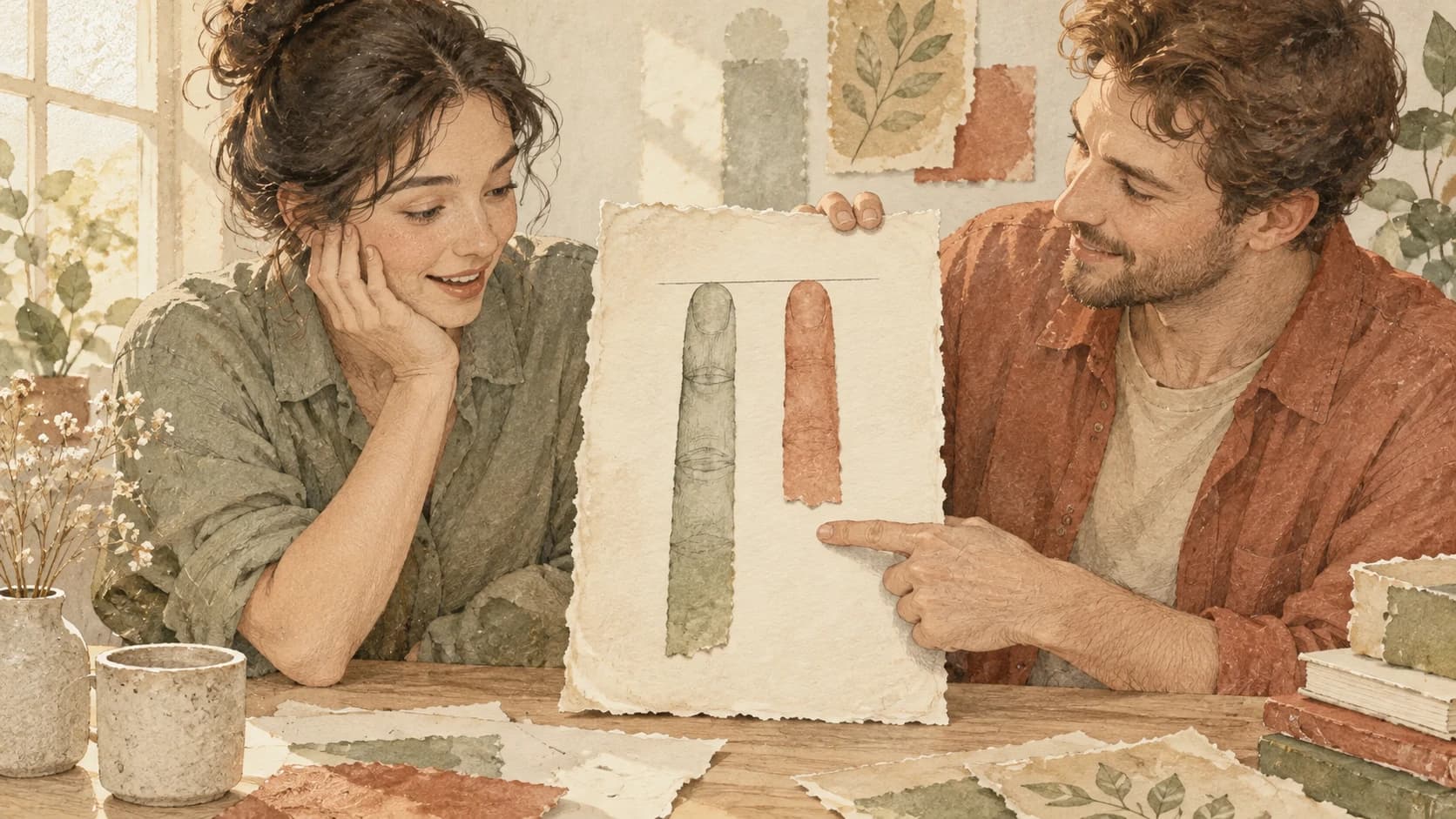
In Cheiro's palmistry, the index finger is Jupiter and the ring finger is Sun. He associated a long Jupiter finger with command and a long Sun finger with recognition. He also assigned a balance meaning to equal index and ring length. Those are his interpretations, not findings about your personality.
Before applying a label, there is another question: are you comparing where the fingertips reach, or a length from each finger's chosen base? Two tips finishing at the same height do not, by themselves, answer both questions.
What the index and ring fingers meant to Cheiro
Cheiro's Palmistry for All supplies a named historical meaning key, not a personality test. Its Part II calls the index finger Jupiter and the ring finger Sun. The chapter describes each as "long" without making every association a direct index-versus-ring comparison. His foreword separately makes an explicit claim about the first and third fingers being equal.
| Description in the book | Cheiro's association | What the description does not establish |
|---|---|---|
| Long index finger, called Jupiter | Desire for power and command | That an index finger longer than the ring finger proves leadership |
| Long ring finger, called Sun | Interest in beauty, celebrity and fame | That a ring finger longer than the index finger proves creativity |
| First and third fingers of equal length | An equally balanced mind | That apparently level fingertips demonstrate a balanced personality |
These rows paraphrase Cheiro's foreword and chapter on finger length. Keep the difference between his general "long" descriptions and his explicit equal-length claim. Turning them into "index wins, therefore you lead" adds a rule this passage does not supply.
Nor does the table justify an opposite verdict for the shorter finger. A named belief can be interesting without becoming a judgement about you. If you are trying to locate the planetary names rather than compare fingers, the map of palmistry mounts answers that separate question.
Want to see yours?
Scan your palm for a full interpretive reading.


Place your palms here
Both palms, please: your left on the left, your right on the right.

Tap to upload


Tap to upload
Required · 18 or older
Photo privacy · Refund terms ·Details
- Your photos are sent to our analysis provider to write your reading. This browser may temporarily keep pending photos for sign-in or recovery. Photos sent from your phone are kept temporarily for hand-off. See our privacy policy for details.
- When you press Read my palms, both photos go to our analysis provider for a clarity check before payment. This checks the photos, not the validity of a reading.
- Doesn't sound like you? Email us within 7 days of your first reading for a full refund, if you haven't used a second. If a photo can't be read, your credit is returned.
- Next: your reading uses one of your readings, or a short checkout if you have none.
Photo tips
 Photo tips
Keep your palm flat, fingers slightly apart and lines in focus. Use bright, even light, and photograph each palm the same way.
 ✓ Like this
 ✕ Too dark
 ✕ Fingers cut off
Two starting points, two different questions
Tip height describes where an endpoint sits. Length describes a distance between a stated start and an endpoint. An imaginary paper example makes the distinction visible: two unequal strips can finish at the same height if their lower ends start at different heights. Nothing has become equal in length just because the tops line up.
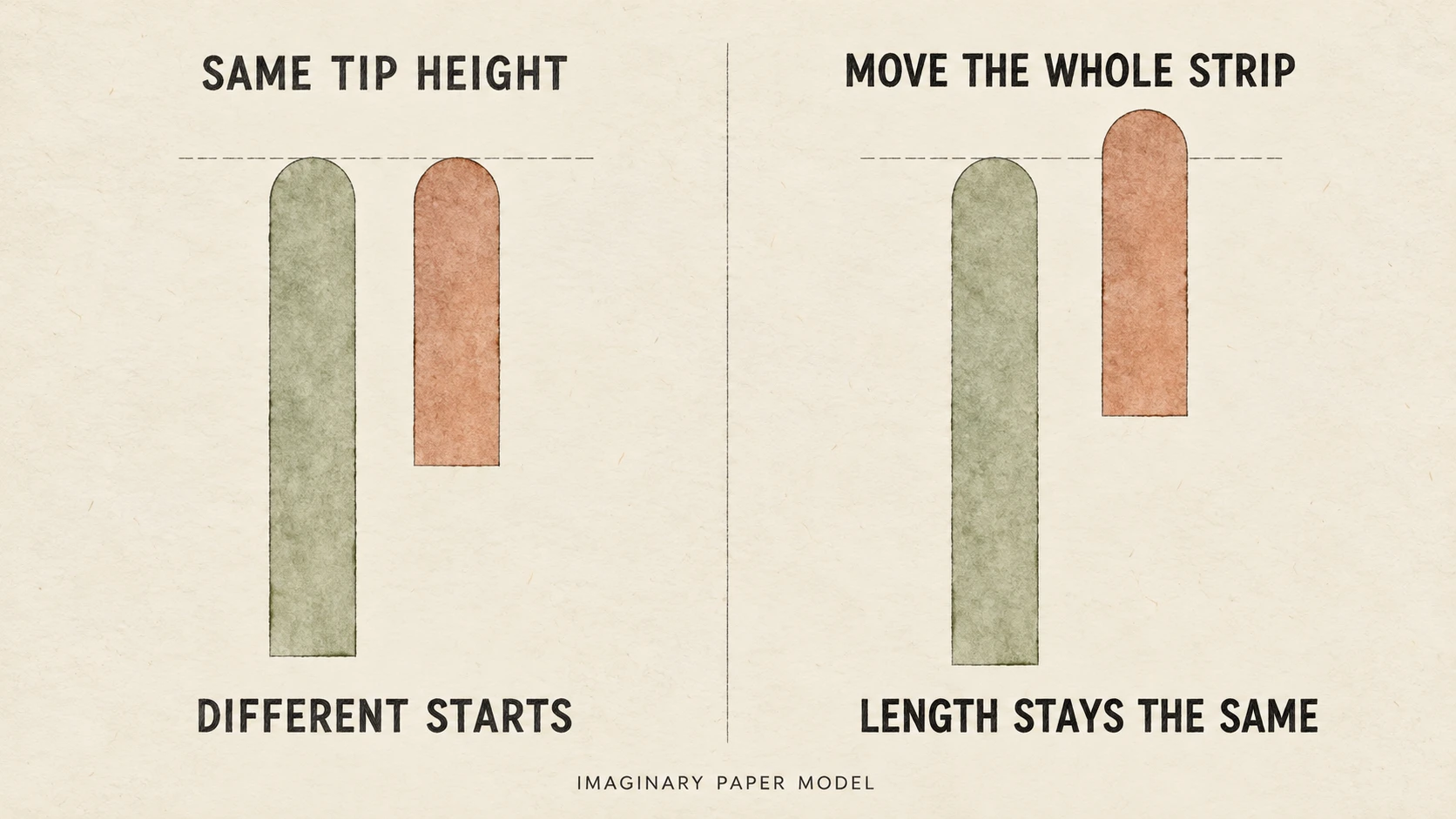
A made-up paper model, not a measured hand or a finger-measuring protocol.
Picture the model in two positions:
- Align the upper ends of a long strip and a shorter strip. The tips reach the same height; the lower ends do not align.
- Move the whole short strip upwards without stretching it. Its tip now reaches higher, but its bottom moves with it. The strip's own length stays the same.
The model does not tell you which landmark to choose on a hand. It shows why "reaches further" and "is longer from its own base" need different descriptions.
John McDonald and Charlene Kemmerle's University of Delaware explanation of finger-length comparisons notes that finger angle changes relative tip position, skin landmarks move, and methods with different starting points give different results. That is a reason to state what you compared, not a reason to adopt a supposedly definitive home measurement.
Whole-hand proportions are another question again. The guide to palmistry hand shapes covers those labels and their limits.
Leave the small difference undecided
If a difference looks tiny or changes with the pose, you can leave it uncertain. Write an observation before attaching a meaning. For example: "In this photo the tips look level. I have not defined a base for each finger, so I have not compared their lengths." That note describes what you saw without assigning a character trait.
The beginners' palm-reading guide offers a notebook format for keeping observations, historical interpretations and your own questions separate.
If the symbolic idea interests you, choose a question yourself. "Where would I like more say in a decision?" is a reflection prompt about command. Your answer comes from your experience, not from which finger seems taller.
For an optional photo-based interpretation, read what PalmMingle's AI palmistry involves, or inspect its labelled sample reading. An interpretation is not a calibrated finger measurement and cannot settle a personality, health or hormone question. You do not need an upload or another reading to finish this comparison.
Palmistry is an interpretive tradition, not a diagnostic tool. PalmMingle frames palm readings as entertainment and self-reflection, not prediction.