
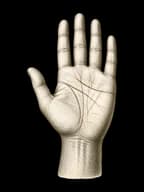
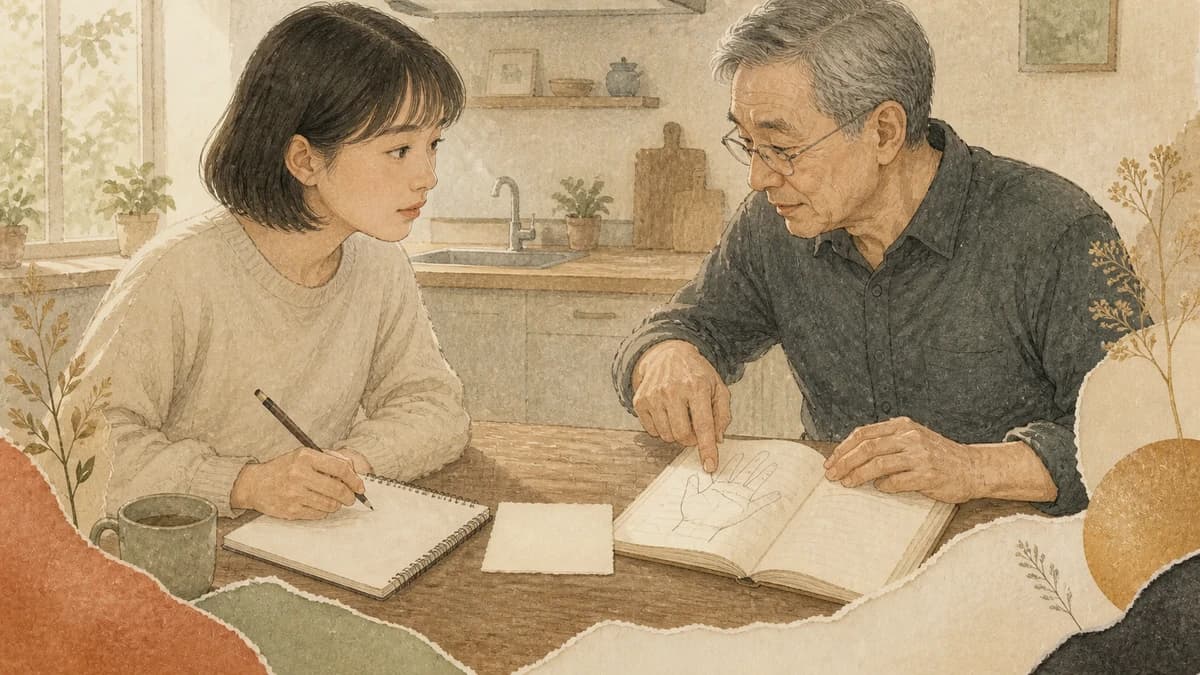
Chinese palm reading is not one single manual or one belief shared by every Chinese family. If a relative mentioned it, or you have found a guide online, start with the particular source and its vocabulary.
You can be interested in the practice without accepting claims that a hand reveals health, wealth or character. Respect for a cultural subject does not require treating a prediction as fact.
This guide uses WOFS as one contemporary practitioner's account, not a description of every Chinese palm-reading tradition.
Build a small glossary from one source
A useful Chinese palm-reading glossary records who used a term and what they meant by it. Keep the publisher's vocabulary attached to its diagram rather than assembling a supposedly universal chart from unrelated pages. This is a reading exercise, not a translation authority.
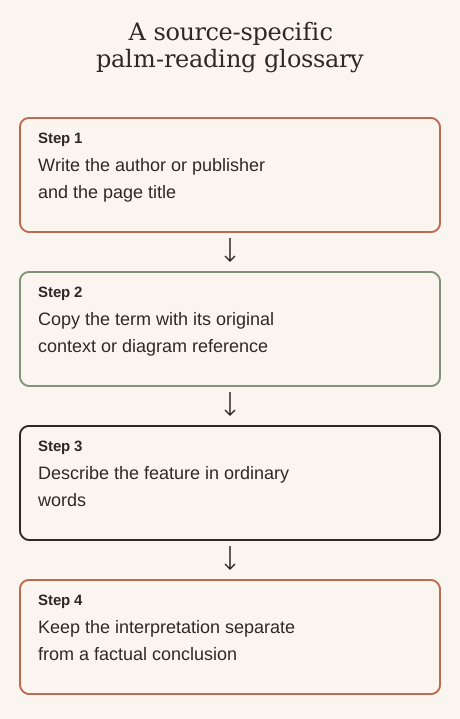
Record a source’s term, location and interpretation before comparing translations.
- Write the author or publisher and the page title.
- Copy the term with its original context or diagram reference.
- Describe the feature in ordinary words.
- Keep the interpretation separate from a factual conclusion.
For the WOFS account discussed below, a note can distinguish its five-element categories from the four-element hand chart in another guide. If a relative recalls a different word, record their wording as their recollection; do not correct it solely because an English-language website uses another label. Ask where they heard it and what the reading meant to them. Leave unfamiliar translations unresolved. That approach allows a family story and a published account to differ without making either stand for every Chinese community.
For a closer look, compare three named accounts; identify the separate four-element chart; check hand-choice conventions.
Want to see yours?
Scan your palm for a full interpretive reading.
Place your palms here
Both palms, please: your left on the left, your right on the right.
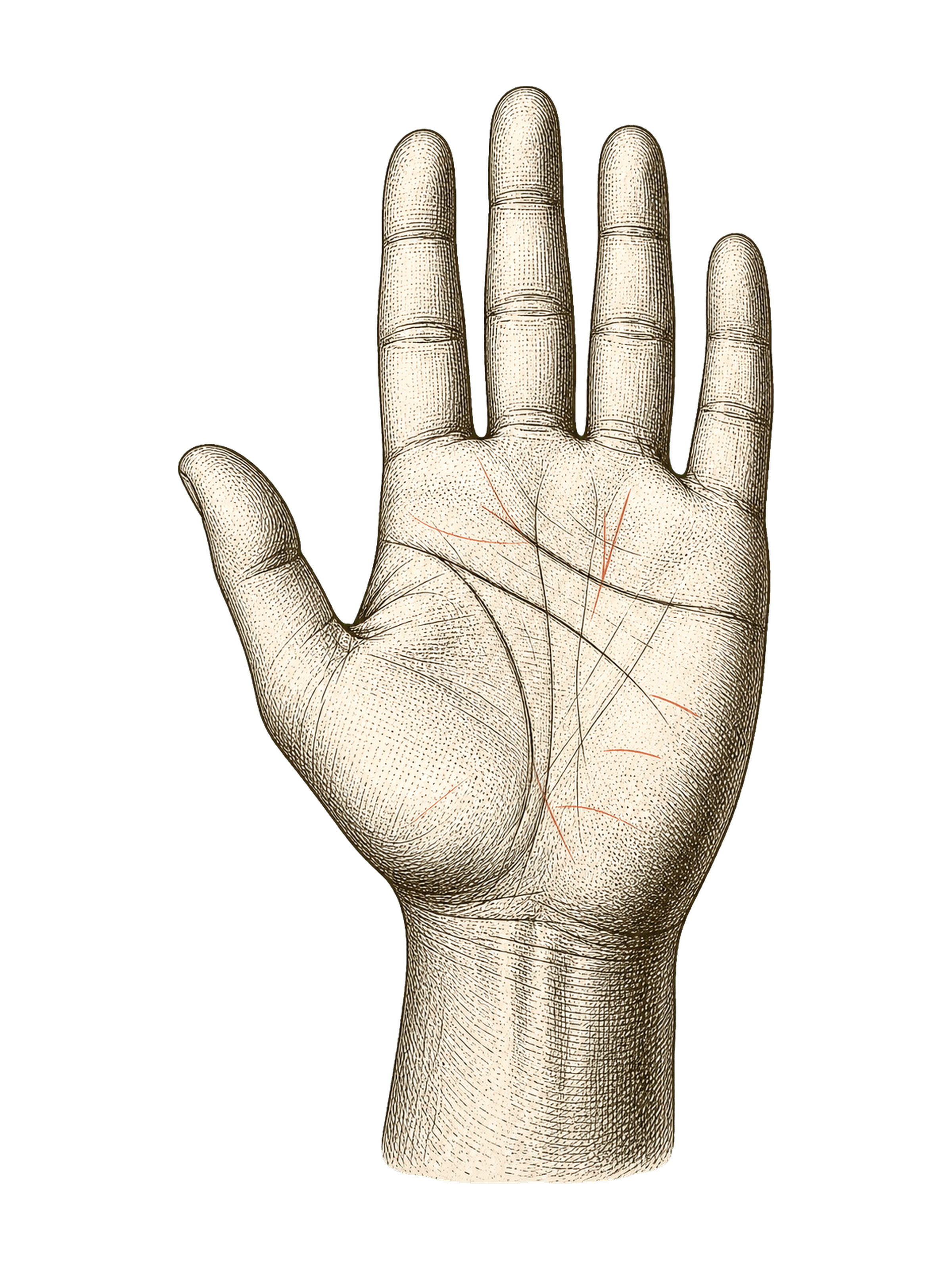
Tap to upload
Tap to upload
Required · 18 or older
Photo privacy · Refund terms ·Details
- Your photos are sent to our analysis provider to write your reading. This browser may temporarily keep pending photos for sign-in or recovery. Photos sent from your phone are kept temporarily for hand-off. See our privacy policy for details.
- When you press Read my palms, both photos go to our analysis provider for a clarity check before payment. This checks the photos, not the validity of a reading.
- Doesn't sound like you? Email us within 7 days of your first reading for a full refund, if you haven't used a second. If a photo can't be read, your credit is returned.
- Next: your reading uses one of your readings, or a short checkout if you have none.
Photo tips
 Photo tips
Keep your palm flat, fingers slightly apart and lines in focus. Use bright, even light, and photograph each palm the same way.
 ✓ Like this
 ✕ Too dark
 ✕ Fingers cut off
Start with a named account
This introduction looks at WOFS's "Chinese Palm Reading" article, a contemporary practitioner's account. It is useful evidence of what that publisher teaches. It is not a primary ancient text, a survey of Chinese communities or a scientific study.
The article combines five-element hand categories, palm-line names and a diagram using the eight trigrams. It also makes literal predictions about fortune and health. Describing it as purely psychological reflection would misrepresent the source.
That distinction matters when comparing modern articles. A reassuring summary can quietly remove the very beliefs that need to be examined.
Five elements are not the same four-element chart
WOFS names Wood, Fire, Earth, Metal and Water. That is not interchangeable with the Earth, Air, Fire and Water chart found in some contemporary Western hand-reading guides.
The shared English names can hide different classification rules. Before matching your hand to an element, check how that particular author defines the category. Do not transfer a label from one diagram to another and assume the interpretation comes with it.
Our four-element hand-shape guide explains that other chart and its limits.
Recognisable lines, different vocabulary
In the WOFS account, the heart, head and life lines are associated with heaven, human and earth terminology. It also discusses vertical lines and the arrangement of palm regions.
Learning those names can help you follow the article. It does not show that a clear crease means clear thinking, or that a faint mark predicts hardship. The physical description and the assigned meaning are separate claims.
When a translated term is unfamiliar, record the source and the diagram rather than assuming a universal equivalent. Two English-language pages may use similar words for different features.
Four questions for any guide you read
- Who is speaking? A named practitioner, a translated historical author and an anonymous summary offer different kinds of evidence.
- What can be seen? Separate the visible feature from the interpretation.
- What is being claimed? A fortune prediction is not made factual by calling it a metaphor later.
- What would be needed to verify it? A diagram alone cannot establish a health, personality or financial conclusion.
These questions let you stay curious without asking a source to be something it is not.
If the subject connects with family memories
You might ask which name a relative used, where they learned it and whether they treated the reading as serious advice, entertainment or something else. Let them describe their experience rather than assigning a story to an entire culture.
A useful family conversation can end with disagreement. You do not have to share a belief to learn about its place in someone's life. Nor do you have to share private photographs or relationship details to participate.
Common questions
Is Chinese palm reading an ancient personality test?
That label is misleading. The account discussed here includes predictions and character claims, not a validated personality assessment. It cannot establish how every historical practitioner understood the subject.
Can a short life line show low energy or an early death?
Do not use a palm reading to infer either. Our life-line guide explains why swapping lifespan language for "energy" does not supply evidence.
Can PalmMingle provide a factual prediction?
No. PalmMingle offers an optional interpretive palm reading, not a diagnosis or a reliable forecast. Cultural vocabulary does not change that limit.
The most useful starting point is a source you can name, a claim you can identify and room to decide what, if anything, the symbolism means to you.
Palmistry is an interpretive tradition, not a diagnostic tool. PalmMingle frames palm readings as entertainment and self-reflection, not prediction.