

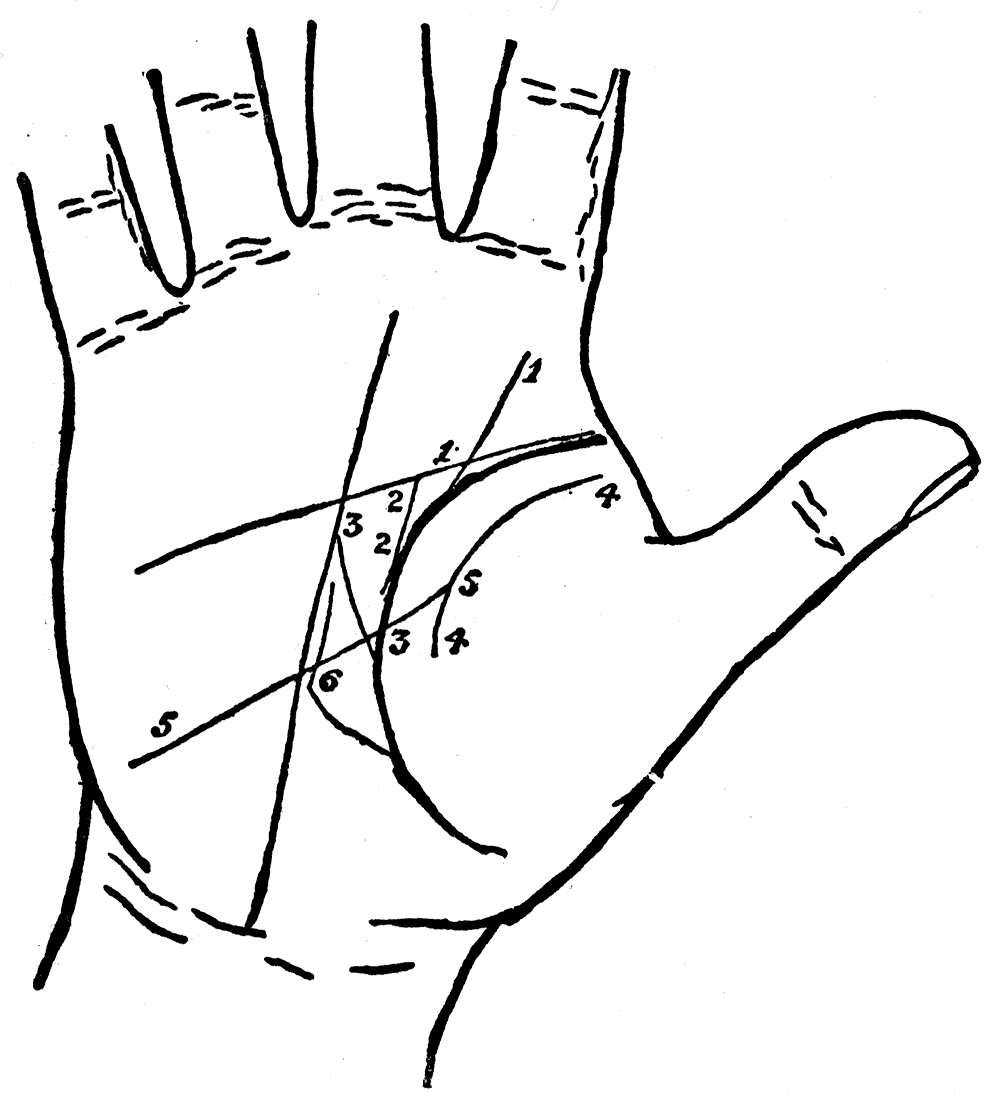
The Mars line is Cheiro's name for a curve inside Life, around the thumb pad called Venus. In his palmistry, it is also the Inner Life or Sister Life line, distinguished from finer parallel Venus lines by where it starts. Compare those source landmarks before naming a second crease; none establishes extra protection.
The three imaginary maps below separate what you can see from the label a book supplies. They are not a test for identifying a line in your photograph.
Where does Cheiro put the Mars line?
Look inside the Life curve, on the thumb-pad side, when following Cheiro's map. In Chapter IV of Palmistry for All, he describes the Mars line encircling Venus inside Life and rising from the region he calls Mars. This is his locating convention, not a claim that every palmistry author uses the same names.
The line is a drawn path; a mount is a named padded area. For the surrounding landmarks, the mounts-of-the-palm map distinguishes Venus and the Mars regions. Do not mistake the word Mars on an area map for a crease running through it.
Start with the main Life curve as your reference. Our Life-line guide covers that landmark and the limits of interpreting a nearby parallel crease. Here, the additional question is how Cheiro separates two kinds of inner paths.
Want to see yours?
Scan your palm for a full interpretive reading.


Place your palms here
Both palms, please: your left on the left, your right on the right.

Tap to upload


Tap to upload
Required · 18 or older
Photo privacy · Refund terms ·Details
- Your photos are sent to our analysis provider to write your reading. This browser may temporarily keep pending photos for sign-in or recovery. Photos sent from your phone are kept temporarily for hand-off. See our privacy policy for details.
- When you press Read my palms, both photos go to our analysis provider for a clarity check before payment. This checks the photos, not the validity of a reading.
- Doesn't sound like you? Email us within 7 days of your first reading for a full refund, if you haven't used a second. If a photo can't be read, your credit is returned.
- Next: your reading uses one of your readings, or a short checkout if you have none.
Photo tips
 Photo tips
Keep your palm flat, fingers slightly apart and lines in focus. Use bright, even light, and photograph each palm the same way.
 ✓ Like this
 ✕ Too dark
 ✕ Fingers cut off
Compare the path, not just the second line
Compare position, visible start and connection separately. A curve can lie inside Life without showing where it begins; another can visibly share a point. The same imaginary hand outline and Life curve appear in all three cases, so the changed inner paths are easy to compare. These are observation examples, not three definitive categories of real hands.
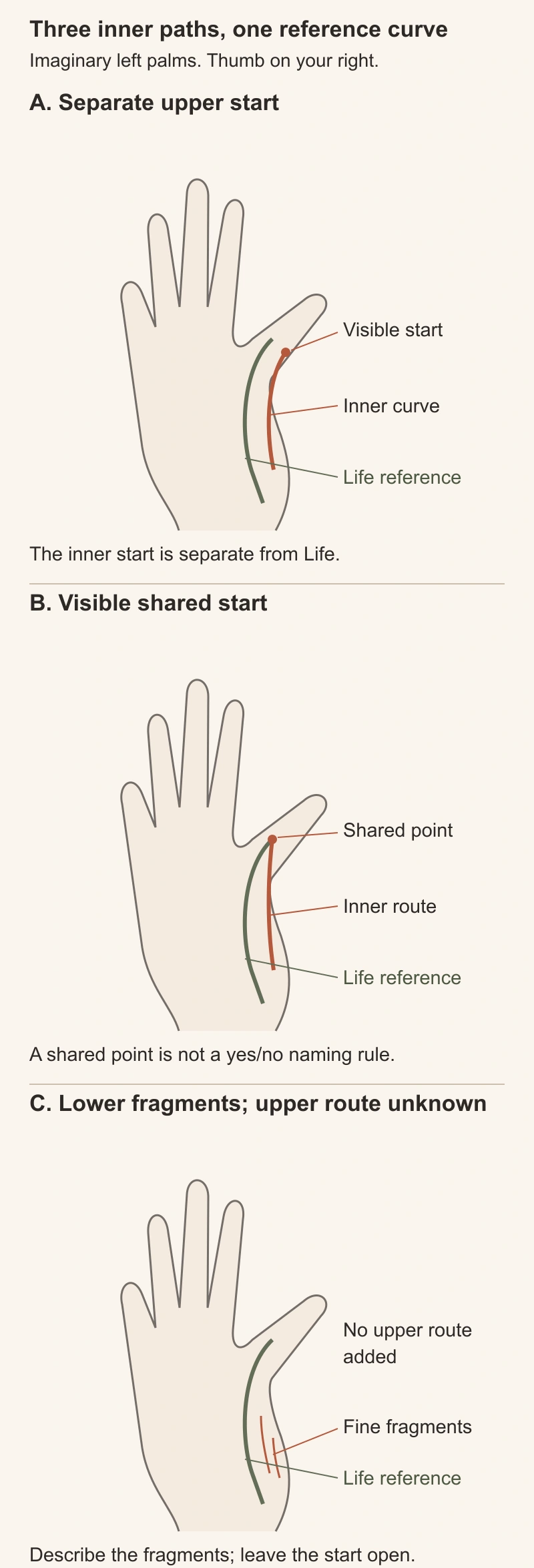
Original imaginary geometry, not measured hands or product output. The upper and lower starts illustrate the comparison in Cheiro's Chapters IV and VIII; the shared-start case is our teaching example, not his classification rule.
| Case | What the drawing shows | What it does not settle |
|---|---|---|
| A: separate upper start | An inner curve begins near the thumb web, with space between it and Life | Whether a similar real crease should receive Cheiro's label |
| B: shared upper start | The inner route and Life visibly meet at their starting point | A universal rule excluding a Mars line |
| C: lower fragments | Fine paths appear on the lower thumb pad; their upper routes are absent | Where they originally start or whether they join another crease |
Cheiro also describes a branch coming off his Mars line in Chapter IV and Plate X. Branching is therefore not a blanket disqualifier in this source. Our palmistry-symbols guide handles the separate local question of branches, crosses and split-rejoined shapes.
Why does the starting point matter in this source?
Cheiro's Chapter VIII describes fine Venus influence lines running parallel with Life, then distinguishes his Mars or Sister Life line as starting higher, nearer Mars. That makes the visible beginning relevant when comparing his two descriptions. It does not give a millimetre cutoff, minimum length or reliable way to classify every faint crease.
Plate X illustrates the Mars path; Plate XVIII illustrates the fine Venus paths. They are different hand drawings, not photographs of one hand before and after a change. Our repeated outline is a teaching device to make the starting-landmark comparison easier, not an experiment reproducing those plates.
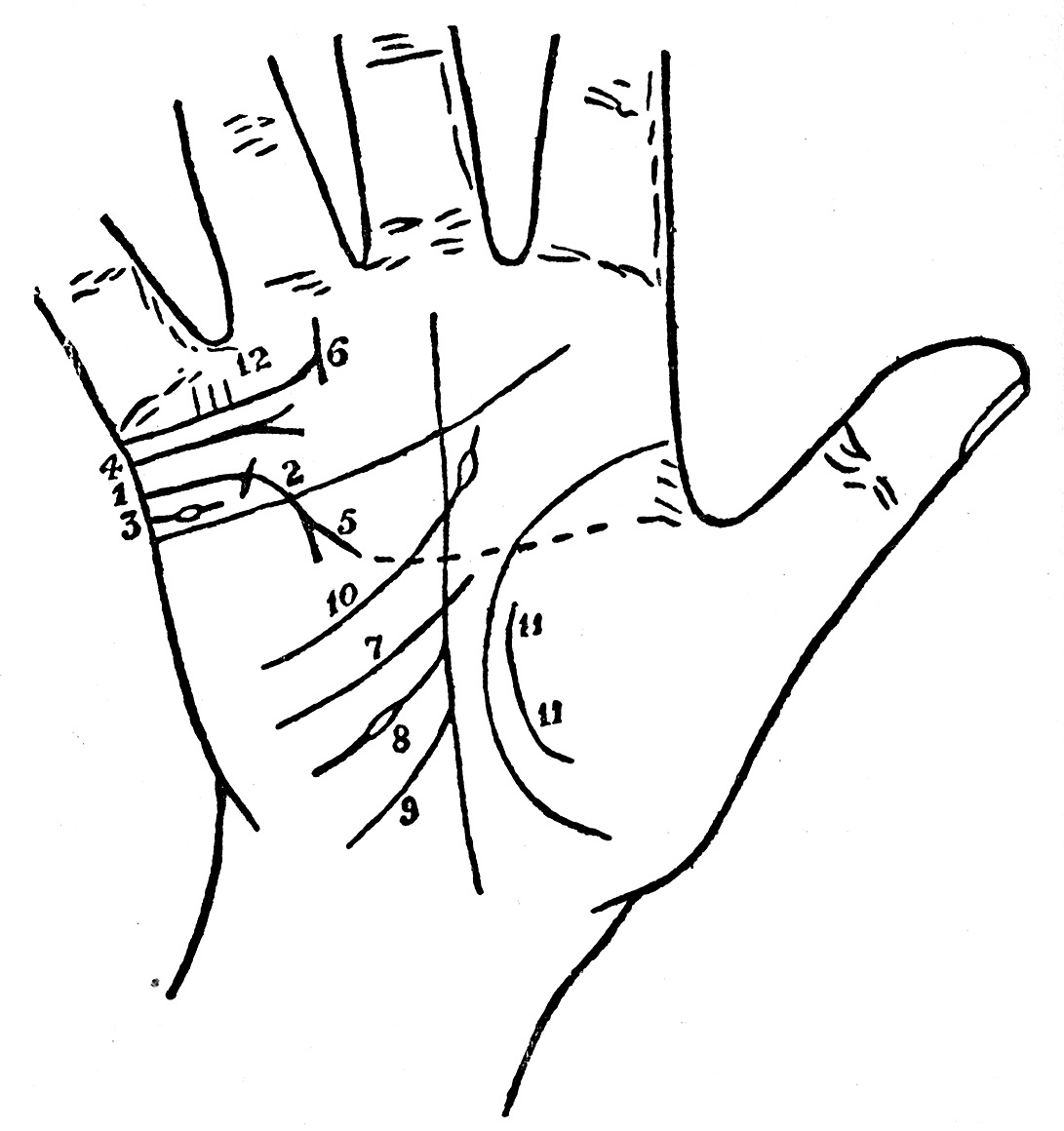
In C, do not imagine an upper extension merely to obtain a name. You can record lower fragments without deciding that they are influence lines. If you cannot see the start, the specific comparison remains unfinished.
An inner curve is not a promise of protection
Keep the observation separate from a personal forecast. The historical manual attaches protective and health-related meanings to its lines; those claims do not establish what a second crease can do for you. This page uses its map terminology, not those meanings as facts about a reader.
A note for imaginary C could read: "Two fine fragments lie inside Life on the thumb pad. Their upper routes are not shown, so I have not chosen a source label." That leaves a useful description without inventing a connection or a reassuring verdict.
No upload or purchase is needed for this comparison. If you want to consider a broader interpretive reading, PalmMingle's AI palmistry explanation describes its format and limits. It is for entertainment and reflection, not a certified minor-line detector. The optional worked-example sample shows the written format; it is not your reading or a customer's result.
Palmistry is an interpretive tradition, not a diagnostic tool. PalmMingle frames palm readings as entertainment and self-reflection, not prediction.