

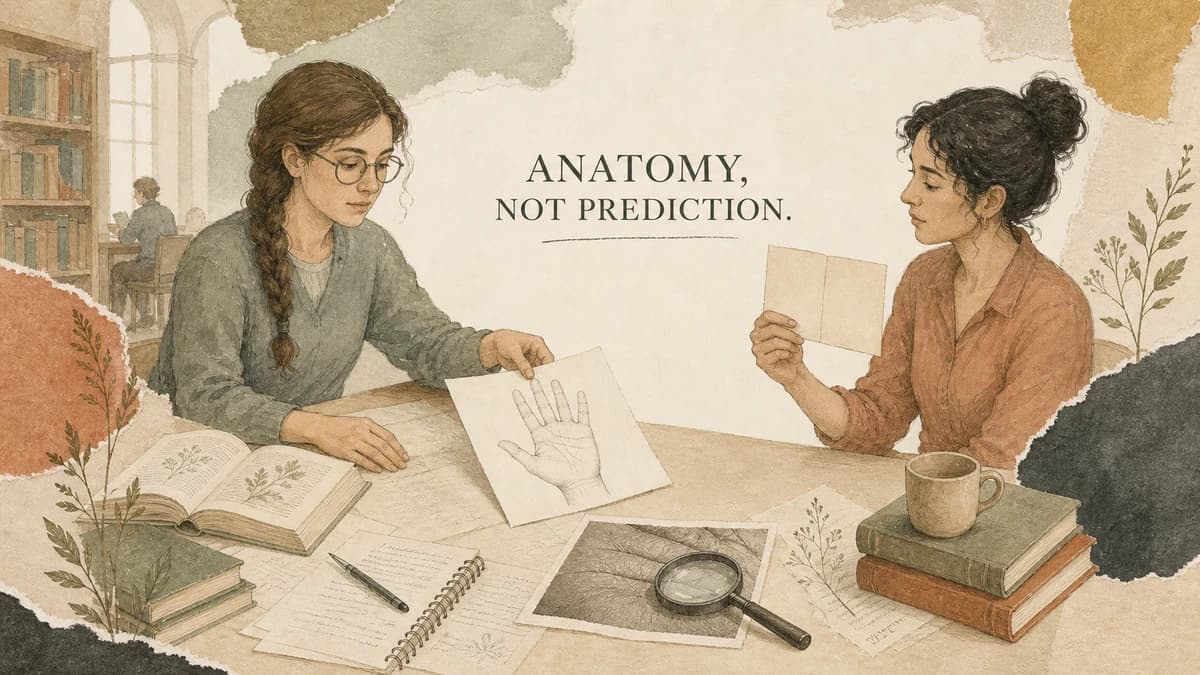
When people ask about the science behind palm reading, it helps to distinguish studies of hand development from tests of palmistry. That research is not evidence that palmistry can read personality or predict the future.

Studying how creases develop and assigning a symbolic meaning to them ask different questions. The table below separates those questions.
Use a claim-to-study match before sharing research
Before treating a hand study as support for palmistry, match its question to the proposed conclusion. A developmental paper can explain a physical feature without testing a symbolic meaning. This check keeps a real citation from carrying a claim it never investigated.
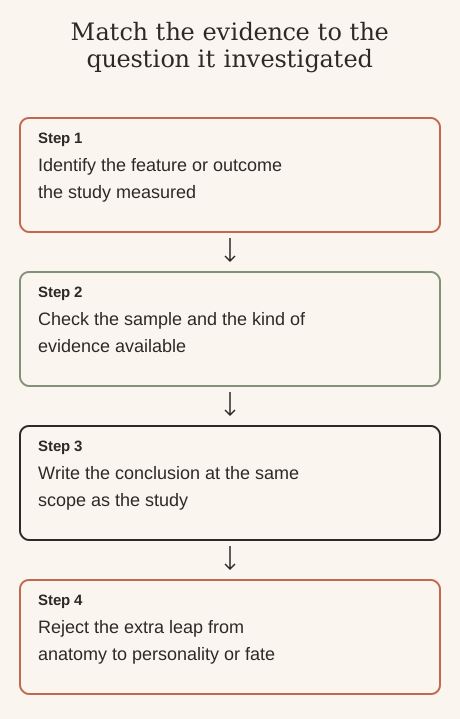
Match each study to the physical feature and question it actually investigated.
- Identify the feature or outcome the study measured.
- Check the sample and the kind of evidence available.
- Write the conclusion at the same scope as the study.
- Reject the extra leap from anatomy to personality or fate.
If an abstract reports when palmar creases appeared in an observed prenatal sample, a suitable summary concerns timing in that sample. It cannot support “this crease predicts a long life” or “this shape reveals attachment style.” If you have read only the abstract, say so rather than presenting a full-paper appraisal. If a medical reference discusses a feature alongside other signs, keep that context attached. The study title containing a hand-related word is a starting point for reading, not permission to transfer its authority.
For a closer look, separate personal meaning from accuracy; read about clinical context for a single crease; compare appearance without inferring a new future.
Want to see yours?
Scan your palm for a full interpretive reading.


Place your palms here
Both palms, please: your left on the left, your right on the right.

Tap to upload


Tap to upload
Required · 18 or older
Photo privacy · Refund terms ·Details
- Your photos are sent to our analysis provider to write your reading. This browser may temporarily keep pending photos for sign-in or recovery. Photos sent from your phone are kept temporarily for hand-off. See our privacy policy for details.
- When you press Read my palms, both photos go to our analysis provider for a clarity check before payment. This checks the photos, not the validity of a reading.
- Doesn't sound like you? Email us within 7 days of your first reading for a full refund, if you haven't used a second. If a photo can't be read, your credit is returned.
- Next: your reading uses one of your readings, or a short checkout if you have none.
Photo tips
 Photo tips
Keep your palm flat, fingers slightly apart and lines in focus. Use bright, even light, and photograph each palm the same way.
 ✓ Like this
 ✕ Too dark
 ✕ Fingers cut off
What two developmental studies investigated
Kimura and Kitagawa's 1986 study examined prenatal development of flexion creases. Its abstract reports that most creases appeared alongside developing volar pads, while others appeared independently; with exceptions, crease development appeared independent of hand and foot flexion movements.
That does not support the simple story that the lines form because a baby repeatedly clenches its fists.
Stevens and colleagues' 1988 study examined the timing of palmar and digital crease development. The published abstract reports development between 8 and 13 fetal weeks in the observed sample, with palmar creases consistently visible by 13 weeks.
These summaries are based on the published abstracts, not a review of the full papers. Neither abstract tests palmistry predictions, personality categories or relationship outcomes.
Keep the research question attached to the result
| Evidence | What it addresses | What it does not establish |
|---|---|---|
| Observations of prenatal crease development | Timing and physical development | A personality revealed by a line |
| A clinician examining a hand alongside other information | A possible feature in a broader assessment | A diagnosis from a palmistry photograph alone |
| A historical palmistry manual | What an author taught | Whether the author's predictions are valid |
| A reader saying an interpretation feels familiar | That person's response | Accuracy caused by the hand's features |
Moving a finding from the first column to an unrelated conclusion is the error to avoid. Scientific vocabulary does not make that leap smaller.
Clinical context is not fortune-telling
MedlinePlus explains that a single palmar crease is often a normal variation, while it can also occur with some conditions. Assessment considers other signs, history and examination.
That does not license a palm reader or app to diagnose a person from one crease. Nor should someone assume a condition because their hand resembles an illustration. Our single-crease guide discusses this boundary.
If a symptom or change concerns you, seek a qualified healthcare professional. This article cannot evaluate its cause.
What about a reading that feels unusually accurate?
Feeling recognised and demonstrating accuracy are different outcomes. A fair test would need to specify what the reader is claiming, how correctness is measured and whether the result depends on the relevant hand information.
This article does not claim to have reviewed every palmistry experiment or to have run such a test. It also does not offer a clinical-benefit claim for reflection. An interesting description remains an interpretation unless appropriate evidence supports more.
An optional metaphor, clearly labelled
You can use a traditional theme to pose a question. For example, after learning the term "fate line", you might ask what gives your current plans structure.
Answer from your actual circumstances. The question does not need to be true of everyone with that crease, and its usefulness would not validate the underlying palmistry system.
See is palm reading real? for the distinction between cultural practice, personal meaning and factual claims.
Common questions
Does more detailed image analysis make palmistry scientific?
A clearer image may help describe visible features. It does not validate the meanings attached to them.
Does PalmMingle diagnose health or measure personality?
No. It provides an optional AI-assisted interpretive reading, not a medical or validated psychological assessment.
Do creases changing mean my future changed?
No such conclusion follows. Our comparison guide explains why photographs and surface appearance need caution.
Hands are legitimate subjects of science. A palmistry claim still needs its own evidence.
Palmistry is an interpretive tradition, not a diagnostic tool. PalmMingle frames palm readings as entertainment and self-reflection, not prediction.