

Palm reading is real as a practice: people study hand features and attach meanings to them. That does not make its predictions or personality assessments factual.

PalmMingle offers an AI-assisted interpretation from a hand photograph. We do not present it as a validated psychological test, a diagnosis or a reliable forecast. You should not have to discover that limit after receiving a reading.
To separate a conversational technique from a hand-reading tradition, compare cold reading and palmistry as different concepts.
Ask what an accurate reading would have to show
A factual claim needs a test that could distinguish a correct reading from a plausible description. You can ask for that evidence without denying someone's personal enjoyment. The following questions are a reasoning checklist, not a report of an experiment we performed.
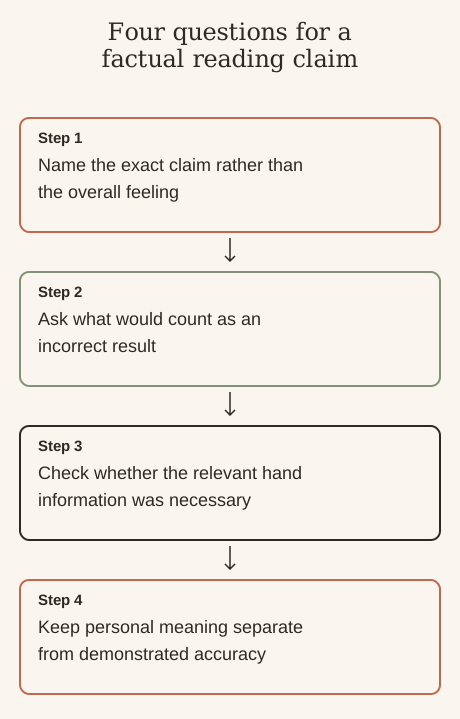
Ask what the claim predicts, what would disprove it, and whether hand information is needed before separating meaning from accuracy.
- Name the exact claim rather than the overall feeling.
- Ask what would count as an incorrect result.
- Check whether the relevant hand information was necessary.
- Keep personal meaning separate from demonstrated accuracy.
Consider the statement “You sometimes want company and sometimes need space.” It may feel familiar, but that feeling does not show that a particular crease supplied the information. A stronger claim would need a defined outcome and a comparison that rules out other explanations. Likewise, remembering a striking match while forgetting several misses cannot establish a success rate. You do not need to settle every question about palmistry before enjoying its history; simply avoid treating enjoyment as evidence for a prediction.
For a closer look, check what hand research actually studies; compare two symbolic practices; decide whether the PalmMingle format fits.

Want to see yours?
Scan your palm for a full interpretive reading.


Place your palms here
Both palms, please: your left on the left, your right on the right.

Tap to upload


Tap to upload
Required · 18 or older
Photo privacy · Refund terms ·Details
- Your photos are sent to our analysis provider to write your reading. This browser may temporarily keep pending photos for sign-in or recovery. Photos sent from your phone are kept temporarily for hand-off. See our privacy policy for details.
- When you press Read my palms, both photos go to our analysis provider for a clarity check before payment. This checks the photos, not the validity of a reading.
- Doesn't sound like you? Email us within 7 days of your first reading for a full refund, if you haven't used a second. If a photo can't be read, your credit is returned.
- Next: your reading uses one of your readings, or a short checkout if you have none.
Photo tips
 Photo tips
Keep your palm flat, fingers slightly apart and lines in focus. Use bright, even light, and photograph each palm the same way.
 ✓ Like this
 ✕ Too dark
 ✕ Fingers cut off
Three different meanings of "real"
| Question | A careful answer |
|---|---|
| Do palmistry books and traditions exist? | Yes. Their existence documents beliefs and practices. |
| Can a reading feel personally meaningful? | You can find a description interesting without proving how it was produced. |
| Does the hand reliably reveal a future event or personality trait? | A familiar-sounding interpretation does not establish that claim. |
These questions often get collapsed into one. An old book is evidence that someone taught a system, not evidence that the system works as an assessment.
Cheiro's Palmistry for All (1916), for example, makes confident claims about character and future events. We use it to identify historical terminology, not to validate those conclusions.
Why a description feeling right is not an accuracy test
Suppose two friends read the sentence "You value closeness but sometimes need space." Each might connect it with a different event. This is an invented example.
Their responses would tell you that the sentence resonated. They would not show that a palm supplied the information, that the statement distinguishes those friends from other people, or that the reading predicts what either will do.
A factual accuracy claim needs a defined target and a fair test against something independent of the reading. Agreement, praise or a striking anecdote is not enough on its own.
Reflection is an option, not a proven treatment
An image or phrase can be a starting point for a question. You might take "direction" from a fate-line discussion and ask which project deserves your attention. That does not mean the line measured your priorities.
The question is available whether the reading feels right, wrong or irrelevant. You can keep it, change it or ignore it. We do not claim that palmistry bypasses psychological defences, reveals hidden trauma or works like therapy.
Our beginners' guide separates observation, attributed belief and optional reflection.
What PalmMingle actually offers
The current reading flow accepts hand photographs and returns an AI-assisted interpretive reading. It requires sign-in and a reading credit; check the current purchase terms before choosing it.
An automated system can misidentify a feature or generate an interpretation that does not fit. Different inputs do not guarantee meaningfully different outputs. No accuracy percentage, friendship outcome or compatibility guarantee is established here.
Read the product scope before uploading. You are free to decide that this kind of entertainment is not for you.
Where the boundary should stay firm
Do not use a palm reading to diagnose symptoms, forecast lifespan, make an investment or decide whether someone is faithful. The life-line guide addresses one common frightening claim.
A reading about another person also needs their consent. It does not give you privileged knowledge of their character.
Common questions
Can palm reading predict whether an ex will return?
No reliable answer follows from a crease. A reading cannot establish another person's intentions.
Is an AI reader more accurate than a human reader?
We do not have evidence here supporting that comparison. Automation is not validation.
If you are choosing the experience instead, our AI versus human reading format comparison separates a saved report from an appointment and its follow-up.
Is enjoying palmistry the same as believing its claims?
No. You can enjoy symbolism, history or a conversation while keeping its limits clear.
The honest offer is an interpretation you can question—not an uncomfortable truth you are required to accept.
Palmistry is an interpretive tradition, not a diagnostic tool. PalmMingle frames palm readings as entertainment and self-reflection, not prediction.