

Palmistry begins with visible hand features, such as creases and proportions. Astrology interprets celestial positions and patterns. They use different starting material, but neither should be treated here as a reliable forecast or validated personality assessment.

Choosing between them for entertainment is a matter of interest, not a scientific ranking. Palmistry does not automatically make someone more accountable, and astrology does not automatically make someone avoid responsibility.
Compare what each reading asks you to supply
Palmistry and astrology begin with different inputs, so compare their procedures before comparing their language. Neither a detailed hand image nor an exact birth time establishes the validity of the interpretation that follows. You may choose either experience, both or neither.
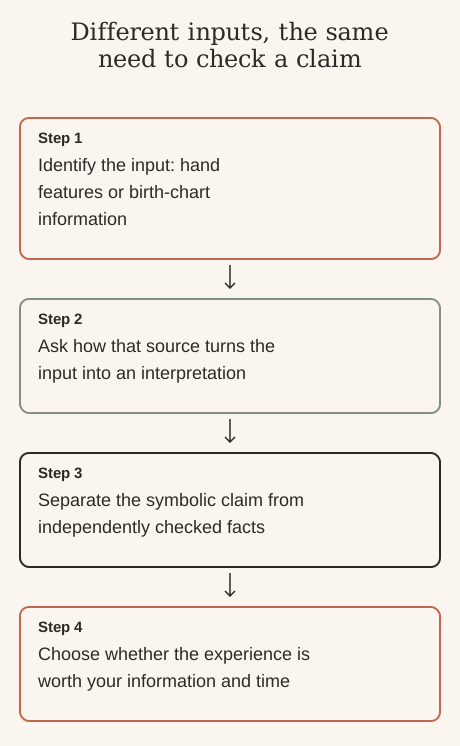
Compare the inputs and attributed meanings, then check each claim’s evidence.
- Identify the input: hand features or birth-chart information.
- Ask how that source turns the input into an interpretation.
- Separate the symbolic claim from independently checked facts.
- Choose whether the experience is worth your information and time.
Suppose you enjoy a palmistry discussion because it starts with something visible, while a friend prefers an astrological story. That preference tells you about the experiences you enjoy; it does not show that one predicts events more accurately. If either reading advises a consequential decision, look for evidence about the decision itself. You can discuss the metaphor without supplying another person's photograph or birth details. An ordinary conversation is also a valid way to explore the same question.
For a closer look, evaluate what a reading establishes; keep anatomy research in scope; compare named palmistry accounts.
Want to see yours?
Scan your palm for a full interpretive reading.


Place your palms here
Both palms, please: your left on the left, your right on the right.

Tap to upload


Tap to upload
Required · 18 or older
Photo privacy · Refund terms ·Details
- Your photos are sent to our analysis provider to write your reading. This browser may temporarily keep pending photos for sign-in or recovery. Photos sent from your phone are kept temporarily for hand-off. See our privacy policy for details.
- When you press Read my palms, both photos go to our analysis provider for a clarity check before payment. This checks the photos, not the validity of a reading.
- Doesn't sound like you? Email us within 7 days of your first reading for a full refund, if you haven't used a second. If a photo can't be read, your credit is returned.
- Next: your reading uses one of your readings, or a short checkout if you have none.
Photo tips
 Photo tips
Keep your palm flat, fingers slightly apart and lines in focus. Use bright, even light, and photograph each palm the same way.
 ✓ Like this
 ✕ Too dark
 ✕ Fingers cut off
What each practice starts with
| Question | Palmistry | Astrology |
|---|---|---|
| What is interpreted? | Hand shapes, creases and other visible features | Positions and relationships of celestial bodies within an interpretive system |
| What might a reader request? | A view or photograph of a hand | Information appropriate to the reading; a natal chart commonly uses birth details |
| What does a detailed description prove? | That features have been described, not that assigned meanings are valid | That positions have been represented, not that personal predictions are valid |
| What should remain outside the reading? | Diagnosis and consequential decisions treated as fact | The same limits |
The exact process varies by practitioner. A casual sun-sign horoscope and a detailed chart are not the same format; nor are a short palmistry guide and an individual reading.
Astronomy is a useful comparison—but not an endorsement
NASA distinguishes astronomy from astrology. Astronomy investigates space through evidence and data. Astrology attaches personal or predictive meanings to celestial positions; NASA explains that those claims are not based on scientific evidence.
Accurately locating a planet does not establish an interpretation about a person. The same reasoning applies to a palm: accurately locating a crease does not establish a claim about attachment, intelligence or future success.
Palmistry also has a history of prediction
It is misleading to claim that palmistry has always been about present-day reflection while astrology alone concerns fate. Cheiro's Palmistry for All (1916) includes explicit predictions about life events.
We can study that history without endorsing it. Our comparison of named palmistry sources explains why whole traditions should not be assigned neat personalities.
Two symbols, one blank notebook
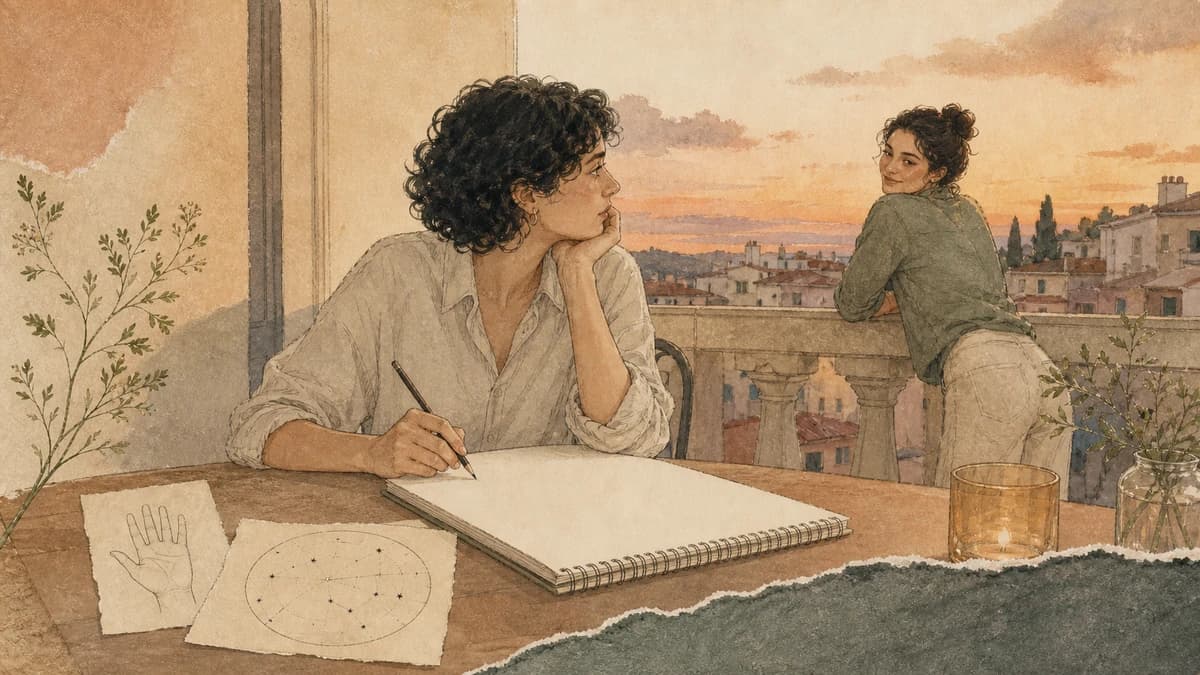
Imagine setting a star chart and a hand diagram beside a notebook. Either might prompt a question about something you want to explore. Neither has already written the answer for you.
A useful question could be "What am I postponing?" or "What would I like to make time for?" Your response comes from your experience, not from proof hidden in the chart or crease.
This is a suggested reflective exercise, not a claim that either practice improves wellbeing or outperforms another activity. You can use an ordinary conversation or blank page instead.
Choosing an experience without buying certainty
Before paying for a reading, look for clear scope, current terms and room to disagree. Be wary of guarantees about health, relationships or wealth, and of pressure to buy something to prevent a predicted disaster.
Consider the information you are being asked to share. A palm photograph and birth details are different inputs, but both deserve an informed choice about who receives them and why.
PalmMingle offers an optional AI-assisted palm interpretation. The reading flow requires sign-in and a credit; see current terms.
Common questions
Which is more accurate?
We do not have evidence here establishing a predictive or psychological accuracy advantage for either. Complexity and personal resonance are not substitutes for a fair test.
Does a hand show stress or emotional history?
A palmistry interpretation cannot establish those claims from creases. Do not turn physical appearance into a psychological verdict.
Can I enjoy both?
Yes, while keeping the distinction between interest and evidence. You can also enjoy neither.
Where can I learn the palm-reading basics?
Our beginners' guide starts with visible landmarks and separates them from historical beliefs.
Look at the sky or look at your hand if you are curious. Keep authorship of your decisions with you.
Palmistry is an interpretive tradition, not a diagnostic tool. PalmMingle frames palm readings as entertainment and self-reflection, not prediction.