

The head line is the palmistry name for a major crease crossing the middle of the palm, usually below the heart line. Historical readers associated it with thought. Its length, curve or branches do not establish your intelligence, decision speed, mental health or relationship habits.

You can learn to locate the feature without accepting the personality verdicts attached to it. The useful first question is "What can I actually see?", not "What is wrong with the way I think?"
A more upright route through the palm is a different landmark: the fate-line guide distinguishes it by destination rather than by a claim about work or thinking.
Trace the route before choosing a shape label
For a head-line observation, record a beginning, a visible route and an endpoint. Those details are more useful than immediately choosing “logical” or “creative”. This exercise helps you describe a photograph; it does not measure how you think.
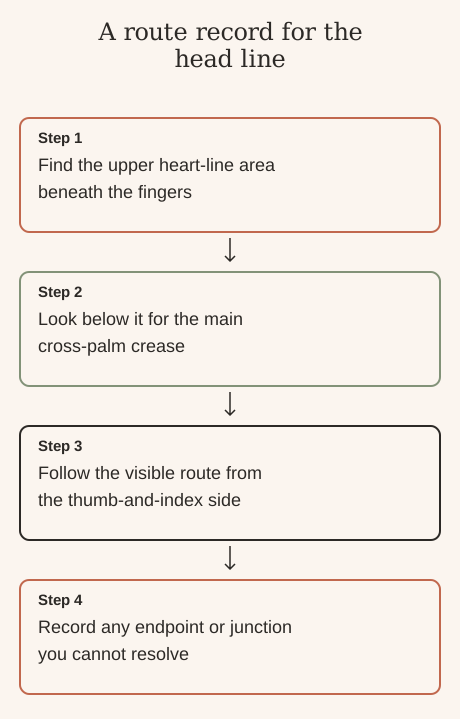
Trace the Head line’s start, course and branches before adding a symbolic interpretation.
- Find the upper heart-line area beneath the fingers.
- Look below it for the main cross-palm crease.
- Follow the visible route from the thumb-and-index side.
- Record any endpoint or junction you cannot resolve.
A worked note might say, “The crease begins near the thumb side, crosses the middle palm and slopes downward near the outer edge. A nearby mark may cross it; I cannot confirm a fork.” That note leaves an uncertain intersection open instead of converting it into a personality. Compare the two branches only if both can be followed from the same junction. A career choice or a worry about concentration needs information about your actual circumstances, not a more confident name for the line.
For a closer look, locate the neighbouring heart line; locate the life-line curve; learn the three main landmarks.
Want to see yours?
Scan your palm for a full interpretive reading.


Place your palms here
Both palms, please: your left on the left, your right on the right.

Tap to upload


Tap to upload
Required · 18 or older
Photo privacy · Refund terms ·Details
- Your photos are sent to our analysis provider to write your reading. This browser may temporarily keep pending photos for sign-in or recovery. Photos sent from your phone are kept temporarily for hand-off. See our privacy policy for details.
- When you press Read my palms, both photos go to our analysis provider for a clarity check before payment. This checks the photos, not the validity of a reading.
- Doesn't sound like you? Email us within 7 days of your first reading for a full refund, if you haven't used a second. If a photo can't be read, your credit is returned.
- Next: your reading uses one of your readings, or a short checkout if you have none.
Photo tips
 Photo tips
Keep your palm flat, fingers slightly apart and lines in focus. Use bright, even light, and photograph each palm the same way.
 ✓ Like this
 ✕ Too dark
 ✕ Fingers cut off
Locate it using neighbouring landmarks
Look at your relaxed palm in even light. Find the upper crease beneath the fingers, commonly called the heart line. The head line usually runs below it, from the thumb-and-index side toward the opposite edge.
Near the thumb, it may appear to meet the life-line curve or begin separately. Follow the visible route rather than drawing a connection through a faint area. The mount map can help with orientation.
Not every hand fits a tidy three-line drawing. If the arrangement is unclear, leave it unclear; do not force a photograph to match a diagram.
What Cheiro claimed, and what that proves
Chapter II of Cheiro's 1916 Palmistry for All gives extensive character interpretations of the head line, including its direction and connection with the life line. It is a historical source for those beliefs, not a validated assessment of thinking.
A modern guide does not fix an unsupported claim by changing its tone. "A long line means genius" and "a long line means you overthink every message" both infer mental characteristics from skin. Neither conclusion follows from the visible crease.
Treat the old vocabulary as symbolism. Do not use it to label a friend, explain a diagnosis or excuse hurtful behaviour.
Describe the shape without assigning a type
| Visible feature | A reasonable note | An unsupported conclusion |
|---|---|---|
| Longer or shorter route | Where the crease visibly ends | Fast or slow thinking |
| Straight or downward-sloping route | Its direction across this palm | Logic versus imagination |
| Two branches near an endpoint | A possible fork, if both are clear | Writing talent or indecision |
| Apparent join with the life line | A shared starting area | Family dependence |
| Separate starting areas | A visible gap between creases | Recklessness or independence |
These are observation aids, not clinical categories. For uncertain intersections, compare our guide to small palmistry symbols.
Turn a verdict into a question
If you enjoy palmistry as an imaginative prompt, try this small exercise. Write down a claim you encountered, then remove the part saying your hand proves it.
Instead of "My forked line makes me indecisive", ask "What information am I missing for this decision?" Instead of "My straight line means I am logical", ask "Which assumption have I checked?"
Answer from an actual example: a choice you made, feedback you received or a problem you are working on. Someone with a different line could ask exactly the same questions. The hand supplies a starting image, not the answer.
With another person, invite their interpretation rather than telling them how their mind works. They are allowed to disagree or decline.
Common questions
Does a short head line mean low intelligence?
No. Do not rank intelligence from the length of a palm crease.
Does a fork mean I should become a writer?
No. A branch cannot select a career. If you want to write, a small writing project will tell you more about that interest than a palm photograph.
Can PalmMingle identify my thinking style?
PalmMingle offers an AI-assisted interpretive palm reading, not a validated cognitive assessment. An automated description can also miss or misread a visible feature.
What if my hand looks different in another photo?
Compare the same hand with similar posture and light. Our photo-comparison guide explains why a changed picture need not mean a changed line.
The head-line metaphor is most useful when it opens a question. It should not close the case on who you are.
Palmistry is an interpretive tradition, not a diagnostic tool. PalmMingle frames palm readings as entertainment and self-reflection, not prediction.