

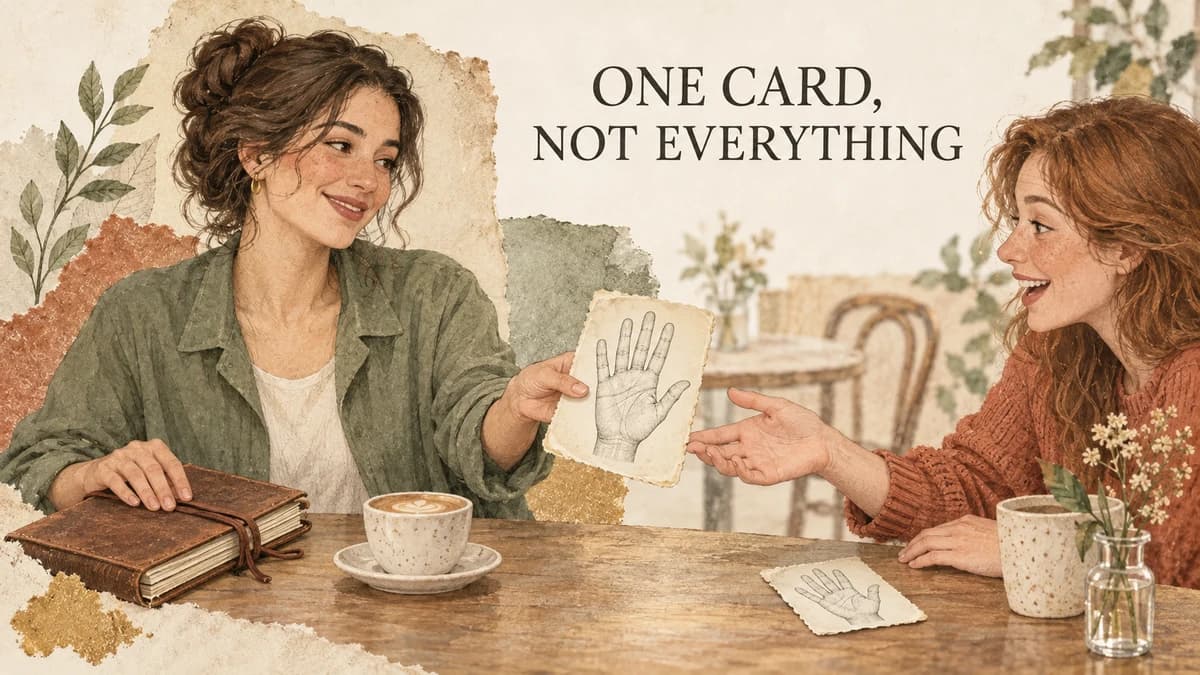
To share a palm reading in PalmMingle, choose a card from your own reading and inspect its preview before sending. The selected card does not send your palm photograph, full report or Mina conversation. It can still show your first name and an interpretation, and a recipient can pass the image or public link onward.
That makes two decisions worth separating: what you send and who might see it. A smaller card is not an anonymous card. This guide concerns PalmMingle's own-hand sharing controls, not every palm-reading service.
A card is not the whole reading
Your saved reading and a shareable card are different objects. The whole-hand card can show illustrated line shapes, your Mark, up to three descriptive words and a short interpretive sentence. Choosing one chapter narrows the illustrated line and removes those descriptive words. It can still carry your first name, Mark and a sentence. The Mark is the reading's symbol, not proof of a trait.
Use this comparison before choosing a delivery method:
| Object | What it contains or shows | What to check |
|---|---|---|
| Saved reading | The account's report, with its fuller interpretations and Mina follow-up | Sharing a selected card does not send this whole report or chat history. |
| Exported card image | The illustrated whole-hand or chapter card shown in the sharing preview | Read the visible name, words and sentence. Save image saves this picture. |
| Public card link | A page showing the selected card, without requiring the recipient to sign in | A link holder can forward it. Do not assume it is restricted to one friend or permanently unchanged. |
| Chat link preview | A title that can include your first name and a named pattern, with a pattern illustration or brand image | It is not the same picture as the exported card. Chat platforms can display previews differently. |
The distinction matters even when you send both an image and a link. The picture you inspect is an export; the linked page can reflect later saved answers. Do not treat the image preview as a promise that every future opening of the link shows an identical copy.
If you want to discuss a pattern without treating its interpretation as a fact, the beginner's observation and interpretation guide keeps those two activities separate.
For questions about the uploaded photograph rather than the shared output, use the separate palm-reading privacy checklist.
Want to see yours?
Scan your palm for a full interpretive reading.


Place your palms here
Both palms, please: your left on the left, your right on the right.

Tap to upload


Tap to upload
Required · 18 or older
Photo privacy · Refund terms ·Details
- Your photos are sent to our analysis provider to write your reading. This browser may temporarily keep pending photos for sign-in or recovery. Photos sent from your phone are kept temporarily for hand-off. See our privacy policy for details.
- When you press Read my palms, both photos go to our analysis provider for a clarity check before payment. This checks the photos, not the validity of a reading.
- Doesn't sound like you? Email us within 7 days of your first reading for a full refund, if you haven't used a second. If a photo can't be read, your credit is returned.
- Next: your reading uses one of your readings, or a short checkout if you have none.
Photo tips
 Photo tips
Keep your palm flat, fingers slightly apart and lines in focus. Use bright, even light, and photograph each palm the same way.
 ✓ Like this
 ✕ Too dark
 ✕ Fingers cut off
Four checks before you send
Check the selected content, the personal wording, the delivery method and the possible audience. These checks let you choose a smaller disclosure or stop. They do not make a forwarded image confidential, remove someone else's copy or turn an interpretive sentence into a finding about you.
- Choose the card. Decide whether the whole-hand card or one chapter serves the conversation. A chapter is narrower, but it is not automatically impersonal.
- Read what remains. Inspect your first name, Mark, descriptive words and any sentence. A sentence can reveal more than a hand illustration. You do not have to send a description you would rather keep to yourself.
- Check what you are sending. Save image and Copy link send different objects. Where supported, the device's Share action can include both a picture and a link. Look at the message before sending, including any link preview.
- Allow for onward sharing. Ask whether you would be comfortable if the friend copied the image or forwarded the link. Closing the sharing dialog is not a way to recall a public link. If that wider audience changes your answer, pause.
A card is something you choose to discuss, not a label your friend must accept. Our guide to using a reading as a conversation starting point explains that separate choice.
A small example, and a reason to stop
Imagine Alex wants to discuss one interpretation with Sam, but not the rest of the reading. Alex chooses a chapter card rather than the whole-hand card, then reads its name and sentence. This is a fictional example, not a customer account. The choice reduces what travels; it does not decide where the card might travel next.
Alex notices that the sentence feels too personal for a group chat. Saving the image would not remove that sentence or prevent someone copying it. Alex can keep the card unsent and discuss the idea in their own words instead. No purchase or sharing obligation follows from curiosity.
If Sam wants to understand the format, the labelled worked sample is a different option. It is not Sam's personal reading or a customer's result. Receiving a card does not require buying a reading or agreeing to introductions.
PalmMingle's reading overview describes the interpretive experience. It does not validate personality, predict a relationship or guarantee confidentiality. For help with a control, see the product questions.
One card can be enough for a conversation. No card is also a valid choice.
Palmistry is an interpretive tradition, not a diagnostic tool. PalmMingle frames palm readings as entertainment and self-reflection, not prediction.