

Palm reading starts with features of a hand; tarot starts with selected cards, interpreted individually or in a layout. Choose between them by the material you want to explore, not by expecting either to provide a verified forecast.
A hand cannot be reshuffled. A deck can. Yet a new set of words can appear even when neither physical input changes. That is the part worth watching: where does the detail end and the story begin?
One question, two different starting points
The distinction becomes clearer when you keep the question the same and show the interpretation being invented. Imagine someone wondering, “How would I like to spend a free Saturday?” Below is a fictional comparison, not a reading we performed, a customer's experience or a lesson in established symbol meanings. The prompts are ours; the weekend remains theirs to plan.
Starting with a hand
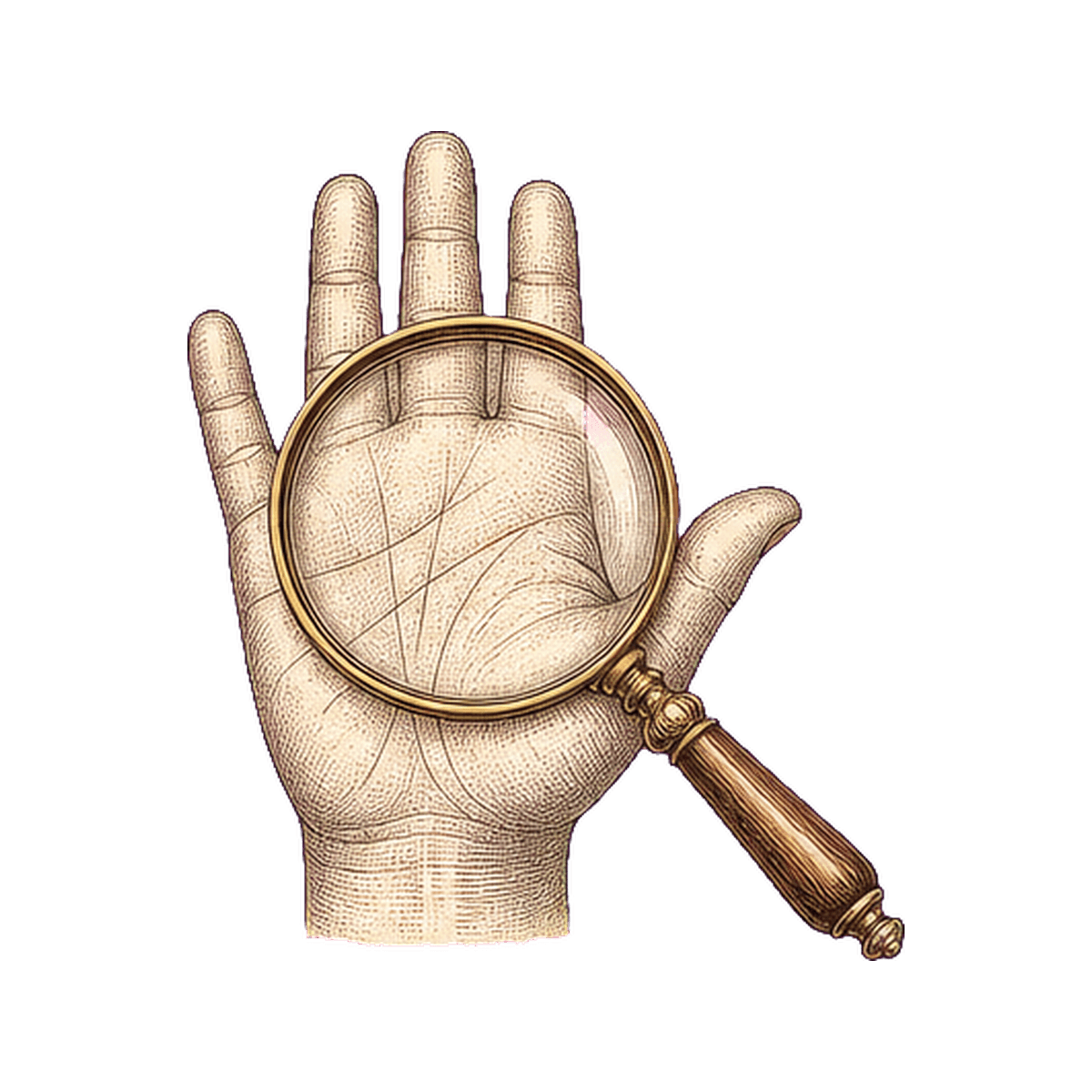
Imagine a simple drawing of a palm with a clearly visible crease that branches. The description stops there: one path separates into two. It does not say the person has two careers, divided loyalties or an important decision coming.
We could turn that shape into a playful question: “Would I enjoy splitting Saturday between something familiar and something new?” Perhaps the person writes down breakfast at home and a visit to a nearby garden. Or perhaps the branching image suggests nothing useful, and they drop it.
The branch did not contain that itinerary. We supplied the comparison; the fictional person supplied the preference. A conventional palm-reading interpretation would also need its own named source, rather than treating our invented prompt as a traditional meaning.
Starting with a card
Now imagine the selected card is the Two of Wands as described by A.E. Waite. His text depicts a figure on a battlemented roof, holding a globe and looking over sea and shore. That is a particular textual description of the card, not a description of every tarot deck.
For our fictional weekend, we choose the looking-outward detail and invent a different question: “Is there somewhere close by that I keep meaning to explore?” The person might think of the same garden. They might prefer a quiet afternoon at home instead.
That question is not Waite's divinatory meaning. We have deliberately made up a non-predictive prompt from the scene. The card has not recommended a destination, revealed a need or promised a satisfying day.
These small examples show the material difference without pretending to represent every practitioner. In Palmistry for All, Cheiro made career assertions from different Fate-line configurations; that records his historical beliefs, not anyone's actual career. In one method in The Pictorial Key to the Tarot, Waite selected a representative card, then shuffled and cut the remaining pack and assigned meanings to cards in particular positions. A layout of that kind is called a spread. His specified procedure is one example, not a rule every tarot reader follows or evidence that its predictions work.
Want to see yours?
Scan your palm for a full interpretive reading.


Place your palms here
Both palms, please: your left on the left, your right on the right.

Tap to upload


Tap to upload
Required · 18 or older
Photo privacy · Refund terms ·Details
- Your photos are sent to our analysis provider to write your reading. This browser may temporarily keep pending photos for sign-in or recovery. Photos sent from your phone are kept temporarily for hand-off. See our privacy policy for details.
- When you press Read my palms, both photos go to our analysis provider for a clarity check before payment. This checks the photos, not the validity of a reading.
- Doesn't sound like you? Email us within 7 days of your first reading for a full refund, if you haven't used a second. If a photo can't be read, your credit is returned.
- Next: your reading uses one of your readings, or a short checkout if you have none.
Photo tips
 Photo tips
Keep your palm flat, fingers slightly apart and lines in focus. Use bright, even light, and photograph each palm the same way.
 ✓ Like this
 ✕ Too dark
 ✕ Fingers cut off
Try changing just one thing
When a second reading sounds different, first separate a changed input from a changed interpretation. A clearer photo, another card and another person's wording are different changes. The following are imagined variations on our example, not results from a test. None establishes that the person's weekend, character or future has changed.
| Change in the example | What changed? | What has not been established? |
|---|---|---|
| Replace a blurry palm photo with a clearer one | The visible detail available to inspect | That a newly noticed crease signals a new event |
| Keep the same photo but describe the branch differently | The reader's attention or wording | That the hand itself changed |
| Shuffle and select cards again | The selected card may change; the same card can also return | That either selection is a more reliable answer |
| Put the same card in a differently labelled position | The role assigned to it within that layout | That moving a card changes the person's circumstances |
| Keep the same cards and layout but tell another story | The interpretation | That the new wording is newly discovered information |
The palm gives you a feature to return to; a card selection gives you a particular image or combination to return to. Neither guarantees identical wording on another occasion. If the physical detail matters to your enjoyment, keep its description separate from the interpretation so you can tell which part you are revisiting.
Choose what you want to look at
Choose palm reading if inspecting your own hand features is the part that interests you. Choose tarot if you would rather begin with selected card images and the meanings assigned to them. You can also choose neither. This is a preference about an interpretive activity, not a claim that one format suits a particular personality or will solve a problem.
There is no need to buy the tidy division “palms for your whole life, cards for today.” Our two fictional prompts both concerned a weekend. The named historical texts make claims beyond that small question, but their ambitions do not establish what either method can know.
If your real question is about evidence rather than format, our look at the science behind palm reading covers that separate issue. If you are deciding between software and a booked conversation, the AI and human palm-reader comparison discusses delivery instead. Our palmistry and astrology comparison looks at another pairing of symbolic systems.
PalmMingle offers an AI-assisted palm-photo interpretation, not a tarot service. If that format appeals, the AI palmistry explanation describes its interpretive scope. Treat it as entertainment and optional reflection, not a forecast or a decision-maker. You can finish this comparison without uploading a hand or trying either format.
For the imaginary weekend, the interesting result is not that both routes mentioned a garden. We wrote both routes. The person can still look at the weather, check the opening hours and decide what they actually want to do.
Palmistry is an interpretive tradition, not a diagnostic tool. PalmMingle frames palm readings as entertainment and self-reflection, not prediction.