

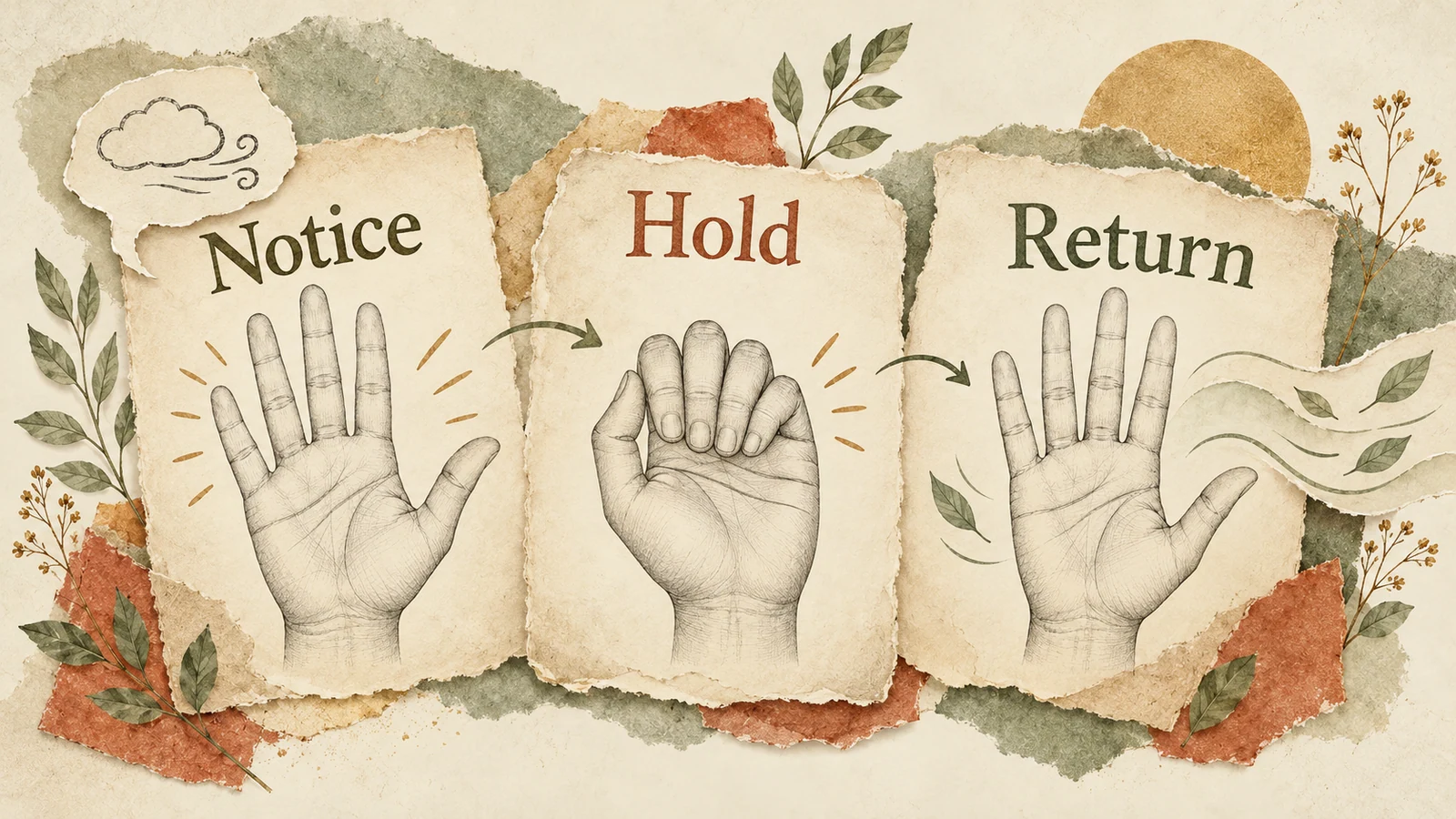
To stop interrupting people, notice what makes you jump in, hold your thought without saying it and wait for a turn that is actually available. When you cut someone off, stop and return the floor: “Sorry, I interrupted. Please finish.” The repair works only if you then let them finish, rather than explaining your interruption over the rest of their sentence.
You do not need to become silent. You are practicing contributing without taking away the other person's opportunity to complete what they were saying.
Find your cue, then choose a replacement
Notice what happens immediately before you interrupt, and choose a response for that moment. You might be excited by a connection, worried you will forget a thought, eager to correct a detail or ready with advice. Those are descriptions of an urge, not proof of its cause or a diagnosis of your personality.
| What you notice | What you are tempted to do | A replacement to try |
|---|---|---|
| “That happened to me too” | Start your story over theirs | Hold one keyword and listen to the end of their story |
| “I'll forget my point” | Say it immediately | Make a brief private note, if suitable for the setting |
| “That detail is wrong” | Correct before hearing the point | Wait and decide whether the detail changes anything important |
| “I know how to fix this” | Supply a solution | Hear the problem, then ask whether advice would help |
| “They paused, so they're done” | Take the floor | Leave space and check if the turn is unclear |
Pick the pattern you actually recognize. Trying to monitor every possible interruption at once can turn listening into a task about your performance instead of their meaning. For the advice impulse, see how to stop giving unsolicited advice.
Want to see yours?
Scan your palm for a full interpretive reading.
Place your palms here
Both palms, please: your left on the left, your right on the right.
Add a photo

Add a photo
Required · 18 or older
Photo privacy · Refund terms ·Details
- Your photos are sent to our analysis provider to write your reading. This browser may temporarily keep pending photos for sign-in or recovery. Photos sent from your phone are kept temporarily for hand-off. See our privacy policy for details.
- When you press Read my palms, both photos go to our analysis provider for a clarity check before payment. This checks the photos, not the validity of a reading.
- Doesn't sound like you? Email us within 7 days of your first reading for a full refund, if you haven't used a second. If a photo can't be read, that reading is returned.
- Next: your reading uses one of your readings, or a short checkout if you have none.
Photo tips
 Photo tips
Keep your palm flat, fingers slightly apart and lines in focus. Use bright, even light, and photograph each palm the same way.
 ✓ Like this
 ✕ Too dark
 ✕ Fingers cut off
Hold the thought without rehearsing a speech
Keep only enough of your idea to revisit it, then return your attention to the speaker. A keyword or a brief note can be an option when the setting allows it. The point is to free you from saying the thought immediately, rather than prepare a complete reply while the other person is still talking.
For example, if a friend's account of moving apartments reminds you of a useful packing tip, you might hold “labels” in mind. Keep listening. Their next sentence may reveal that they have finished moving and are actually talking about missing their old neighborhood. Your tip may no longer be relevant.
If you take a note in a personal conversation, explain if necessary: “I'm jotting one word so I can keep listening.” Do not record the person or collect private details as a memory aid. If note-taking is distracting, let the thought go. Not every thought needs a later turn.
Read the turn instead of imposing a fixed countdown
Wait for the person's point, not just the first silence. A pause may be part of thinking, finding a word or using an access tool. If you are unsure whether they have finished, a simple check can work better than applying an exact number of seconds to every person and setting.
“Were you going to add something?” or “Have you finished that thought?” can clarify an uncertain turn. Ask naturally, rather than making the conversation sound like a hearing.
Stivers and colleagues' cross-language study of turn-taking found broad organization toward minimizing gaps and overlap alongside variation in response timing. It does not supply a universal pause length that guarantees you will never interrupt. Pay attention to this conversation, including any preferences the person tells you.
Brief agreement and simultaneous enthusiasm can be welcome between some people. If someone says your overlap stops them getting a thought out, take that information seriously. “I meant it supportively” explains your intention; it does not restore their unfinished sentence.
Repair the interruption in the same moment
When you notice you have cut in, stop your own contribution and return the turn. Keep the apology brief enough that it does not become another interruption. You can acknowledge your mistake without asking the other person to reassure you, diagnose your reasons or repeat the entire story from the beginning.
Compare these exchanges:
Friend: “I finally spoke to my manager about—”
You: “You should email them. That's what I did, because when my manager—”
The conversation has shifted to your advice and your story before your friend has explained theirs.
Try instead:
You: “Sorry, I cut you off. You were saying you spoke to your manager.”
Friend: “Yes. I asked to change shifts, and they agreed.”
You: “How are you feeling about the new arrangement?”
The repair returns both the floor and the subject. You did not have to finish your advice first. If the person has lost their place, you can offer the last point you remember without insisting it was where they meant to go.
Handle video-call overlap as a coordination problem
On a call, two people can start speaking together even when both are trying to wait. Stop, offer the turn and make a clear return if needed. Use the meeting's available turn-taking convention rather than assuming repeated overlap proves that someone is rude, uninterested or trying to dominate.
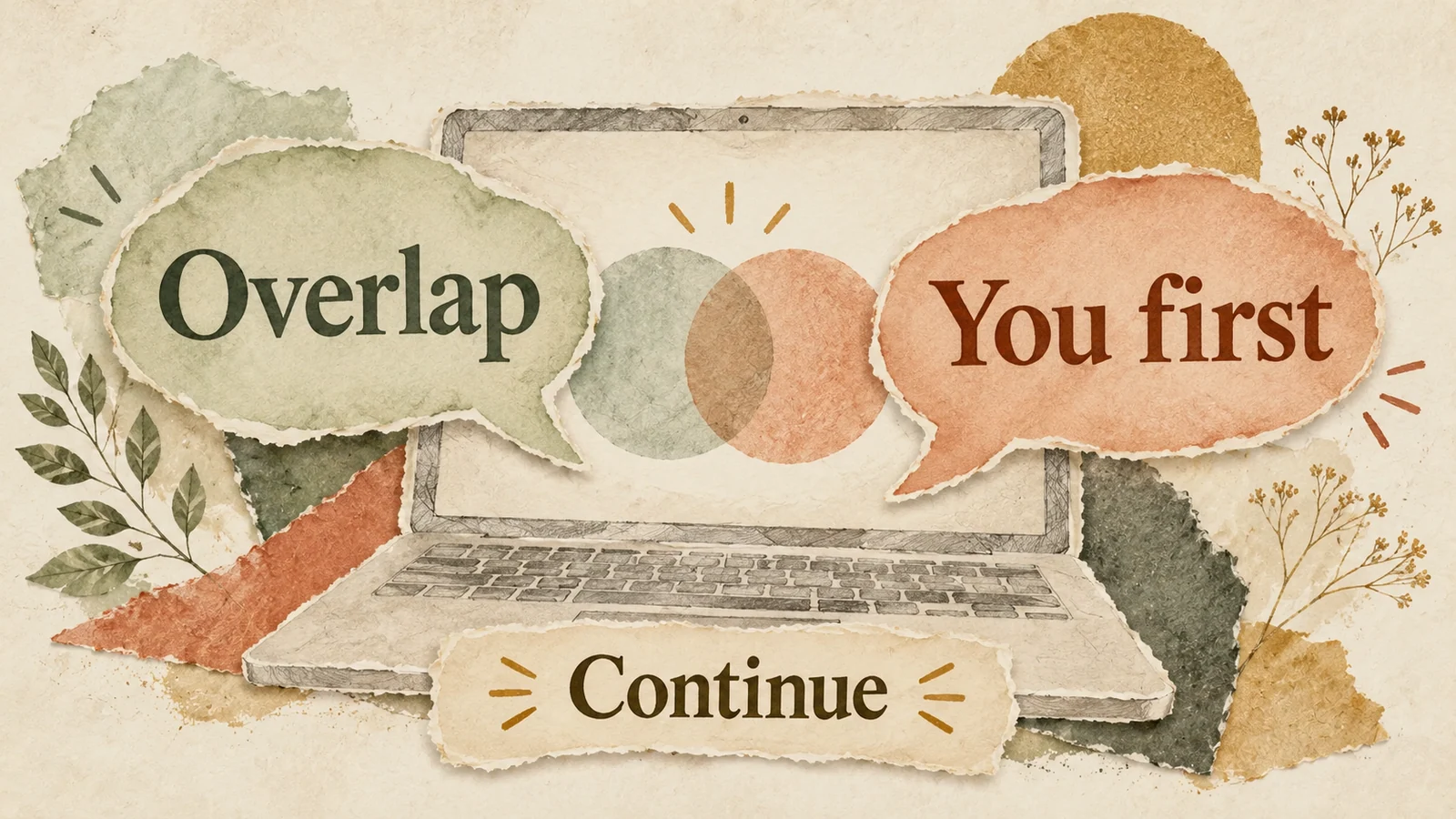
Try: “We started together. You go first.” Then wait. If the other person also yields, settle it simply: “Go ahead, and I'll follow.” In a larger meeting, a hand-raise function, facilitator or agreed speaking order may be useful if the group chooses it.
If you need more time to speak or use a communication tool, state the preference: “I sometimes pause while forming my answer. Please check before moving on.” If someone asks the same of you, follow their request rather than judging the pause against your usual rhythm.
Practice with an agreement, not a scorecard for your friend
Ask a willing person whether they would help you notice the habit, and agree on a brief signal. You remain responsible for changing your behavior; they do not become your unpaid conversation monitor. If they decline or forget to signal, that does not make the next interruption their responsibility.
You might say: “I'm working on cutting in less. If I do it, would you be comfortable saying ‘let me finish’?” Agree that you will respond by stopping, rather than defending yourself in the moment.
Afterwards, reflect on something specific: Did you notice the urge before speaking? Did you return the turn when you missed it? Did you understand the point the other person was making? Those observations are more useful than asking them to grade whether you are now a good listener.
If you realize you dismissed something important, how to apologize to a friend can help you pair an acknowledgment with repair. If you are the person being cut off, describe the impact to your friend rather than trying to diagnose their reason. If the problem is persistent and causing difficulties beyond what these practical changes address, qualified support can help you consider your own situation without guessing a cause from one habit.
For optional symbolic reflection, PalmMingle's AI palm reading offers an interpretive experience. It cannot explain an interruption habit or evaluate your listening. The useful evidence is what happens when you notice the urge, leave room and return the floor.
Palmistry is an interpretive tradition, not a diagnostic tool. PalmMingle frames palm readings as entertainment and self-reflection, not prediction.