

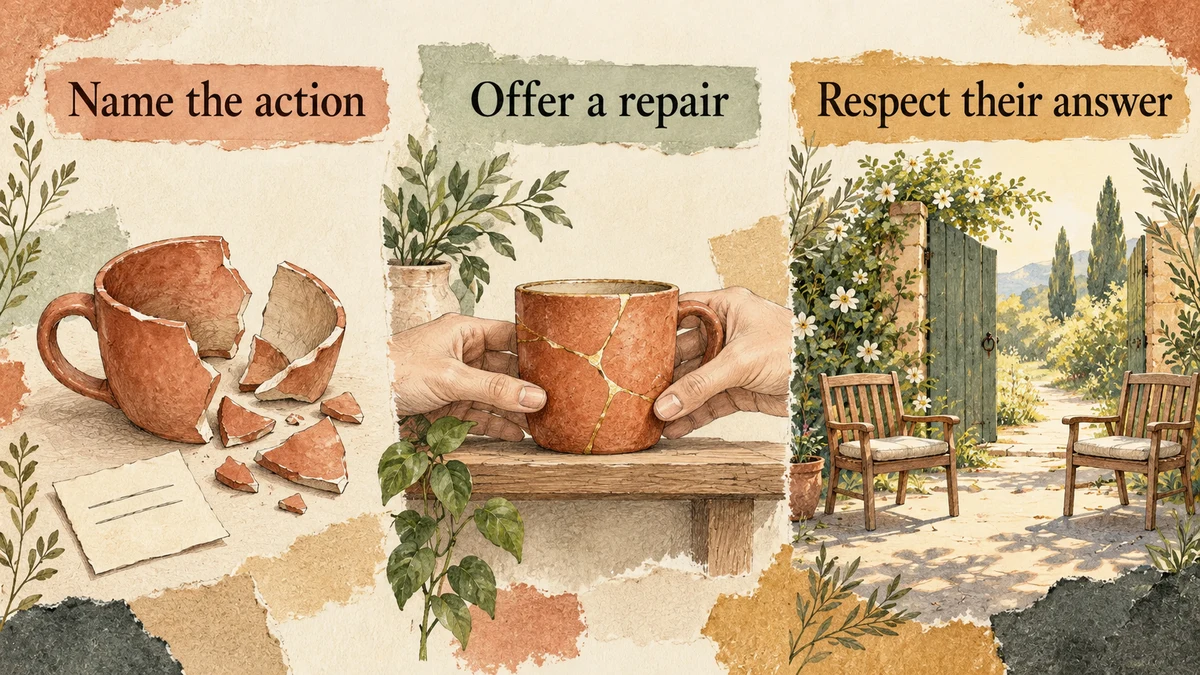
To apologize to a friend, name what you did, acknowledge its impact, say you are sorry and offer a specific repair. Then give your friend room to respond. A useful apology makes your responsibility clear; it does not ask the hurt person to reassure you or promise that the friendship will return to normal.
A message you can adapt:
I repeated something you told me privately. That was mine to keep confidential, and I broke your trust. I’m sorry. I’ll ask the person I told not to share it, and I won’t discuss it again. You don’t need to reply before you’re ready.
That is a starting point, not a speech to copy regardless of what happened. Choose a repair that fits the harm and stays within what you can actually do.
Start with the action you are responsible for
An apology is clearer when it identifies an action rather than the other person’s reaction. You can own a hurtful joke, a missed commitment or a breach of confidence without deciding that you are a terrible person. Keep the first sentence close enough to the event that your friend does not have to explain what you mean.
| If you were about to write… | Try something more accountable |
|---|---|
| Sorry you took the joke badly | I joked about something you had asked me not to mention |
| Sorry, but I’ve been busy | I agreed to meet and did not tell you I couldn’t come |
| Sorry for everything | I shared your news before you were ready to tell people |
| I’m the worst; I bet you hate me | I let you down, and I’m sorry |
Context can come later. Explaining a missed train helps clarify a delay; blaming your friend for expecting you to arrive moves responsibility back onto them.
Want to see yours?
Scan your palm for a full interpretive reading.
Place your palms here
Both palms, please: your left on the left, your right on the right.
Add a photo

Add a photo
Required · 18 or older
Photo privacy · Refund terms ·Details
- Your photos are sent to our analysis provider to write your reading. This browser may temporarily keep pending photos for sign-in or recovery. Photos sent from your phone are kept temporarily for hand-off. See our privacy policy for details.
- When you press Read my palms, both photos go to our analysis provider for a clarity check before payment. This checks the photos, not the validity of a reading.
- Doesn't sound like you? Email us within 7 days of your first reading for a full refund, if you haven't used a second. If a photo can't be read, that reading is returned.
- Next: your reading uses one of your readings, or a short checkout if you have none.
Photo tips
 Photo tips
Keep your palm flat, fingers slightly apart and lines in focus. Use bright, even light, and photograph each palm the same way.
 ✓ Like this
 ✕ Too dark
 ✕ Fingers cut off
Choose a repair that matches what happened
A practical repair addresses the cost your action created. Replacing a lost object is different from correcting a rumour or changing how you handle private information. Offer something concrete and proportionate, then listen if your friend says it misses the point. Do not make them design your entire plan before you take responsibility.
After cancelling a plan without warning:
I left you waiting and didn’t message. I’m sorry. If you want to meet again, I’ll choose a time I can keep and confirm beforehand. I also want to cover the ticket you bought for me.
Offer reimbursement only if there was an actual cost you owe and you can pay it. A new invitation does not erase the inconvenience of the first one.
After a hurtful joke:
I made your job search the punchline in front of everyone. I’m sorry. I won’t bring it up that way again. Would you like me to correct what I said with the people who heard it, or would that draw more attention to it?
After sharing a confidence:
I told someone something you trusted me with. I’m sorry. I can’t promise they will forget it, but I can stop sharing it and ask them not to repeat it. I’ll check with you before trying to correct anything publicly.
Notice the limit in the last example: you cannot undo another person’s knowledge. A credible apology does not promise control you do not have.
What apology research actually tested
Responsibility and repair are more than pleasing wording. In Lewicki, Polin and Lount’s study of apology structure, participants evaluated apologies in written trust-violation scenarios. Acknowledging responsibility and offering repair were important components. These were evaluations of scenarios, not a test showing that a particular friendship message produces forgiveness.
The useful takeaway is to check what your apology does: does it acknowledge the action, or merely express your discomfort? Does it offer a repair, or ask the other person to move on? Use that distinction to edit your message rather than trying to include a magic number of apology ingredients.
Pick a channel that gives your friend some choice
A short text can acknowledge the harm and ask whether a conversation would be welcome. A call or meeting can leave more room for questions if both people want one. The more public the original incident, the more carefully you need to discuss whether a public correction would help or expose your friend further.
You could begin:
I want to apologize for what I said yesterday. Would you rather read a message or talk when you have time?
Do not arrive at their home uninvited, recruit mutual friends to deliver the apology or use a group chat to make them respond in public. If they have asked you not to contact them, respect that request; a desire to apologize is not permission to cross it.
Let their answer change your next step
An apology opens a possibility of repair; it does not set a deadline for acceptance. Your next step depends on what your friend actually says. You can listen to anger without agreeing to insults, allow time without sending daily reminders, and accept that someone may want the behaviour to stop without wanting the friendship back.
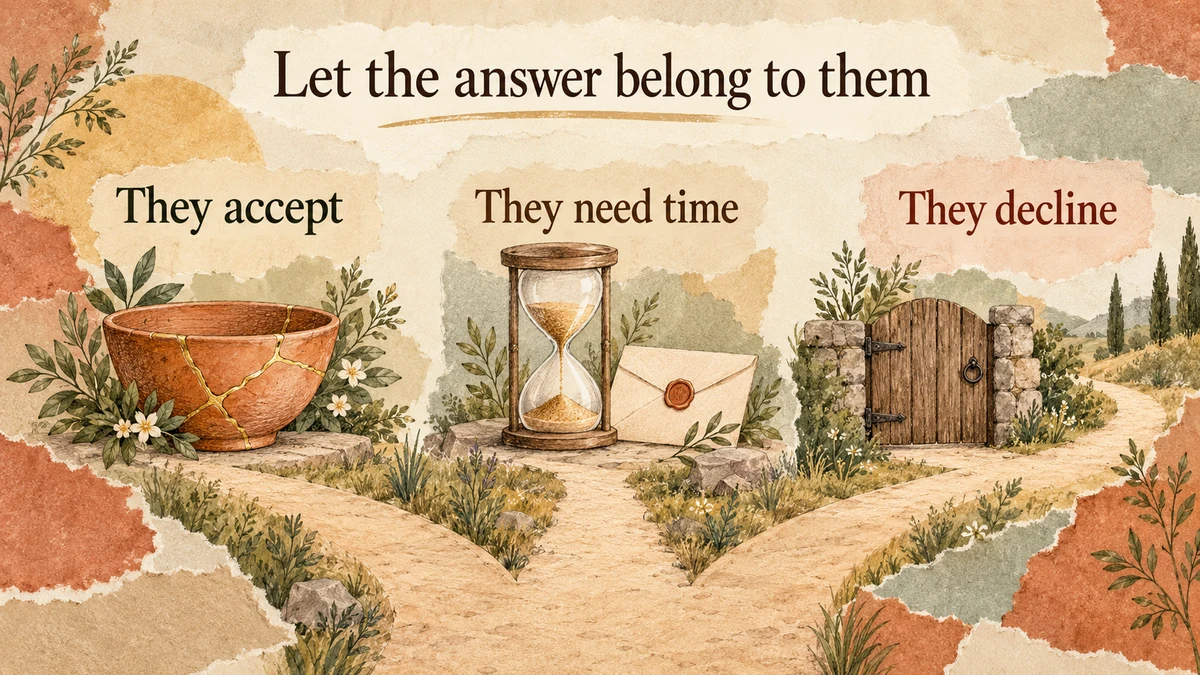
- They accept: thank them and carry out the repair. Do not treat acceptance as permission to repeat the behaviour.
- They need time: acknowledge that once, then allow the space they asked for.
- They disagree with your account: ask which part you have missed. Separate a factual disagreement from an argument over whether they are allowed to feel hurt.
- They decline further contact: stop pressing. You can change your conduct without gaining access to them again.
If the same incident keeps recurring, another polished message is not the missing ingredient. Change the arrangement that lets it happen: decline plans you cannot keep, stop discussing private information, or leave the topic alone. Our guide to friendship reciprocity can help you discuss participation without keeping a score, while Gottman’s Four Horsemen in friendship separates a useful communication lens from a verdict about a relationship.
Send the apology, then live the correction
Before sending, remove any sentence that asks your friend to take care of your guilt. Keep the action, the apology and the repair. Read it once from their side: would they know what you understand, what you will do differently and whether they are free to choose their response?
When the main issue is an ordinary lapse in contact rather than a specific hurt, reconnecting with an old friend may be a better starting point than a large apology.
PalmMingle explores symbolism and self-reflection through AI-assisted palm readings. It cannot tell you whether someone will forgive you. That answer belongs to your friend; the conduct you change belongs to you.
Palmistry is an interpretive tradition, not a diagnostic tool. PalmMingle frames palm readings as entertainment and self-reflection, not prediction.