


Friendship reciprocity means that care and participation can move both ways; it does not require identical favours, matching message lengths or a perfectly even turn count. A useful question is whether both people have room to matter. If something feels one-sided, name the particular pattern and make a clear request before assuming you know the other person's motives.
The checklist here separates attention, initiative and practical help. These invented examples are conversation prompts, not a diagnostic scale.
Look at different forms of contribution
A person might rarely organise outings but reliably show up, remember important details and offer practical help. Another might send frequent messages but leave little space for your concerns. Those patterns deserve a more specific conversation than a global claim that one person gives and the other takes.
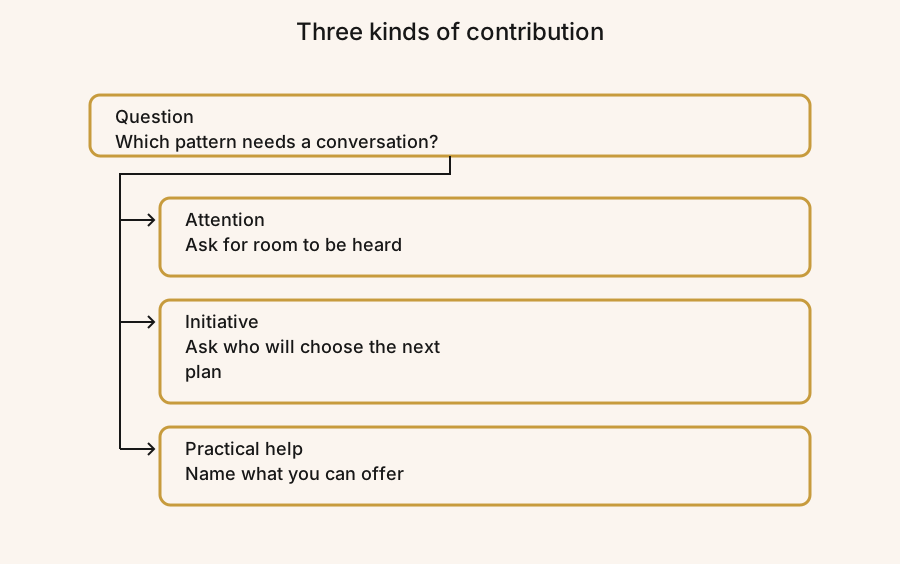
| Area | An observation you could name | A request you could make |
|---|---|---|
| Attention | We have mostly discussed your situation during our recent calls | Could I have room to talk about something difficult today? |
| Initiative | I have arranged our recent meetings | Would you choose the next plan if you want to meet? |
| Practical help | I agreed to a favour I cannot keep doing | I can help with this part, but I cannot take on the whole task |
Use a specific exchange to describe the pattern you want to discuss.

Want to see yours?
Scan your palm for a full interpretive reading.


Place your palms here
Both palms, please: your left on the left, your right on the right.

Tap to upload


Tap to upload
Required · 18 or older
Photo privacy · Refund terms ·Details
- Your photos are sent to our analysis provider to write your reading. This browser may temporarily keep pending photos for sign-in or recovery. Photos sent from your phone are kept temporarily for hand-off. See our privacy policy for details.
- When you press Read my palms, both photos go to our analysis provider for a clarity check before payment. This checks the photos, not the validity of a reading.
- Doesn't sound like you? Email us within 7 days of your first reading for a full refund, if you haven't used a second. If a photo can't be read, your credit is returned.
- Next: your reading uses one of your readings, or a short checkout if you have none.
Photo tips
 Photo tips
Keep your palm flat, fingers slightly apart and lines in focus. Use bright, even light, and photograph each palm the same way.
 ✓ Like this
 ✕ Too dark
 ✕ Fingers cut off
What research can and cannot tell you about mutuality
Research on disclosure and responsiveness gives a reason to examine the interaction, not just how much either person says. In diary studies, Laurenceau, Barrett and Pietromonaco examined disclosure, perceived responsiveness and experienced intimacy in everyday exchanges. Their findings linked these processes; they did not supply an equal-contribution formula for adult friendship. See the author-hosted research paper.
Feeling heard involves what happens after disclosure, while a message count records only one narrow form of activity. A short reply leaves plenty to ask about the exchange.
Separate a temporary imbalance from a standing expectation
Ask what has changed and what each person can presently offer. Illness, caregiving, money, travel or work might be relevant context, but do not invent an explanation on the other person's behalf. You can acknowledge a possible constraint while still being honest about your own capacity.
In a fictional example, Jo has done the travelling for several visits and is exhausted by the cost. The immediate issue is the travel arrangement. Jo does not need to decide that their friend is uncaring before asking whether they could meet halfway or switch to a call.
For the separate question of why contact changes, read our friendship-drift guide. When the issue is how a conversation leaves you feeling, our mood-and-boundaries article avoids diagnosing the other person from your fatigue.
If the request becomes an argument, our friendship conflict comparison offers ways to phrase a repair while explaining why couples research cannot predict a friendship's outcome.
Make one request the other person can answer
Choose the behaviour you want to change, explain its effect and make a manageable request. Leave space for a different proposal or an honest no.
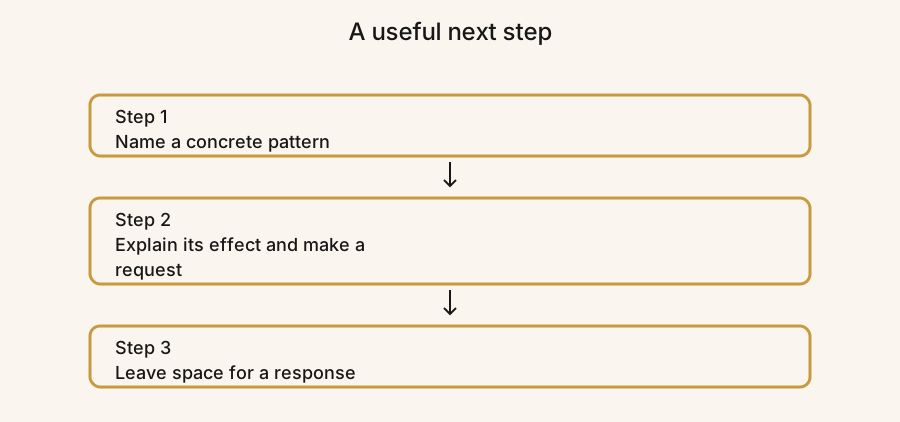
An original example: I value our calls, but I have been leaving without discussing what is happening for me. Could we make room for that today? It asks for a change without demanding a confession about motives.
If the response is dismissive, consider the actual response rather than endlessly improving your wording. If the person proposes a workable alternative, you can try it and see what happens. A willingness to discuss the pattern is different from a promise that everything will become perfectly balanced.
You can set a limit without completing a verdict
You are allowed to decline a favour, reduce the effort you can offer or step back from a painful pattern. You do not need a numerical proof that the contributions are unequal. You can also value a friendship while choosing a form of contact that is sustainable for you.
PalmMingle's palm-reading format can offer a symbolic conversation prompt if that is enjoyable to both people. It cannot measure reciprocity, reveal hidden motives or certify a match. Keep the relationship discussion grounded in consent, actual exchanges and what each person says they can do.
Palmistry is an interpretive tradition, not a diagnostic tool. PalmMingle frames palm readings as entertainment and self-reflection, not prediction.