


There is no fixed answer to how long it will take to make a friend. The University of Kansas report on Jeffrey Hall's research gives estimates of roughly 40–60 hours for casual friendship, 80–100 hours for friendship, and more than 200 hours for close friendship. These are estimates, not deadlines or a rule that someone owes you closeness after enough time.
The practical lesson is to make room for repeated, mutually wanted time. Counting hours is much less useful than noticing whether both people want another meeting.
What the study measured
Hall examined time together, shared activities and reported friendship closeness in two studies. One involved adults who had recently moved; another followed first-year university students getting to know new acquaintances. The research concerns associations and changes in reported closeness, not an experiment assigning everyone a guaranteed friendship after a set exposure.
The paper's publisher record describes the design and findings and dates its online publication to 2018 and journal issue to 2019. The familiar headline numbers are best treated as a broad summary of those samples, not a universal schedule for all ages, cultures or circumstances.
The report also distinguishes leisure time from time spent working together. Being in the same office does not automatically describe the same experience as choosing to spend time together outside required tasks.

Want to see yours?
Scan your palm for a full interpretive reading.


Place your palms here
Both palms, please: your left on the left, your right on the right.

Tap to upload


Tap to upload
Required · 18 or older
Photo privacy · Refund terms ·Details
- Your photos are sent to our analysis provider to write your reading. This browser may temporarily keep pending photos for sign-in or recovery. Photos sent from your phone are kept temporarily for hand-off. See our privacy policy for details.
- When you press Read my palms, both photos go to our analysis provider for a clarity check before payment. This checks the photos, not the validity of a reading.
- Doesn't sound like you? Email us within 7 days of your first reading for a full refund, if you haven't used a second. If a photo can't be read, your credit is returned.
- Next: your reading uses one of your readings, or a short checkout if you have none.
Photo tips
 Photo tips
Keep your palm flat, fingers slightly apart and lines in focus. Use bright, even light, and photograph each palm the same way.
 ✓ Like this
 ✕ Too dark
 ✕ Fingers cut off
The estimates are cumulative, not an extra charge at each stage
Read the report as approximate total time associated with stages of closeness, rather than consecutive blocks to add together. Nor should a broad label such as friend be treated as a precisely measured biological state. The original investigation asked people about their relationships and time together.
| Label in the report | What to notice | What it cannot promise |
|---|---|---|
| Casual friend | Early familiarity through shared time | That everyone feels the same after that interval |
| Friend | More repeated, chosen time together | A required upgrade in the relationship |
| Close friend | The report’s longest time estimate | A deadline, permanent bond or exclusive status |
The report’s labels describe reported closeness; individual relationships can differ.
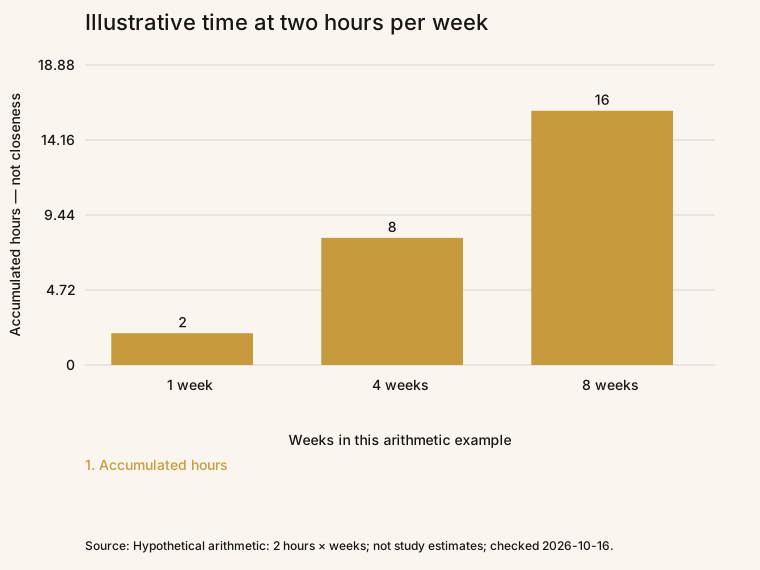
Hypothetical arithmetic at two hours a week, not a prediction from the study. The chart shows why occasional meetings accumulate gradually; it does not score a friendship.
Plan the next invitation, not the eventual label
Choose an activity you both seem to enjoy and offer a concrete, easy-to-decline plan. A short walk, a shared hobby session or a call can be enough for a next step. Ask what is convenient rather than trying to intensify contact until a published estimate is reached.
For example: I enjoyed our conversation at the class; would you like to walk to the cafe afterwards next week? They may prefer another activity or decline.
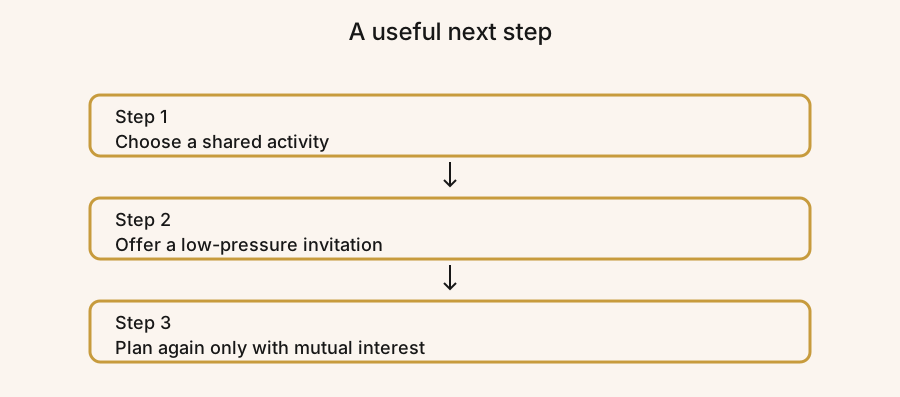
If invitations are repeatedly one-sided, the answer is not necessarily to contribute more hours. There may be a mismatch in interest, schedule or desired closeness. Our guide to friendships drifting apart considers changing contact without automatically assuming rejection.
Slow progress is not a verdict about your likability
You cannot infer another person's feelings from a calendar alone. A warm but infrequent friendship and an intense early acquaintance can have very different rhythms. Ask about plans and notice their responses, while leaving room for uncertainty about motives.
Research on the liking gap found that people in the studied conversations underestimated how much their partners liked them. That does not mean everyone secretly wants a closer friendship with you. It does suggest that your anxious guess after a conversation need not be treated as direct access to the other person's opinion.
If patterns of closeness are the question, our attachment-styles article keeps those ideas provisional rather than assigning fixed identities to friends.
For the separate question of making space for connection over a lifetime, read our careful account of the Harvard adult-development study. That research is not a timetable for a new friendship either.
Where a symbolic prompt fits
An optional shared symbol can start a conversation; it cannot accelerate a relationship to a guaranteed stage. PalmMingle's AI palm reading is entertainment and reflection, not a friendship-hour calculator or a validated compatibility test. You do not need it to invite someone for a walk.
Keep the useful part of the research: time together matters enough to make room for. Leave the timetable open, and let both people decide what the relationship becomes.
Palmistry is an interpretive tradition, not a diagnostic tool. PalmMingle frames palm readings as entertainment and self-reflection, not prediction.