


Good deep questions to ask friends invite a specific answer while leaving the other person free to pass. Try asking what has changed their mind recently, what kind of support they actually welcome, or which ordinary moment they would like more of. Start with the level of openness you both want, rather than using a question list to demand vulnerability.
These are original prompts, not a validated questionnaire or a reproduction of a research protocol. Choose one that fits the moment; you do not need to work through the list.
Choose a question by comfort, not intensity
For a newer friendship, begin with experiences and preferences. With an established friend, ask whether they want a more reflective conversation before moving to needs or a disagreement. A deeper topic is not automatically a better topic, especially in a group or a setting where the answer would be public.
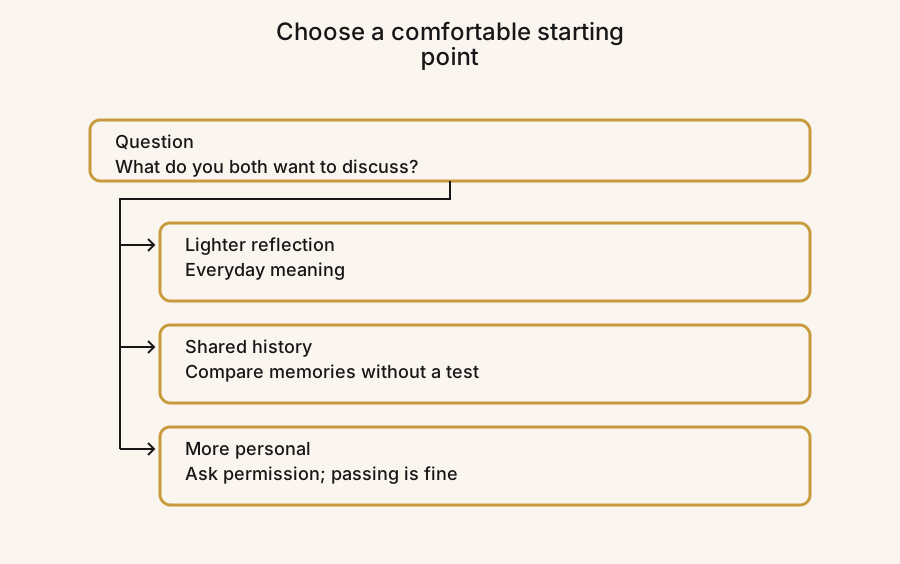
Two quick choices: for a relaxed catch-up, try the everyday-meaning questions; for a friend who has asked for support, try the care questions. Neither route requires discussing trauma, secrets or another person's private story.
Want to see yours?
Scan your palm for a full interpretive reading.


Place your palms here
Both palms, please: your left on the left, your right on the right.

Tap to upload


Tap to upload
Required · 18 or older
Photo privacy · Refund terms ·Details
- Your photos are sent to our analysis provider to write your reading. This browser may temporarily keep pending photos for sign-in or recovery. Photos sent from your phone are kept temporarily for hand-off. See our privacy policy for details.
- When you press Read my palms, both photos go to our analysis provider for a clarity check before payment. This checks the photos, not the validity of a reading.
- Doesn't sound like you? Email us within 7 days of your first reading for a full refund, if you haven't used a second. If a photo can't be read, your credit is returned.
- Next: your reading uses one of your readings, or a short checkout if you have none.
Photo tips
 Photo tips
Keep your palm flat, fingers slightly apart and lines in focus. Use bright, even light, and photograph each palm the same way.
 ✓ Like this
 ✕ Too dark
 ✕ Fingers cut off
Everyday meaning: a place to begin
These prompts invite a concrete example without presuming distress or hidden conflict. Ask the one you are also willing to answer. If your friend picks a small answer, stay with it rather than treating it as an obstacle to something more revealing.
- Which ordinary part of your week would you miss most if it disappeared?
- What have you become more curious about lately?
- Which small decision recently felt unusually right for you?
- What are you learning to enjoy without needing to be good at it?
- What have you changed your mind about in the past year?
- Which place helps you feel like yourself, and what is it about that place?
A natural follow-up is what made that stand out? It follows the answer already offered, rather than switching immediately to the next card.
Shared memories without a friendship test
Use shared history as an invitation to compare perspectives, not a quiz about whether the other person remembers enough. Different memories can coexist. Let your friend say they do not remember the event, or choose another moment that matters to them.
- Which small moment from our time together do you remember more clearly than you expected?
- When have we made an ordinary day more enjoyable for each other?
- What did you assume about me before we properly knew each other?
- Which activity would you like us to try again, perhaps differently this time?
- What part of our friendship has changed in a way you appreciate?
- Is there a story we tell about ourselves that you would tell another way now?
If question nine produces an awkward answer, curiosity is optional. You can say you want a moment before discussing it. The list does not require turning every answer into an immediate lesson.
Care and capacity: ask what helps
These questions concern present preferences, not a promise to provide unlimited support. Ask when there is time to listen, and be honest about your own limits. A person can welcome friendship while declining a particular conversation.
- When something is difficult, what kind of response do you usually want first?
- What is a small way friends can make your week easier without creating another obligation?
- How would you like someone to check in when you have gone quiet?
- What do you wish people asked before offering advice?
- Which boundary have you become clearer about recently?
- What is one thing you would enjoy asking for more directly?
If the answers expose an uneven pattern, our guide to feeling drained in conversation offers a separate discussion of mood and boundaries. A question card cannot diagnose why someone is struggling.
A little more personal, if both people want that
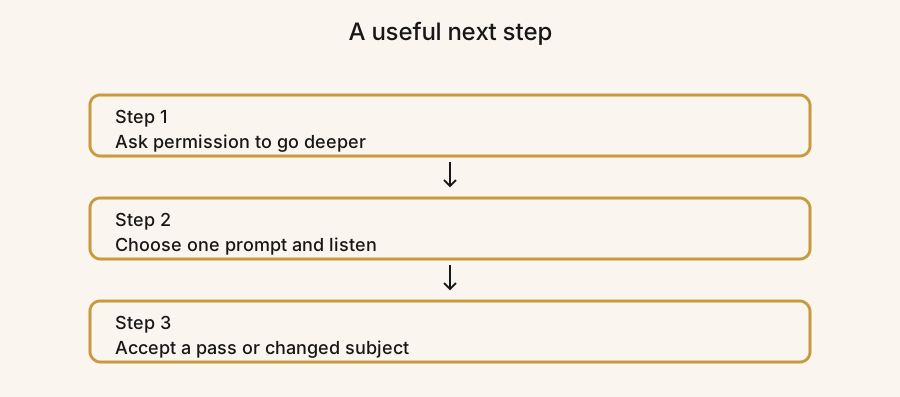
These prompts invite reflection on values and change. Ask permission to go there and accept a pass without requesting an explanation. Being a trusted friend does not create an entitlement to every detail.
- Which expectation have you decided you do not want to organise your life around?
- What part of your current life would surprise an earlier version of you?
- When have you felt understood without having to explain yourself perfectly?
- What would you like more room to be uncertain about?
- Which kind of change feels worth the discomfort at the moment?
- What question would you rather be asked than the one people usually ask you?
What the closeness research supports
In Aron and colleagues' experimental work, one study found greater immediate closeness after gradually escalating disclosure and relationship-building tasks than after comparable small-talk tasks. That finding does not establish that any particular list produces lasting friendship, romantic love or a benefit for every participant. See the original publisher abstract and notes.
These prompts are not that experiment. Treat them as options for a conversation you both choose. The attachment-styles guide likewise keeps psychological ideas separate from fixed labels assigned to a friend.
For making time to listen beyond a single conversation, our Harvard study article considers connection over the longer term without promising a result from a question list.
If you both enjoy symbolism, PalmMingle's interpretive palm reading is another optional conversation starting point. It is entertainment and reflection, not a closeness method or compatibility test. A thoughtful follow-up to your friend's actual answer is available without any tool.
Palmistry is an interpretive tradition, not a diagnostic tool. PalmMingle frames palm readings as entertainment and self-reflection, not prediction.