


Attachment ideas can help frame questions about closeness, reassurance and dependence in friendship. They cannot tell you exactly why a friendship ended or predict that it will fail.

A slow reply is not an attachment diagnosis. Needing space is not proof that someone cannot care. Start with the situation and what each person says, rather than assigning a type.
When both people want a fuller conversation, choose questions that leave room to pass.
Try a reply-gap checklist before assigning a style
An unanswered message gives you an event to describe, not enough evidence to classify a friend. Use this small checklist to prepare a question about the particular relationship. It is an original communication prompt, not an attachment questionnaire or a diagnostic exercise.
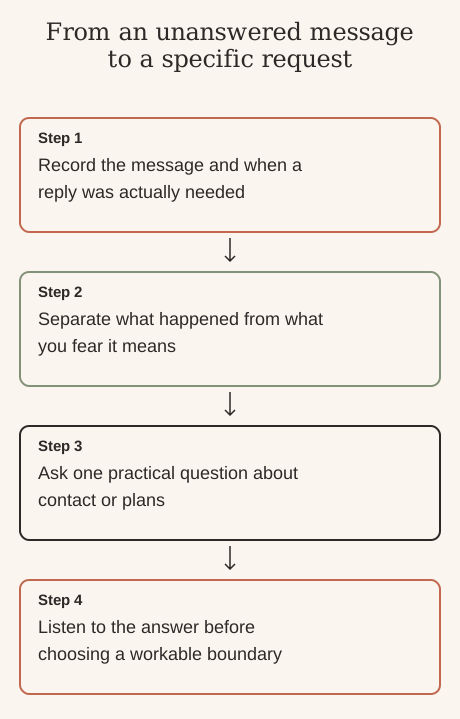
Separate an unanswered message from your interpretation before asking what happened.
- Record the message and when a reply was actually needed.
- Separate what happened from what you fear it means.
- Ask one practical question about contact or plans.
- Listen to the answer before choosing a workable boundary.
Suppose you sent a casual photo on Tuesday and a time-sensitive invitation on Thursday. Treating both silences as the same rejection hides a useful distinction: only the invitation needed an answer by a deadline. You might say, “For weekend plans, could we confirm by Friday? Casual messages can wait.” The other person can explain a different preference. A proposed arrangement gives you something concrete to discuss without making either person defend a psychological label.
For a closer look, think through reduced contact; consider conversation capacity; describe a specific conflict.

Want to see yours?
Scan your palm for a full interpretive reading.


Place your palms here
Both palms, please: your left on the left, your right on the right.
Tap to upload

Tap to upload
Required · 18 or older
Photo privacy · Refund terms ·Details
- Your photos are sent to our analysis provider to write your reading. This browser may temporarily keep pending photos for sign-in or recovery. Photos sent from your phone are kept temporarily for hand-off. See our privacy policy for details.
- When you press Read my palms, both photos go to our analysis provider for a clarity check before payment. This checks the photos, not the validity of a reading.
- Doesn't sound like you? Email us within 7 days of your first reading for a full refund, if you haven't used a second. If a photo can't be read, your credit is returned.
- Next: your reading uses one of your readings, or a short checkout if you have none.
Photo tips
 Photo tips
Keep your palm flat, fingers slightly apart and lines in focus. Use bright, even light, and photograph each palm the same way.
 ✓ Like this
 ✕ Too dark
 ✕ Fingers cut off
What relationship-specific research measures
R. Chris Fraley's documentation for the ECR-RS questionnaire describes a self-report measure used across close relationships, including a best friend. It distinguishes attachment-related anxiety and avoidance for each relationship.
In that framework, anxiety concerns worries about care and abandonment; avoidance concerns discomfort with dependence or emotional openness. These are research dimensions, not moral grades or a diagnosis made from another person's messages.
The relationship-specific approach also matters: your experience with one person need not describe every connection in your life. We are summarising the measure's scope here, not administering it or interpreting your score.
Describe the moment before naming a pattern
Consider a hypothetical situation: a friend has not replied to an invitation. One person might feel rejected; another might assume the friend is busy. Neither interpretation establishes the reason for the silence.
Try separating three things:
- Observation: "I sent an invitation on Monday and have not had a reply."
- Interpretation: "I am worried they no longer want to see me."
- Request: "Could you let me know whether this weekend works?"
That distinction leaves room for information you do not yet have. It also makes your concern easier to discuss without declaring that your friend has a psychological defect.
When reassurance and space need negotiation
Different preferences for contact can create friction without making either person the villain. Talk about what is workable.
You might say, "I enjoy hearing from you, but I cannot message during work. Would an evening catch-up suit us?" Or, "When plans change, a short message helps me know where I stand."
These are suggested communication examples, not guaranteed ways to regulate someone else's feelings. Do not promise a reply time you cannot keep, and do not treat availability as a test of love.
A boundary can be legitimate even when someone feels disappointed. Equally, a label does not excuse threats, surveillance or repeated disregard for another person's limits.
Do not turn the theory into blame
Being mistreated is not proof that you selected suffering or failed to become "secure". Another person's harmful behaviour remains their responsibility.
If you notice a repeated difficulty in your own actions, describe that action specifically. "I keep sending follow-up messages when I feel unsure" is something you can reflect on. "I ruin every friendship because of my type" is a much larger claim.
If distress or unsafe behaviour is affecting you, support from a qualified professional or a trusted person may be more useful than another online label.
Where palmistry does not fit
A heart line or hand shape cannot identify attachment style. PalmMingle's interpretive palm reading is entertainment, not this kind of psychological assessment and not a way to select compatible friends.
Our heart-line guide makes that distinction explicit. If the issue is reduced contact rather than conflict, see why friends drift apart.
Common questions
Can I tell whether my friend is avoidant?
You cannot establish that from one behaviour or this article. Ask about the particular situation rather than announcing a label.
Does needing reassurance make me a bad friend?
No. What matters in the conversation is how needs are expressed and whether both people's boundaries are respected.
Can these ideas guarantee a repair?
No. Repair depends on the people, circumstances and willingness involved. You cannot do another person's part for them.
Use the vocabulary to make a conversation more specific, not to make a person smaller.
Palmistry is an interpretive tradition, not a diagnostic tool. PalmMingle frames palm readings as entertainment and self-reflection, not prediction.