


To reconnect with an old friend, send a short message that says why you thought of them and offers an easy, optional next step. If you owe an apology, acknowledge the hurt instead of treating it as ordinary lost contact. If they asked you not to contact them, respect that boundary.
You do not need a perfect opening, and you cannot write a message that guarantees a welcome. The examples here are original drafts you can adapt, not scripts tested to produce a particular response.
Choose the right route before choosing the words
Ordinary distance, a missed exchange and an unresolved injury are different starting points. A warm memory can open a simple catch-up; it should not be used to bypass an apology. An explicit no-contact request is different again and does not become permission because time has passed.
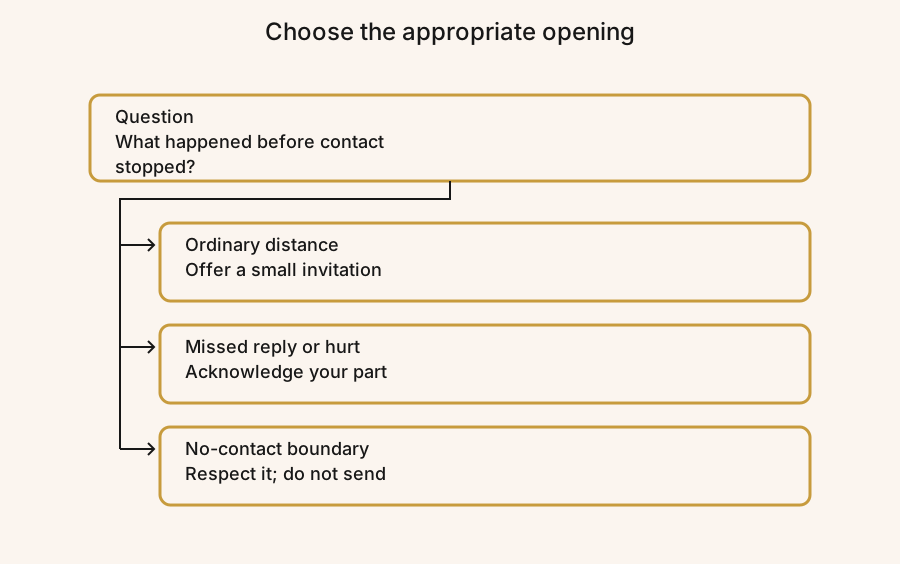
If your main question is why contact faded, our friendship-drift article addresses that broader issue. This page focuses on the narrower job of making an appropriate invitation and handling the response.
Want to see yours?
Scan your palm for a full interpretive reading.


Place your palms here
Both palms, please: your left on the left, your right on the right.

Tap to upload


Tap to upload
Required · 18 or older
Photo privacy · Refund terms ·Details
- Your photos are sent to our analysis provider to write your reading. This browser may temporarily keep pending photos for sign-in or recovery. Photos sent from your phone are kept temporarily for hand-off. See our privacy policy for details.
- When you press Read my palms, both photos go to our analysis provider for a clarity check before payment. This checks the photos, not the validity of a reading.
- Doesn't sound like you? Email us within 7 days of your first reading for a full refund, if you haven't used a second. If a photo can't be read, your credit is returned.
- Next: your reading uses one of your readings, or a short checkout if you have none.
Photo tips
 Photo tips
Keep your palm flat, fingers slightly apart and lines in focus. Use bright, even light, and photograph each palm the same way.
 ✓ Like this
 ✕ Too dark
 ✕ Fingers cut off
Four message examples for different situations
Use an honest detail and remove wording that does not sound like you. Keep the message small enough that the other person can answer without summarising their entire life or immediately agreeing to a meeting. Leave them free to decline your proposed plan.
After ordinary lost contact: I walked past the cafe where we used to meet and thought of you. I would enjoy hearing how things are going. Would you be up for a short call sometime?
When you left a message unanswered: I realised I never answered your last note. I am sorry I left it hanging. I would like to catch up if you are open to that, and I understand if now is not a good time.
When a specific memory prompted you: I tried making the meal you showed me and remembered our chaotic first attempt. It made me smile. How have you been? No need for a big update if you are busy.
When you owe an apology: I have been thinking about how I dismissed what you told me. That was hurtful, and I am sorry. I am not asking you to reassure me. If you ever want to talk, I would be willing to listen; I will respect it if you do not.
The last example opens a possibility rather than assuming forgiveness. Do not add a demand for an explanation, a deadline or a claim that a real friend would answer.
Why a small message can still feel difficult
Research by Aknin and Sandstrom found reluctance to contact old friends even in study situations where participants wanted to reconnect and had the means to do so. The work also examined how an old friend can feel like a stranger. That helps frame the hesitation; it does not establish that your particular friend wants renewed contact. See the original research article.
You can feel awkward and still offer a respectful invitation. You can also decide that an old relationship is better left where it is. The research is not an instruction to override your judgment about safety, consent or a history of harm.
Let the reply determine the next step
Respond to the message you receive rather than a story about what it secretly means. A warm reply can lead to a concrete plan. A vague reply may remain uncertain. Silence supplies no explanation of motive, but it also supplies no agreement to keep contacting someone.
| Response | A possible next step | Avoid |
|---|---|---|
| Warm interest | Offer a manageable time or ask what suits them | Sending an overwhelming life update immediately |
| Friendly but vague | Leave room or offer one simple option | Treating politeness as a firm commitment |
| Clear decline | Acknowledge it and stop pursuing contact | Negotiating their boundary |
| No response | Leave the invitation without escalation | Repeated messages or another route to force attention |
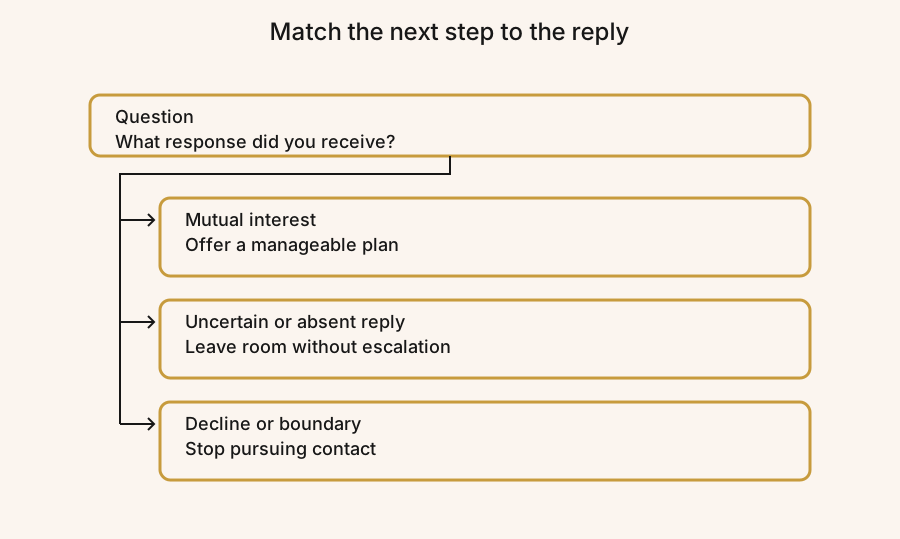
If the friend has repeatedly declined or asked for space, the answer is to respect that. A shared past does not create a present obligation to resume the relationship.
If you find yourself explaining a silent reply with a fixed psychological label, our attachment-styles article explains why those ideas need care. An interpretation does not give you access to another person's motives.
Reconnect with the person they are now
An old friendship does not have to restart at its previous intensity. Ask what life looks like now and let new routines emerge if both people want them. You may find familiar warmth, a more occasional connection or a polite ending. None requires declaring the whole past a mistake.
If the conversation reaches an old disagreement, the friendship conflict comparison offers repair phrases while keeping the limits of couples research clear. It is not a prediction of whether this friendship will recover.
PalmMingle's palm reading can be a playful reflection prompt when both people enjoy that format. It cannot reveal whether an old friend misses you or decide whether to send a message. Their actual consent and response matter more than a symbolic interpretation.
Palmistry is an interpretive tradition, not a diagnostic tool. PalmMingle frames palm readings as entertainment and self-reflection, not prediction.