


The Harvard Study of Adult Development is a long-running study of adult lives and relationships. The Harvard report cited below links satisfying relationships with later-life health and wellbeing, while describing other factors too. That is an association, not a promise that any one social action will lengthen your life.

The study does not prove that friendship guarantees a longer life, that money is irrelevant, or that a palm reading can tell you how connected you are.
Turn the research theme into one realistic invitation
A practical response to the Harvard relationship research can be a small invitation, without a new rule that every hour needs to be social. Start with a connection you value and an action you can reasonably offer. This is our planning suggestion, not a tested prescription from the study.
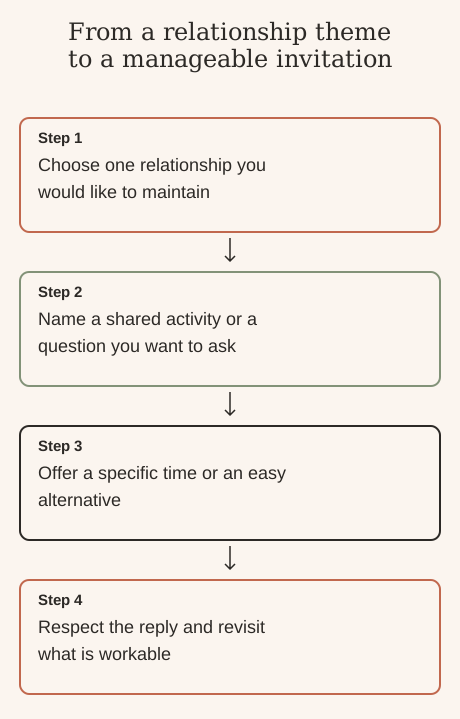
Choose a relationship and shared activity, offer an invitation, then leave room for the reply.
- Choose one relationship you would like to maintain.
- Name a shared activity or a question you want to ask.
- Offer a specific time or an easy alternative.
- Respect the reply and revisit what is workable.
For example: “I miss our chats. Would a short call on Sunday suit you, or is next week easier?” That gives the other person something answerable without treating their availability as a health score. If you have little capacity, a brief message may be more realistic than a standing weekly plan. If the relationship is unsafe, this is not a reason to renew contact. The research theme can prompt attention to connection while leaving room for other needs and circumstances.
For a closer look, consider why contact becomes less frequent; negotiate closeness and space; make room for boundaries as well as contact.

Want to see yours?
Scan your palm for a full interpretive reading.

Place your palms here
Both palms, please: your left on the left, your right on the right.
Tap to upload

Tap to upload
Required · 18 or older
Photo privacy · Refund terms ·Details
- Your photos are sent to our analysis provider to write your reading. This browser may temporarily keep pending photos for sign-in or recovery. Photos sent from your phone are kept temporarily for hand-off. See our privacy policy for details.
- When you press Read my palms, both photos go to our analysis provider for a clarity check before payment. This checks the photos, not the validity of a reading.
- Doesn't sound like you? Email us within 7 days of your first reading for a full refund, if you haven't used a second. If a photo can't be read, your credit is returned.
- Next: your reading uses one of your readings, or a short checkout if you have none.
Photo tips
 Photo tips
Keep your palm flat, fingers slightly apart and lines in focus. Use bright, even light, and photograph each palm the same way.
 ✓ Like this
 ✕ Too dark
 ✕ Fingers cut off
What the Harvard report actually says
A 2017 Harvard Gazette account of the study describes research beginning with 268 Harvard sophomores in 1938, later encompassing a Boston cohort and family members. The original cohorts were men, an important limit on treating their experiences as a universal template.
The report links satisfying relationships with better later-life health and wellbeing. It also discusses physical activity, smoking, alcohol and other factors. Relationships were part of a larger picture, not a replacement for looking after your body.
This article uses that institutional report, not a fresh analysis of the underlying data. Long-term observation can identify associations and patterns; it cannot promise what will happen to one reader after sending one message.
Put a chair in the picture
Imagine a desk covered with a week's plans. Every square is useful: work, shopping, exercise, rest. A friend asks to visit, and there is nowhere to sit without moving something.
That is the metaphor here. You do not need to burn the planner. You might move a stack.
A possible experiment is to offer one small, specific opportunity for contact: a short walk, a call while cooking, or a quiet coffee. Choose something you can genuinely manage rather than a grand reunion you will dread organising.
This is our practical suggestion, not a research-tested dose of friendship. The other person may decline. That does not make the invitation a failure or tell you what they feel.
Quality is a question, not a headcount
Instead of asking whether you have enough friends, consider what happens in the relationships you already have.
- Can you say that something is difficult without performing cheerfulness?
- Is there room for both people's interests and limits?
- Can either person decline a plan without being punished?
- Is there a way back into conversation after an ordinary disagreement?
These questions are not a clinical assessment. They can help you decide what to discuss. A large social circle is not automatically shallow, and a small one is not automatically close.
If contact has become infrequent, our guide to why friends drift apart separates possible explanations from assumptions about someone else's motives.
Connection does not require unsafe closeness
An argument for relationships is not an instruction to remain in one that frightens, humiliates or controls you. Nor does it make you responsible for another adult's behaviour.
You can want company and still need boundaries. You can miss someone and decide not to resume contact. A suggestion to make room for connection should leave those choices intact.
Likewise, a routine can provide necessary support. Work, disability, care responsibilities and limited resources can constrain social time. Difficulty making plans is not evidence that someone values people less.
Where palmistry fits—and stops
PalmMingle's optional AI palm reading offers imaginative interpretation, not a measure of social health. A long heart line does not establish that you have close friendships; a short one does not establish that you lack them.
If you enjoy symbolic reflection, the heart-line guide can supply questions to discuss. Your answers and lived relationships matter more than the symbol.
Does this research mean I should abandon my routine?
No. Consider whether a manageable connection fits alongside the things that already support you.
Is a reading required before reaching out?
No. You do not have to understand or improve every part of yourself before you deserve company.
What is one reasonable next step?
Make an invitation you can comfortably offer, with an easy way to say no. Then listen to the answer. The point is to make room for a person, not to turn friendship into another performance target.
Palmistry is an interpretive tradition, not a diagnostic tool. PalmMingle frames palm readings as entertainment and self-reflection, not prediction.