


If some people seem to drain you, start with the conversation's context and the capacity you had for it. It is not proof that the other person stole your energy, manipulated you, or has a disorder.

Mood can be influenced by social interaction. But before deciding that a friend is an “emotional vampire,” it helps to separate what happened, how you felt, and what you need next.
Valuing connection and keeping a limit can coexist; the Harvard relationship-study discussion treats connection as part of a wider picture rather than a demand to stay constantly available.
Try a capacity check before the next hard conversation
Feeling depleted after a conversation is enough reason to consider your capacity; it is not enough to identify a hidden mechanism or diagnose the other person. Start with the time, topic and limits you can actually describe. The options here are communication suggestions, not treatment.
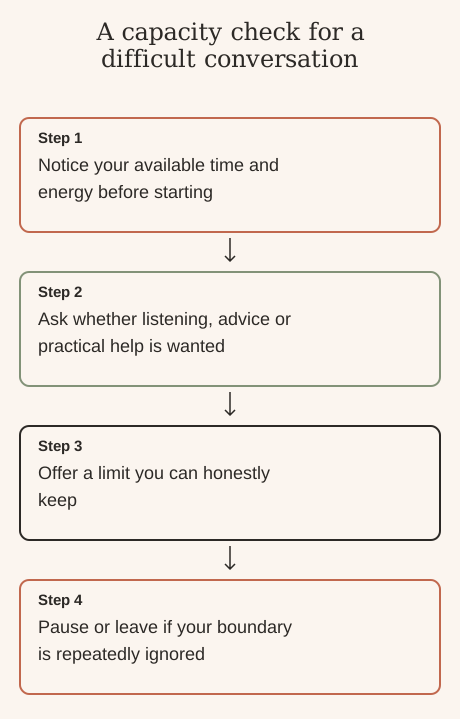
Name the difficult exchange, notice your response and choose a practical boundary.
- Notice your available time and energy before starting.
- Ask whether listening, advice or practical help is wanted.
- Offer a limit you can honestly keep.
- Pause or leave if your boundary is repeatedly ignored.
You might say, “I can listen for a little while, but I cannot help solve this tonight.” If you need support yourself, ask, “Do you have room for something difficult?” Those questions leave room for a real no. Afterward, note whether the length, timing or subject mattered, rather than deciding that someone is an energy vampire. If tiredness continues across settings, a friendship theory should not replace appropriate health advice. You can care about someone while choosing a shorter conversation.
For a closer look, discuss reassurance and space; distinguish less contact from a verdict; make a request about a specific event.

Want to see yours?
Scan your palm for a full interpretive reading.


Place your palms here
Both palms, please: your left on the left, your right on the right.

Tap to upload


Tap to upload
Required · 18 or older
Photo privacy · Refund terms ·Details
- Your photos are sent to our analysis provider to write your reading. This browser may temporarily keep pending photos for sign-in or recovery. Photos sent from your phone are kept temporarily for hand-off. See our privacy policy for details.
- When you press Read my palms, both photos go to our analysis provider for a clarity check before payment. This checks the photos, not the validity of a reading.
- Doesn't sound like you? Email us within 7 days of your first reading for a full refund, if you haven't used a second. If a photo can't be read, your credit is returned.
- Next: your reading uses one of your readings, or a short checkout if you have none.
Photo tips
 Photo tips
Keep your palm flat, fingers slightly apart and lines in focus. Use bright, even light, and photograph each palm the same way.
 ✓ Like this
 ✕ Too dark
 ✕ Fingers cut off
What emotional-contagion research can support
In Sigal Barsade's 2002 laboratory study, 94 business-school undergraduates took part in a simulated managerial group exercise. A trained participant working with the researcher displayed different moods. The study found evidence that these displays influenced other participants' moods.
That is evidence of social mood influence in the studied setting. It is not a diagnosis of your coffee companion, a measurement of an invisible energy transfer, or proof that every tiring encounter has the same cause. The study was not a long-term trial of friendship boundaries.
Describe the scene before naming the person
Imagine two friends in a café. One talks rapidly about a difficult week. The other has barely slept and has an appointment afterwards. By the end, the listener feels overloaded.
Several explanations could fit: the topic, the length of the conversation, the listener's existing tiredness, an uncomfortable dynamic, or some combination. You do not have to settle the cause before asking for a shorter conversation next time.
Try writing three plain sentences:
- “We talked about the same problem for most of lunch.”
- “I felt tense and struggled to concentrate afterwards.”
- “Next time I want to say how much time I have at the start.”
The first describes an event, the second your experience, and the third a possible action. None claims access to the other person's hidden motives.
Ask for capacity before the difficult part
Here are suggested phrases, not a treatment protocol or a guarantee that a conversation will improve.
If you need to talk: “Something difficult happened. Do you have space to hear about it today?”
If you can listen briefly: “I can stay for a little while, but I don't have much capacity tonight.”
If advice keeps missing the point: “Would you like ideas, or would you prefer that I just listen?”
If the subject keeps circling: “I care about this, but I don't think I can add anything useful right now. Can we pause?”
You can speak warmly and still mean the limit. You also do not need to perform a perfect explanation before leaving an interaction that feels unsafe.
Notice patterns without keeping a prosecution file
One hard afternoon is different from a repeated pattern. You might notice that there is rarely space for your news, that requests for a pause are ignored, or that you feel pressured to be constantly available.
Those are behaviours you can discuss or respond to. Calling someone parasitic adds certainty about their character that the observations do not establish.
For a related distinction, attachment language in friendship should not become a way to diagnose someone from a text. And less frequent contact does not automatically mean contempt.
Do not ask your palm to identify the cause
A head line cannot measure emotional workload. An intuition line cannot establish unusual sensitivity. Palmistry's symbols may be used imaginatively, but they are not psychological tests.
PalmMingle's AI palm reading is optional interpretive entertainment, not a way to identify dangerous friends or decide whose feelings are legitimate. An ordinary notebook is enough for the observation exercise above.
Can I care about someone and need a break?
Yes. Wanting a limit does not require deciding that the person is bad.
Should I mute someone for a fixed number of days?
There is no universal number in the research discussed here. Choose a boundary suited to your situation rather than treating a countdown as a clinical intervention.
What if the exhaustion keeps happening beyond these conversations?
Do not assume a friendship explains every symptom. If tiredness is persistent, worrying or affecting daily life, consider discussing it with an appropriate health professional.
The aim is not to sort people into those who charge you and those who drain you. It is to make the next interaction more honest about what each person can offer.
Palmistry is an interpretive tradition, not a diagnostic tool. PalmMingle frames palm readings as entertainment and self-reflection, not prediction.