

With friends who only talk about themselves, ask clearly for a turn and notice what happens next. If the pattern continues, name it outside the rushed moment and decide how much time you want to give the relationship. A one-sided conversation is a behavior you can address; it is not enough to diagnose someone's personality or motives.
Start with: “I want to hear how that went. I also have something I'd like to tell you before we finish.” If they move straight back to their story, be more direct: “I wasn't finished. Can you listen to my part for a moment?”
Describe the pattern you can actually observe
Use concrete examples rather than a global label. “When I started telling you about my move, the conversation returned to your trip” gives the other person something to understand. “You are a narcissist” turns a communication problem into a diagnosis you cannot establish from a chat.
Before raising it, ask what you want to change. Do you want uninterrupted time to share news, some questions about your life, or less time spent on a recurring topic? A specific request is easier to respond to than “be more interested in me,” even when the broader feeling is understandable.
Keep one conversation separate from the whole relationship. A friend dealing with an immediate crisis may have little room for ordinary back-and-forth. That does not require you to ignore a pattern that has continued for months; it asks you to describe it accurately.
Want to see yours?
Scan your palm for a full interpretive reading.


Place your palms here
Both palms, please: your left on the left, your right on the right.
Add a photo

Add a photo
Required · 18 or older
Photo privacy · Refund terms ·Details
- Your photos are sent to our analysis provider to write your reading. This browser may temporarily keep pending photos for sign-in or recovery. Photos sent from your phone are kept temporarily for hand-off. See our privacy policy for details.
- When you press Read my palms, both photos go to our analysis provider for a clarity check before payment. This checks the photos, not the validity of a reading.
- Doesn't sound like you? Email us within 7 days of your first reading for a full refund, if you haven't used a second. If a photo can't be read, that reading is returned.
- Next: your reading uses one of your readings, or a short checkout if you have none.
Photo tips
 Photo tips
Keep your palm flat, fingers slightly apart and lines in focus. Use bright, even light, and photograph each palm the same way.
 ✓ Like this
 ✕ Too dark
 ✕ Fingers cut off
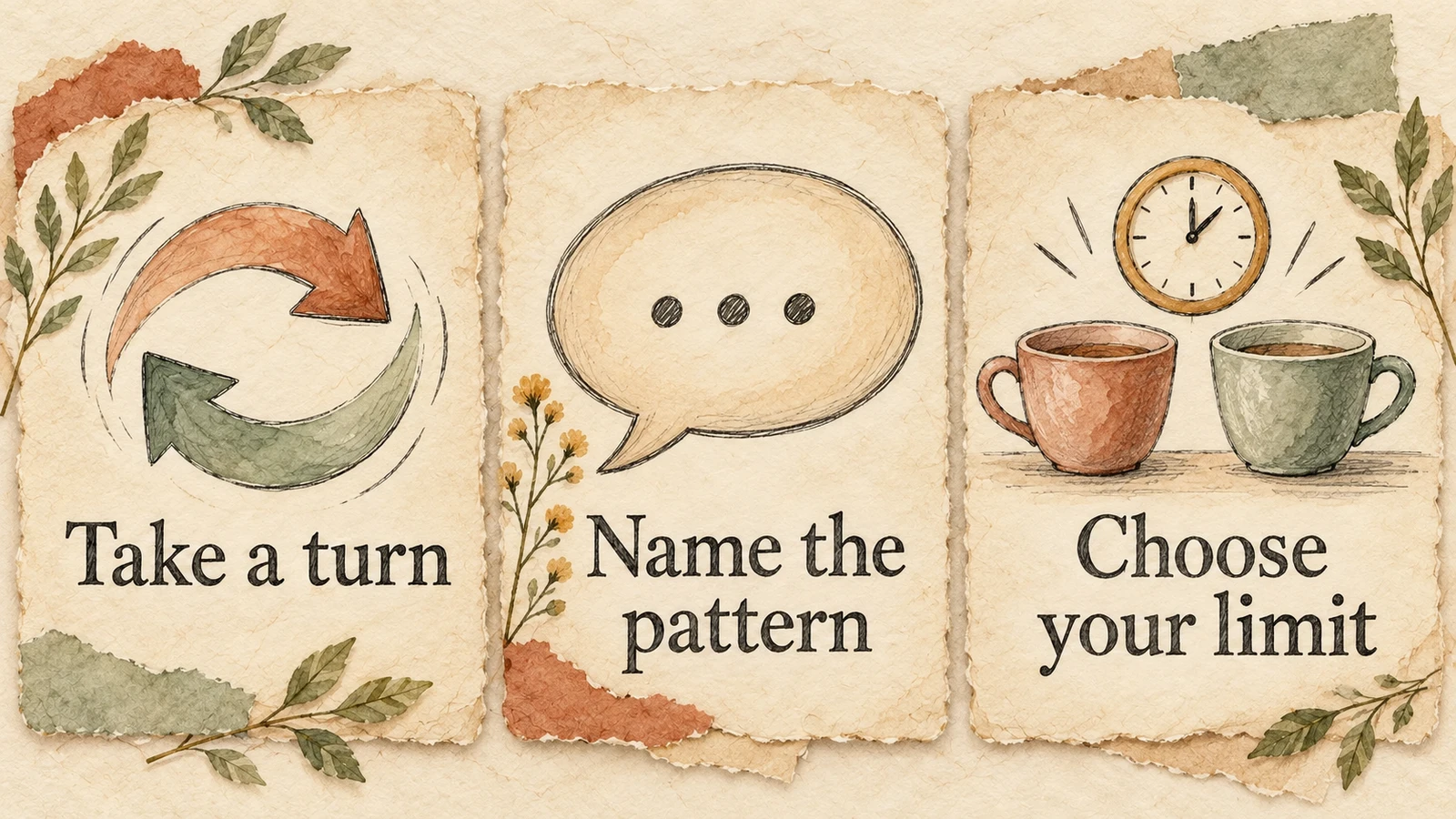
Take a turn before testing them in silence
Say that you want to speak instead of dropping hints and waiting to see whether they guess. You are allowed to contribute without being asked the perfect question. If you usually respond with more follow-ups, try finishing one topic and introducing your own clearly.
A light entry: “That reminds me of something I wanted to tell you about my week.”
A clear request: “Before we move on, can I tell you what happened with my interview?”
After an interruption: “Hold on; I want to finish that thought.”
When time is almost up: “We have spent most of the call on your situation. I need a few minutes to talk about mine too.”
You do not have to make the request amusing or apologetic. Keep your tone as natural as you can, then see whether the other person gives you room.
Name a recurring problem outside the moment
If the issue continues, discuss the pattern rather than fighting for every sentence. Choose a time when you are not already competing with an urgent story. Explain what has been happening, its effect on you and the change you want. Leave room for their account without withdrawing your own.
For example:
I enjoy hearing about your life, but lately I leave our calls feeling that mine hasn't come into the conversation. When I start a story, we often switch back before I finish. I'd like us both to have room to talk. Have you noticed that too?
They may be surprised, embarrassed, defensive or genuinely unaware. Their first expression does not tell you everything. What matters for the continuing relationship is whether the conversation and later behavior make more space for you.
For a broader hurt, use telling a friend they hurt you. Keep this request focused on turn-taking rather than adding every unresolved grievance at once.
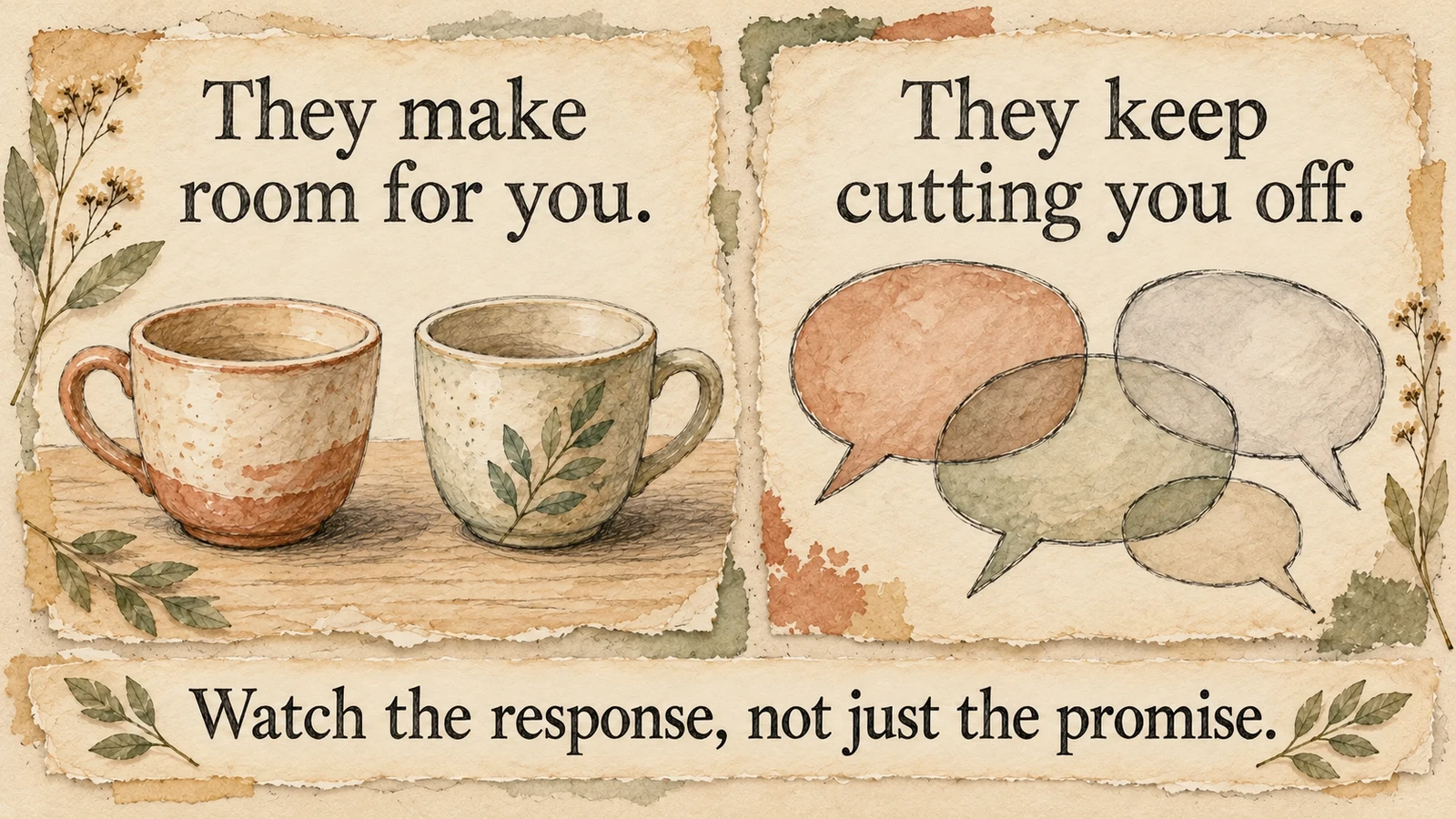
Judge the response, not just the promise
Watch what changes when you ask directly. A friend who pauses, asks you to continue and remembers what you said is responding differently from someone who agrees in principle and immediately cuts you off again. You do not need a numerical conversation score to notice the distinction.
| Response you observe | A proportionate next step |
|---|---|
| They apologize and return the floor | Continue your story; let the repair happen |
| They ask what would help | Give one concrete request, such as letting you finish |
| They say they relate and begin their own story | Clarify that you want to finish yours first |
| They mock the request or repeatedly ignore it | Set a limit on the conversation or your availability |
| They explain an unusual current crisis | Decide what support you can offer while keeping your needs visible |
You are assessing the interaction, not administering a test they did not agree to take. Give clear information about what you need before treating a missed hint as proof they do not care.
Leave room for a different conversation style
Some people offer a related story because they mean to connect. You can acknowledge the intention while explaining that the effect is different for you. “I know you are showing me you understand. Could you let me finish before telling your example?” keeps both things in view.
Likewise, a quiet listener may not show interest in the exact way you expect. Ask for what would help rather than assuming the absence of one signal means indifference. The Mental Health Foundation's support guidance emphasizes checking understanding instead of second-guessing feelings; it does not justify diagnosing someone from their conversational habits.
Do not excuse behavior solely by guessing at a condition, either. You can adapt a conversation with someone's input and still need space for your own voice.
Set a limit you control
If the pattern does not change, choose what you will do rather than repeating the same request indefinitely. You might shorten calls, avoid a topic you cannot keep discussing, meet around an activity or reduce the closeness of the friendship. Say the limit plainly when it affects an existing expectation.
For example: “I can talk for a little while, but I can't do another long call about this tonight.” Or: “I'm going to finish my story now. If we can't make room for that, let's stop the call and try another day.”
A limit is not a punishment designed to make them chase you. It is an action you can carry out. For more examples, see how to set boundaries with friends.
Look at care beyond the chat
Conversation is one part of friendship. Consider whether the person also shows up, follows through, respects private information and responds when you say something matters. Practical kindness does not erase feeling unheard, but neither does one awkward chat describe everything about a relationship.
The friendship reciprocity guide looks at mutual care more broadly. If you decide the relationship no longer works for you, use clear words for ending a friendship. You do not have to prove someone is a bad person to change the amount of contact you want.
PalmMingle's AI palmistry explanation treats reading as interpretation and self-reflection. A palm cannot establish whether your friend is self-centered. Their response to an honest request is more useful information for this decision.
Palmistry is an interpretive tradition, not a diagnostic tool. PalmMingle frames palm readings as entertainment and self-reflection, not prediction.