

To set boundaries with friends, state what you can or cannot do, make any request clear, and explain what you will do if the situation continues. Keep the limit specific: I won’t answer messages while I’m working is easier to understand than You need to respect my energy. You can speak kindly without making your limit negotiable.
Begin with the situation causing a problem. Is it late-night calls, lending money, jokes about a private subject, or plans that take more time than you can give? A boundary works best when both people can tell what it means in practice.
Separate your boundary from a request
A boundary describes your participation; a request asks the other person to change something. Both can be useful. The distinction matters when a friend says no: you can decide what you will do, but you cannot make them agree, feel differently or organise their other relationships around your comfort.
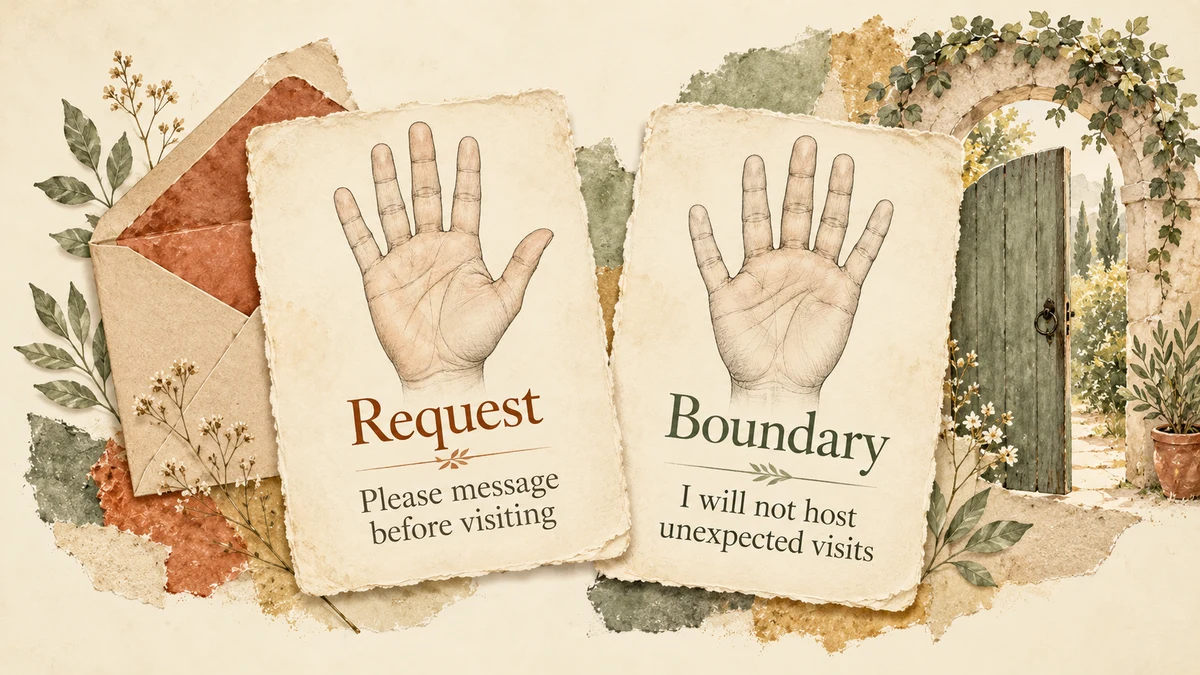
| Situation | Request | Boundary you can carry out |
|---|---|---|
| Unexpected visits | Please ask before coming over | I won’t host a visit I haven’t agreed to |
| Late calls | Could we talk earlier? | I won’t answer after I’ve gone to bed |
| Personal jokes | Please leave my appearance out of the jokes | I’ll leave the conversation if it continues |
| Expensive outings | Can we choose something cheaper? | I can join plans within my budget |
A boundary is not a threat designed to punish someone. Choose an action you actually mean and can carry out. Ending a call is within your control; making a friend apologise is not.

Want to see yours?
Scan your palm for a full interpretive reading.


Place your palms here
Both palms, please: your left on the left, your right on the right.
Add a photo

Add a photo
Required · 18 or older
Photo privacy · Refund terms ·Details
- Your photos are sent to our analysis provider to write your reading. This browser may temporarily keep pending photos for sign-in or recovery. Photos sent from your phone are kept temporarily for hand-off. See our privacy policy for details.
- When you press Read my palms, both photos go to our analysis provider for a clarity check before payment. This checks the photos, not the validity of a reading.
- Doesn't sound like you? Email us within 7 days of your first reading for a full refund, if you haven't used a second. If a photo can't be read, that reading is returned.
- Next: your reading uses one of your readings, or a short checkout if you have none.
Photo tips
 Photo tips
Keep your palm flat, fingers slightly apart and lines in focus. Use bright, even light, and photograph each palm the same way.
 ✓ Like this
 ✕ Too dark
 ✕ Fingers cut off
Eight scripts for ordinary friendship limits
Use a short statement of your limit, with an alternative only when you want to offer one. You do not owe an elaborate account of your finances, health or family responsibilities to make a no count. If a brief explanation would help a friend understand, give it without turning the conversation into a case for their approval.
- Messages: I read messages when I have a break. If I haven’t replied, please don’t keep calling to check whether I’ve seen them.
- Late-night calls: I’m switching off for the night. I can talk tomorrow afternoon if you’re free.
- Money: I’m not able to lend money. I can help you think through other options if you want, but I can’t fund this.
- Costly plans: That restaurant is outside my budget. I’d enjoy a walk or coffee another day.
- Private information: That part of my life is private. Please don’t bring it up with other people.
- Emotional support: I care about what’s happening, but I don’t have the attention for a long conversation tonight. I can listen tomorrow.
- Jokes: I don’t want my dating life used as a joke. If it comes up again, I’ll step away from the conversation.
- Favours: I can help carry the boxes in the morning. I can’t spend the whole day moving.
The emotional-support example is for an ordinary conversation, not an emergency arrangement. Do not promise availability you cannot provide. A friendship can contain care without making either person the other’s sole source of help.
Choose a calm opening, not a perfect performance
Raise a recurring problem when you have enough privacy and time to be clear. You do not have to wait for another incident if the pattern already bothers you. Start with what will change going forward, rather than delivering a list of every occasion when your friend should have guessed you were uncomfortable.
I’ve realised I keep agreeing to plans I can’t afford. From now on, I’ll suggest something cheaper or sit those ones out. I still want to see you.
Mayo Clinic’s guidance on assertiveness recommends direct, respectful communication, simple requests and practising saying no. That is a communication approach, not a guarantee that another person will welcome the limit.
If you are changing a familiar arrangement, acknowledge it. A friend who has always called late may not know that you have been struggling with it. Their initial surprise does not automatically mean they disrespect you.
Answer pushback without adding endless explanations
You can acknowledge disappointment while keeping the same limit. Repeating a concise answer is often clearer than adding new reasons, which can make it sound as though the right counterargument would change your decision. If you do choose to compromise, make the compromise explicit rather than saying yes and resenting it afterwards.
If they say But you always did this before:
I know. I’ve realised it isn’t workable for me, so I’m changing what I agree to.
If they say You don’t care about me:
I do care. I’m still not available tonight. Those can both be true.
If they offer an alternative that works, accept it. Boundaries are allowed to include cooperation; they do not require refusing every suggestion to prove firmness. Friendship reciprocity can help separate mutual care from identical contributions.
Follow through proportionately when a limit is ignored
If the behaviour repeats, carry out the action you named and review what arrangement is realistic. You might stop lending money, end a conversation about a private topic or stop holding evenings for unconfirmed plans. The point is to protect the limit, not to teach a dramatic lesson or force a particular emotional response.
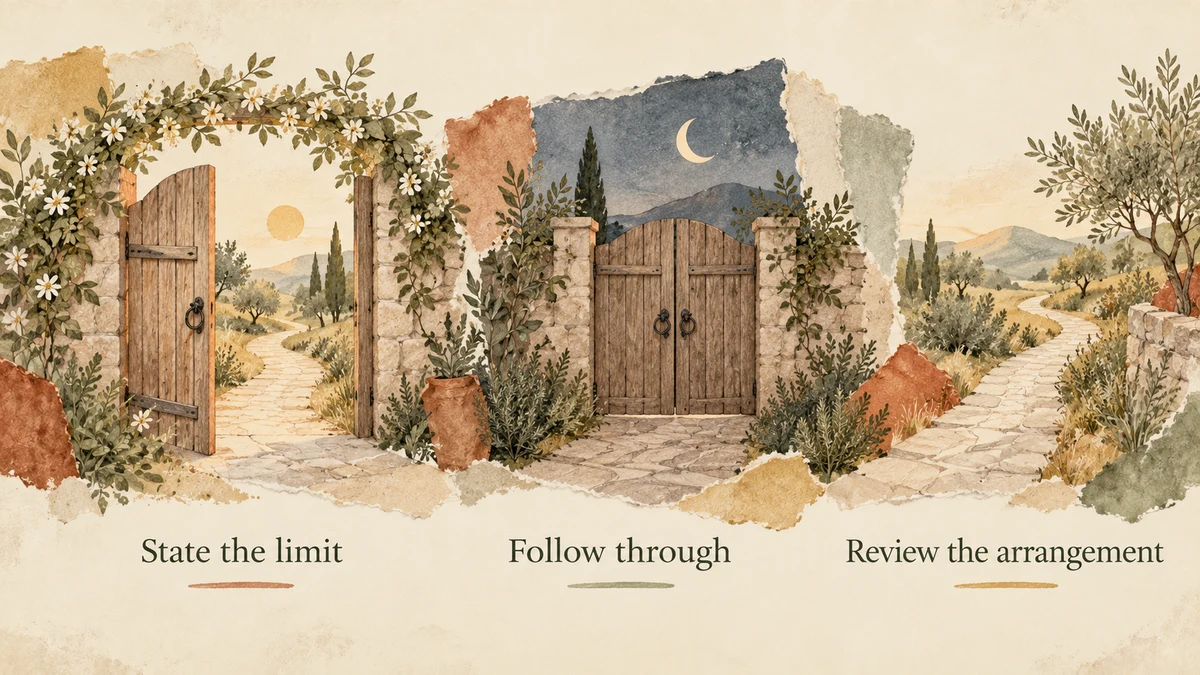
You can say:
I asked for that topic to stay private. Since it came up again, I’m not going to discuss it further with you.
Repeated humiliation, intimidation or pressure deserves more than increasingly polished wording. You can reduce contact or leave without staging another confrontation. If you feel unsafe, prioritise distance and support from someone you trust over delivering the perfect boundary speech.
Different preferences for contact can be discussed without assigning a label; our guide to attachment styles in friendship explains the limits of that lens.
For the conversation underneath a limit, our guide to why some interactions feel draining offers a way to look at the situation without diagnosing the other person. If you enjoy symbolic reflection, PalmMingle’s palm readings are an optional activity; they cannot decide what access someone should have to your time or private life. Your boundary comes from your circumstances and choices.
Palmistry is an interpretive tradition, not a diagnostic tool. PalmMingle frames palm readings as entertainment and self-reflection, not prediction.