

To make friends as a transfer student, look for contact that fits the schedule you actually have: classmates you see again, groups accepting new members and transfer or commuter events you can attend. Start with one person and a specific shared activity, then follow up after a mutual conversation. You do not need to recreate freshman orientation or persuade an entire established group to adopt you.
Joining later changes the starting point. It does not tell you whether a particular person or group has room for another friend.
Build around your available time, not an ideal campus life
Choose a social opportunity you can reach without repeatedly missing work, transport or responsibilities elsewhere. A class break may be more usable than an evening mixer. A recurring club may fit better than many one-off events. The plan needs room for the life you brought with you when you transferred.
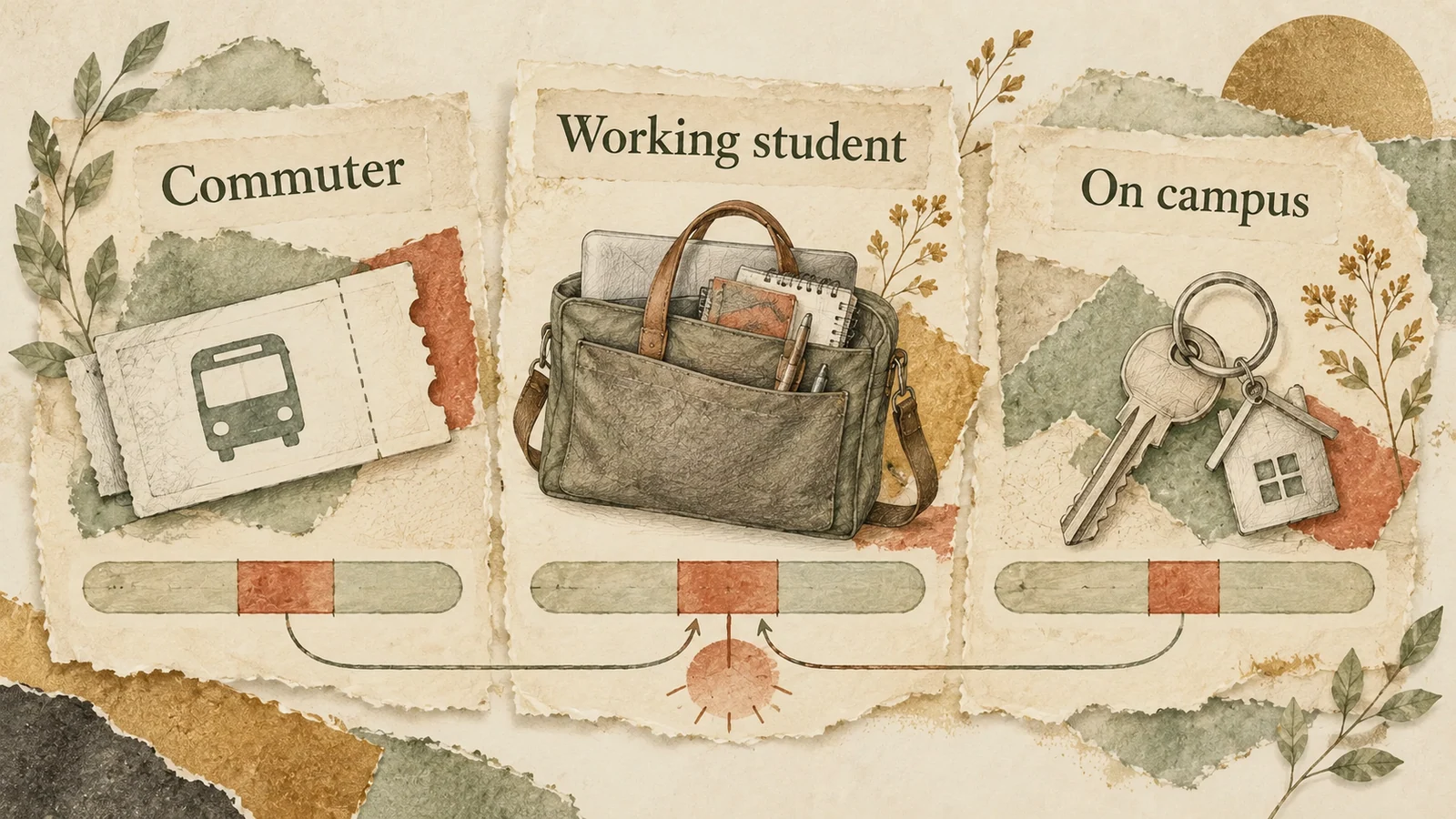
| Your situation | A place to begin | A practical detail to check |
|---|---|---|
| Commuting | A class break, commuter space or event before your journey home | Last transport, travel time and whether you can stay |
| Working alongside study | A small plan next to an existing class | Shift times and an honest finish time |
| Living on campus | A residence activity or open club session | Whether new members can join now |
| Studying mainly online | A live study group or moderated course community | Time zone, access and whether non-course chat is welcome |
| Caring for someone | A short, predictable plan | Timing, flexibility and whether bringing someone is allowed |
Choose one realistic opening first. You can change the plan if it does not fit; being unable to attend a late event is not evidence that you are unwilling to make friends.

Want to see yours?
Scan your palm for a full interpretive reading.


Place your palms here
Both palms, please: your left on the left, your right on the right.
Add a photo

Add a photo
Required · 18 or older
Photo privacy · Refund terms ·Details
- Your photos are sent to our analysis provider to write your reading. This browser may temporarily keep pending photos for sign-in or recovery. Photos sent from your phone are kept temporarily for hand-off. See our privacy policy for details.
- When you press Read my palms, both photos go to our analysis provider for a clarity check before payment. This checks the photos, not the validity of a reading.
- Doesn't sound like you? Email us within 7 days of your first reading for a full refund, if you haven't used a second. If a photo can't be read, that reading is returned.
- Next: your reading uses one of your readings, or a short checkout if you have none.
Photo tips
 Photo tips
Keep your palm flat, fingers slightly apart and lines in focus. Use bright, even light, and photograph each palm the same way.
 ✓ Like this
 ✕ Too dark
 ✕ Fingers cut off
Ask the transfer office questions that lead somewhere
Ask for current opportunities and access details rather than only asking where to make friends. A transfer adviser, student activities team or equivalent office may be able to point you toward groups and spaces, but availability varies by institution. Check what exists on your campus instead of assuming a named facility is universal.
Useful questions include:
- “Which student groups are accepting new members this term?”
- “Are there transfer or commuter events during the day?”
- “Is there a place to spend a gap between classes without buying food?”
- “Where can I find current event dates and accessibility information?”
- “Are there groups for students in my program who entered after the first year?”
If the answer is a long directory, ask for one or two options that match your hours and interests. You still need to check the event and choose for yourself; an office referral is an introduction to an opportunity, not a promise of friendship.
Use class contact without turning coursework into an obligation
Begin with a shared academic moment, then leave room for the connection to extend beyond it. Classmates have an understandable reason to speak, but helping with a course does not obligate someone to socialize. Keep invitations separate from access to notes, group-project decisions or other things they need for study.
A UMass Amherst admissions account by a transfer student describes friendships that began through classmates and a shared-interest club. It is one student's experience, not a timetable for how quickly every transfer should feel settled. The useful starting places are ones you can investigate at your own institution.
Try: “I'm reviewing the lecture before the next class. Would you like to compare notes?” If you enjoy talking, a later invitation could be: “I'm going to get lunch before the seminar. Want to join?”
Use permitted collaboration rules and keep the academic task honest. Making friends is not a reason to share assessed work or pressure someone to help you catch up. If you need academic support, use the appropriate course or campus channel.
Fit one invitation into an ordinary gap
Make a small plan with a start, a place and a finish that suits both people. You do not need an impressive event. A short lunch, a walk between buildings or reviewing a topic together can give you a conversation outside the classroom without requiring either person to surrender the rest of the day.
For example, Jordan has a gap after a seminar and a work shift later. After a mutual conversation about the reading, Jordan asks: “I'm eating in the courtyard before I leave. Would you like to sit together?”
If the classmate says yes, Jordan can mention the finish: “I need to head off for work afterwards, so I won't be staying all afternoon.” If they cannot join, Jordan can say, “No problem; see you in class.” If they offer another time, they can compare schedules.
The plan is useful because it fits a real day, not because a particular duration produces friendship. How to ask someone to hang out has more examples when you want a clear invitation that leaves space for no.
Check whether a group is open rather than assuming it is closed
Ask about participation before deciding an established group cannot welcome you. Some groups accept new people throughout a term; others have a fixed project, roster or enrollment period. Knowing which situation you are facing lets you choose a next step without turning a practical restriction into a verdict about your place on campus.

Message the organizer: “I'm a transfer student interested in the next session. Can someone new join at this point, and is there anything I should bring?” If it is closed, ask when the next entry point is or choose another option. You do not need to win an exception.
At an open session, introduce yourself to one person or ask the host where to start. Existing friends can have room for a newcomer, and individual conversations can grow alongside group membership. There is no need to declare all long-standing groups inaccessible or treat other unattached students as your only possible friends.
Review the fit after a disappointing start
If an attempt falls flat, identify what happened before deciding what to change. The event might have been poorly suited to your schedule, the activity might not interest you, or a particular person might not want further contact. Those possibilities call for different next steps; none establishes that you have missed your chance at friendship. If you are also new to the area, compare places you can return to beyond campus.
Ask yourself whether you could attend again, whether you enjoyed any part of it and whether there was a mutual exchange you would like to continue. If yes, return or follow up. If no, choose another format rather than repeatedly attending something you dislike.
Keep existing friendships where they matter to you. Long-distance friendships can remain part of your life while you build local contact. You do not need to erase the people from your previous college to prove commitment to the new one.
If you enjoy interpretive self-reflection, PalmMingle's AI palm reading is an optional curiosity. It cannot place you in the right campus group or predict who will become a friend. Start with an opportunity you can attend and an invitation another person can freely accept.
Palmistry is an interpretive tradition, not a diagnostic tool. PalmMingle frames palm readings as entertainment and self-reflection, not prediction.