

Respond to criticism by asking what specifically happened, checking what is fair and choosing a reply that matches the concern. You can accept a useful point, disagree with an inaccurate claim or end an insulting exchange. Listening does not require agreeing to everything, and feeling uncomfortable does not by itself establish that the criticism is wrong.
A useful first line is: “Can you give me a specific example?” It turns a broad judgment into something you may be able to understand and address.
Sort the message before choosing the response
Separate a specific concern, a preference, a factual error and an insult. They may arrive in the same sentence, but they do not require the same answer. Look for an observable action or a clear request before accepting a broad label about your character. You can address a fair concern without accepting the label attached to it.
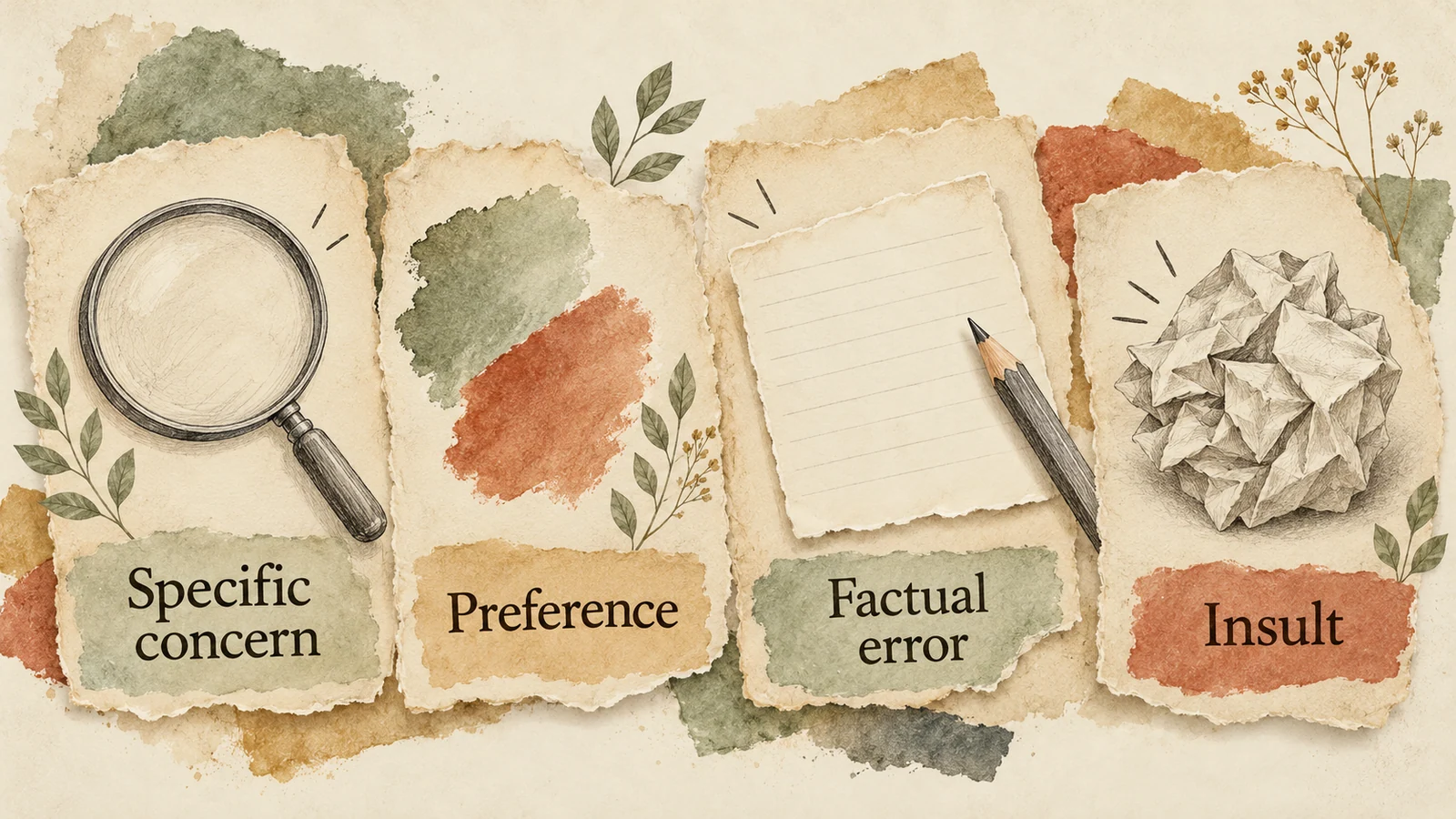
| What you hear | What needs checking | A possible reply |
|---|---|---|
| “You arrived after we'd agreed to start” | What time was agreed, and what happened? | “You're right that I was late. I'm sorry I kept you waiting.” |
| “I don't like that kind of restaurant” | Is this a preference or an agreement you missed? | “Thanks for saying. What would suit you?” |
| “You never told me it was canceled” | Was a message sent, and was it received? | “I sent an update, but it sounds as though you didn't see it.” |
| “You're useless” | Is there a specific concern beneath the insult? | “I can discuss what happened. I won't continue with insults.” |
Do not use the table to dismiss someone because they expressed a concern imperfectly. Equally, a person calling something “feedback” does not make every demand reasonable. Ask what they mean and decide on the substance.
Want to see yours?
Scan your palm for a full interpretive reading.


Place your palms here
Both palms, please: your left on the left, your right on the right.
Add a photo

Add a photo
Required · 18 or older
Photo privacy · Refund terms ·Details
- Your photos are sent to our analysis provider to write your reading. This browser may temporarily keep pending photos for sign-in or recovery. Photos sent from your phone are kept temporarily for hand-off. See our privacy policy for details.
- When you press Read my palms, both photos go to our analysis provider for a clarity check before payment. This checks the photos, not the validity of a reading.
- Doesn't sound like you? Email us within 7 days of your first reading for a full refund, if you haven't used a second. If a photo can't be read, that reading is returned.
- Next: your reading uses one of your readings, or a short checkout if you have none.
Photo tips
 Photo tips
Keep your palm flat, fingers slightly apart and lines in focus. Use bright, even light, and photograph each palm the same way.
 ✓ Like this
 ✕ Too dark
 ✕ Fingers cut off
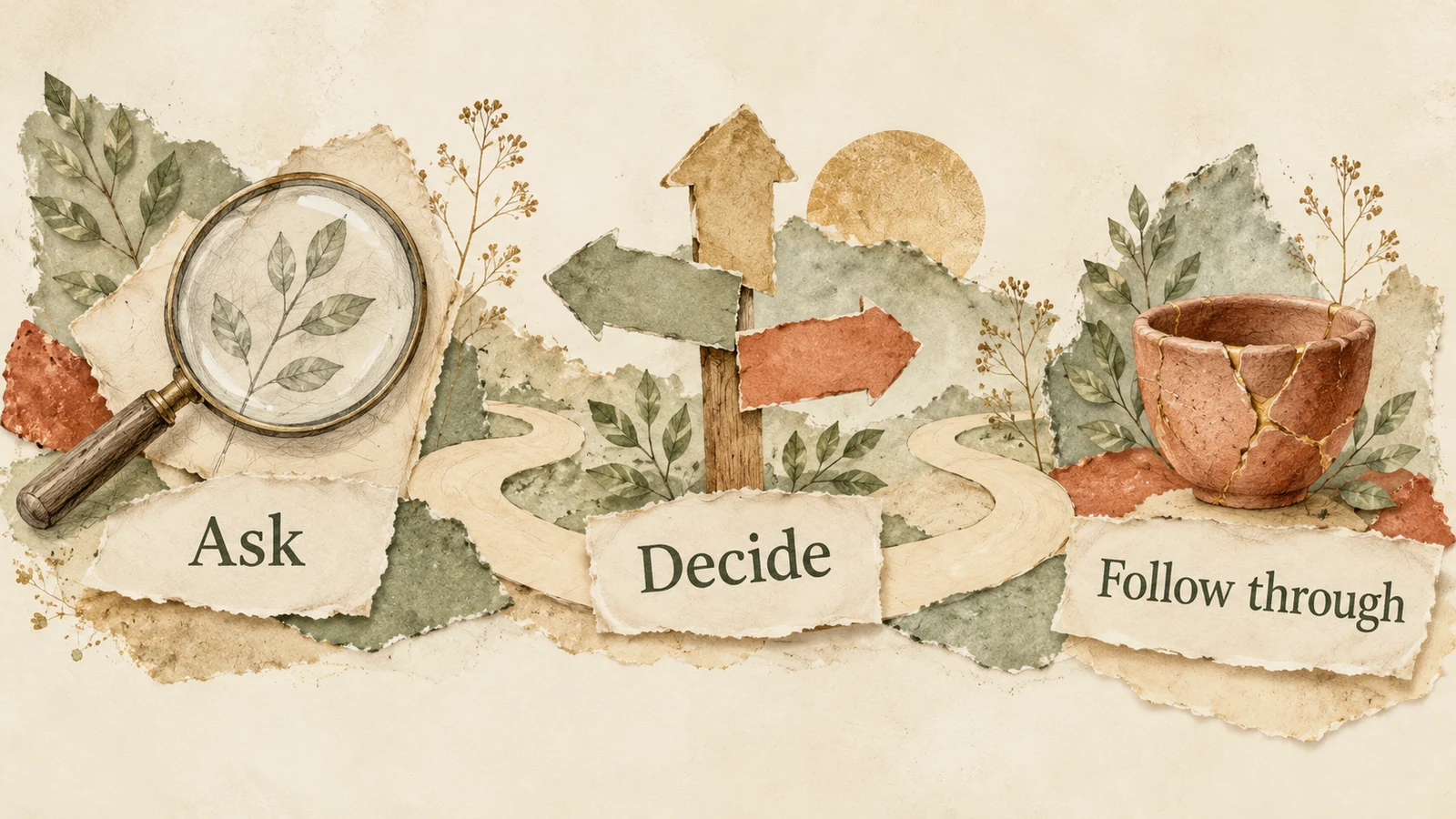
Ask one question before building your defense
If the criticism is vague, request an example or the change the person wants. Listen to the answer without immediately prosecuting every word. You are gathering information, not promising to comply. If the setting is too public or heated for a useful exchange, ask to continue somewhere appropriate or return to it later.
“When you say I didn't listen, which part do you mean?” is more answerable than “Why do you always attack me?” A second useful question is: “What would you have wanted me to do differently?”
The VA's assertive-communication guidance recommends addressing specific behavior or situations rather than general character traits, and being clear and respectful. That principle works in both directions: ask for a concrete concern and make your own response concrete too.
If you need time, say so without disappearing: “I want to think about that before answering. Can we speak tomorrow?” Offer a time only if you can reasonably keep it. If you do not know when you can respond, be honest rather than making a promise to escape the moment.
Accept the part you believe is fair
When a criticism identifies something you did, acknowledge that action and its effect. You do not need to accept an exaggerated summary of your whole character. A specific acknowledgment makes room for a useful next step; a blanket promise to become a different person is difficult to assess and may avoid the actual issue.
For example:
Friend: “You always make everything about yourself. I was telling you about my interview and you started talking about your job.”
You: “I did switch to my work story before you'd finished. I'm sorry. I want to hear how the interview went.”
You have acknowledged the example without debating whether “always” is literally true. Later, if it matters, you can discuss the broader pattern. First, make room for the story you interrupted.
If you agree that repair is needed, offer one relevant action: replace the item you damaged, correct the message you sent or make the arrangement you failed to make. How to apologize to a friend explores that step in more detail.
Disagree without pretending to agree first
When you think the criticism is inaccurate, state the part you understand and the part you dispute. You can be respectful without giving false assent or apologizing for an action you do not believe occurred. Keep the response tied to facts you know, and leave room to discover information you have missed.
“I understand you thought I ignored your message. I didn't see it until this morning, so I don't agree that I deliberately avoided you.” That acknowledges their interpretation without adopting it.
If you partly agree: “I could have made the plan clearer. I don't agree that I promised to pay for everyone.” Then discuss the actual arrangement. If there is a message or document relevant to the disagreement, refer to it without posting private material to a wider group for support.
You may not resolve every difference. “We remember that differently” can be an honest stopping point when repeating the argument adds nothing. If a decision remains necessary, focus on what agreement you can make now.
Separate the useful point from the way it was delivered
You can decide to act on a valid concern while also setting a limit on how you are addressed. These are separate decisions. Harsh delivery does not automatically erase a factual problem, and a factual problem does not require you to remain in a humiliating or threatening conversation to demonstrate maturity.
Try: “I agree I missed the deadline. I will address that. I also need us to discuss it without name-calling.” Or: “I'm willing to talk about the message, but not while you are shouting at me.” State what you will do if the exchange continues, such as ending the call, rather than making a threat to control the other person.
You do not owe a prolonged discussion of every insult. If you feel unsafe, prioritize leaving or getting appropriate help. Looking for a lesson is not a requirement to stay in danger.
Our guide to setting boundaries with friends offers examples of limits based on actions you control.
Follow through without signing up for endless evaluation
After a useful conversation, make the agreed change and clarify whether anything else is needed. Acknowledgment is incomplete if you repeatedly promise an action and never take it. At the same time, accepting one piece of feedback does not appoint the other person as a continuing judge of your personality, choices or worth.
For instance: “I've corrected the date in the group message and checked the next booking. Was there another practical issue we still needed to settle?” That returns to the concrete concern rather than asking whether you are now a good person.
If the same criticism returns, check whether the behavior is continuing, the agreement was unclear or the expectation itself does not work for you. You can renegotiate an arrangement or decide you cannot meet it. Honesty is more useful than repeated agreement you do not intend to honor. When you need to raise a concern of your own, explain the specific behavior and its impact.
PalmMingle's AI palm reading is available for symbolic entertainment and reflection. It cannot settle who is right in an argument or validate a criticism of your character. The relevant work is checking the specific concern and choosing a response you can stand behind.
Palmistry is an interpretive tradition, not a diagnostic tool. PalmMingle frames palm readings as entertainment and self-reflection, not prediction.