

Talk to a shy person by offering an easy shared topic, giving them time to answer and leaving them free to end the conversation. Ask one question, respond to what they actually say and share something of your own. Avoid announcing their quietness, demanding eye contact or treating getting them to talk as a challenge to win.
You cannot tell from silence whether someone is shy, tired, concentrating, finding it hard to hear or simply uninterested. You can make a considerate invitation without deciding which explanation is true.
Make the situation easier before finding a better question
Start with the setting: a conversation is easier to choose when someone can hear it, leave it and participate without an audience. If a noisy group seems awkward, offer an ordinary quieter option rather than pulling the person aside for a special intervention. Let them decide whether the change is welcome.
At a craft class, you might say: “I'm going over to the quieter end of the table. You're welcome to join me.” At a gathering: “I'm getting some water. Would you like anything?” Neither requires a personal explanation or a performance of sociability.
Do not block the doorway, lean over their work or separate them from someone they came with. A quiet setting is useful only if it still feels like a choice. If they prefer messaging, there is no need to insist that a spoken conversation is more meaningful.
Want to see yours?
Scan your palm for a full interpretive reading.


Place your palms here
Both palms, please: your left on the left, your right on the right.
Add a photo

Add a photo
Required · 18 or older
Photo privacy · Refund terms ·Details
- Your photos are sent to our analysis provider to write your reading. This browser may temporarily keep pending photos for sign-in or recovery. Photos sent from your phone are kept temporarily for hand-off. See our privacy policy for details.
- When you press Read my palms, both photos go to our analysis provider for a clarity check before payment. This checks the photos, not the validity of a reading.
- Doesn't sound like you? Email us within 7 days of your first reading for a full refund, if you haven't used a second. If a photo can't be read, that reading is returned.
- Next: your reading uses one of your readings, or a short checkout if you have none.
Photo tips
 Photo tips
Keep your palm flat, fingers slightly apart and lines in focus. Use bright, even light, and photograph each palm the same way.
 ✓ Like this
 ✕ Too dark
 ✕ Fingers cut off
Use a shared detail and one answerable question
Begin with something both of you can observe, then ask a question that allows a short answer. Follow the answer rather than running through a list of prompts. Your own small contribution matters too: without it, even friendly questions can feel like an interview the other person never agreed to attend.
At an art club, try: “I've never used this kind of clay before. Have you?” It is grounded in what you are doing and does not ask them to describe their personality, social life or most interesting experience.
If they say, “Yes, a few times,” you could answer: “I'm still at the lopsided-bowl stage. What do you like making?” If they say, “No,” you could share: “Same here. I'm starting with something small.” Then allow a pause. You do not need to turn every reply into another question.
For more opening ideas, see how to make small talk. Choose an opener that fits the actual moment rather than memorizing a script and pushing through it.
Let their reply change what you do next
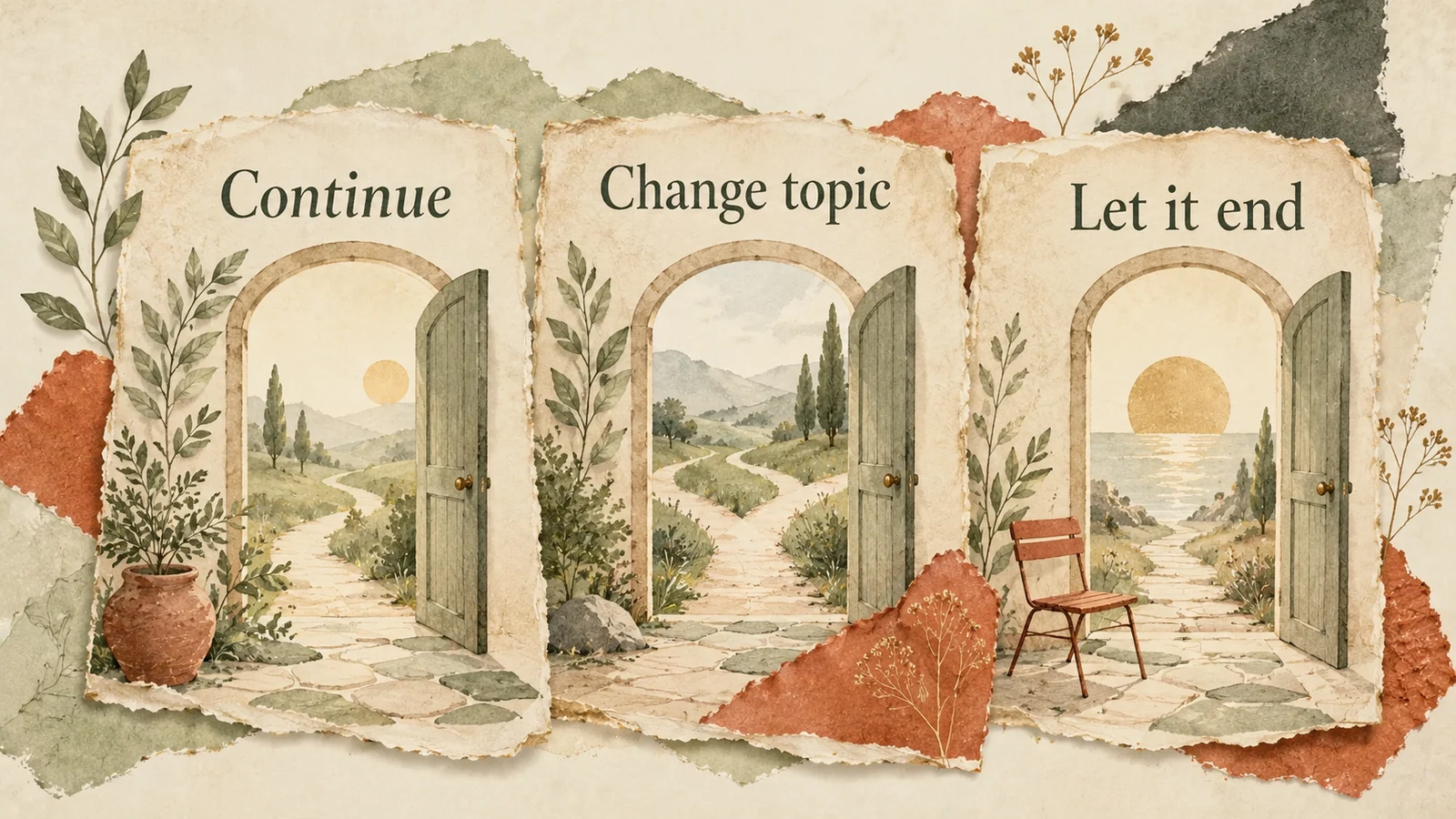
Use the response to choose whether to continue, change direction or finish. No single gesture proves interest, and a short answer is not a diagnosis. The clearest signals are the person's words, whether they choose to contribute and whether they accept or decline the invitation to keep talking.
| Their response | A considerate next move | Example |
|---|---|---|
| They add detail or ask you something | Respond to that detail | “You mentioned making mugs. What do you enjoy about that?” |
| They answer briefly and return to the activity | Let the activity take priority | “I'll let you get back to it. Nice talking.” |
| They say they cannot hear | Offer a practical choice | “Would you prefer somewhere quieter, or to leave it for later?” |
| They say they do not feel like talking | Accept the answer | “Of course. See you around.” |
| They seem unsure what you mean | Rephrase once, simply | “I meant: have you been to this class before?” |
Do not keep escalating the personal stakes to obtain a longer answer. A question about favorite music does not need to become “Why don't you trust people?” because the first reply was short.
Here is a complete exchange with room to decline
A considerate exchange includes an opening, something of your own and an easy stopping point. The aim is to find a conversation both people want, rather than get through a prepared set of questions. If the other person does not take up the opening, a pleasant ending is a successful use of the same skill.
You: “Is this seat free? I'm trying the evening class for the first time.”
Them: “Yes. I've been a couple of times.”
You: “Good to know I'm in the right room. I'm hoping to make a bowl that stands up.”
Them: “Mine collapsed last week.”
You: “Then perhaps I've set an ambitious target. Are you trying another bowl?”
If they start explaining their project, listen. If they smile and turn back to the clay, you can turn to your own project. If they say, “I need to concentrate,” answer, “Absolutely,” and stop asking questions. You have not failed to draw them out; they have told you what they need.
Stop making quietness the topic
Keep the conversation about the shared activity or the person's chosen subject, rather than their level of talkativeness. Comments such as “You're so quiet” or “We finally got you to speak” put their participation on display. Even a compliment can become pressure if it makes the next contribution feel like a public test.
You can acknowledge the substance instead: “I hadn't thought of using that shape,” or “That book sounds interesting.” You do not need to announce that they have overcome anything.
The question-asking research by Huang and colleagues reported greater liking for people who asked more questions, particularly follow-ups, in the interactions studied. A 2025 correction addressed reporting errors and stated that an audit confirmed the conclusions. These studies do not establish a technique for making a particular shy person open up or consent to a conversation.
Offer another invitation only when there is something to build on
If you enjoyed a mutual conversation, make a small invitation related to it. If the interaction remained one-sided or they declined, give them space. You can be friendly at the next encounter without treating familiarity as permission to resume questions they already chose not to answer.
“I'm coming to the next session too. Perhaps I'll see how your mug turns out” keeps the connection inside the shared activity. After more mutual conversation, “I'm getting a coffee after class; would you like to join?” gives a clear next step. A no does not require an explanation.
If they mention an access preference, use it. “I'd rather text,” “I need to see your face to hear you,” or “Please ask one thing at a time” is information about how to communicate with this person. It is more useful than a theory about what shy people are like. Our guide for introverts choosing comfortable friendship settings also offers options for your own social preferences.
The guide to asking someone to hang out offers examples when a further invitation would be welcome. You can also leave the connection at a friendly greeting; not every considerate conversation has to become a friendship.
For your own curiosity, PalmMingle offers interpretive AI palm readings as entertainment and self-reflection. A hand cannot tell you whether someone wants to talk or explain their quietness. Their choices in the conversation remain the guide.
Palmistry is an interpretive tradition, not a diagnostic tool. PalmMingle frames palm readings as entertainment and self-reflection, not prediction.