

Make friends at work through small, repeated conversations, then offer an optional plan outside the immediate task. Start with people you naturally encounter, show interest without pressing for personal information, and notice whether they reciprocate. A friendly colleague can remain a friendly colleague; closeness is an invitation, not a workplace requirement.
Try: “I'm getting lunch in the courtyard. You are welcome to join if you have a break.” It names a real plan and leaves room for a no. For remote work, an equivalent might be: “I've enjoyed our chats before the team call. Would you be up for a short coffee call sometime?”
Start with a moment you actually share
Use a shared context to open an ordinary conversation: a class at work, a break area, a commute or a non-confidential project experience. Offer a little information about yourself, then let the other person choose whether to continue. You do not need to manufacture a deep conversation during a busy shift.
For example: “I tried the new lunch place yesterday. Have you been?” is easier to answer than “Tell me something interesting about yourself.” If they mention an interest, remember it and ask about it another time without treating the detail as permission to investigate their personal accounts.
Avoid making gossip the entrance fee. Shared complaints can become the whole basis of a connection; consider whether you also enjoy talking when nobody else's private business is the topic.
Want to see yours?
Scan your palm for a full interpretive reading.


Place your palms here
Both palms, please: your left on the left, your right on the right.
Add a photo

Add a photo
Required · 18 or older
Photo privacy · Refund terms ·Details
- Your photos are sent to our analysis provider to write your reading. This browser may temporarily keep pending photos for sign-in or recovery. Photos sent from your phone are kept temporarily for hand-off. See our privacy policy for details.
- When you press Read my palms, both photos go to our analysis provider for a clarity check before payment. This checks the photos, not the validity of a reading.
- Doesn't sound like you? Email us within 7 days of your first reading for a full refund, if you haven't used a second. If a photo can't be read, that reading is returned.
- Next: your reading uses one of your readings, or a short checkout if you have none.
Photo tips
 Photo tips
Keep your palm flat, fingers slightly apart and lines in focus. Use bright, even light, and photograph each palm the same way.
 ✓ Like this
 ✕ Too dark
 ✕ Fingers cut off
Match the invitation to how your work happens
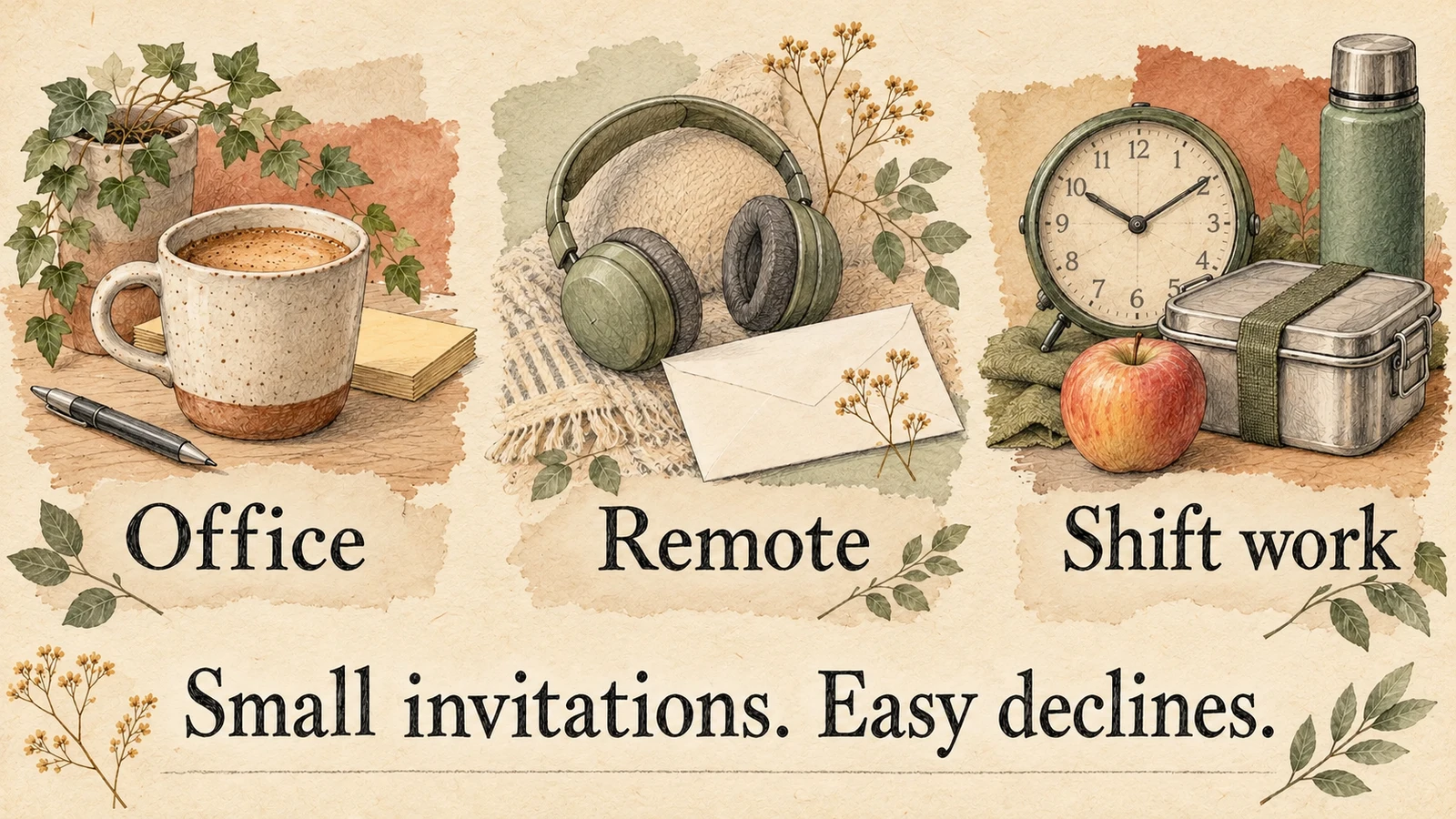
Choose a setting that fits both people's schedules and makes participation genuinely optional. Office, remote and shift work provide different opportunities; copying the same after-hours invitation into each situation can exclude people with other commitments. Start with a small plan that does not require a large expense or an explanation for declining.
| Work pattern | A possible first plan | A detail to check |
|---|---|---|
| Same office | Lunch or a walk during a shared break | Whether breaks and access needs line up |
| Remote team | An opt-in non-work call | Time zone, workload and whether more screen time appeals |
| Shift work | A drink or snack when shifts overlap | Whether anyone is about to start or finish a long shift |
| Hybrid team | A plan on a day you are both present | Whether attendance requires an extra commute |
| Temporary project | A brief catch-up before the project ends | Whether they want to exchange personal contact details |
If the answer is “I can't today,” accept it. A reciprocal suggestion is useful information; repeated polite declines without a counteroffer are a reason to ease off, not improve your persuasion.
Build on a response, not a friendliness quota
Look for a pattern of mutual interest rather than counting conversations. Does the other person start chats sometimes, remember something you said or suggest another time when they cannot join? None of these signals proves friendship, but they can help you decide whether another invitation would be welcome.
If the relationship only exists around a shared task, that can still be valuable. Do not downgrade a good colleague because they prefer not to meet on weekends. You can have trust, warmth and cooperation without becoming each other's closest friend.
Gallup's workplace research connects having a best friend at work with engagement and other workplace outcomes. That association does not mean that making one specific colleague your friend will improve your performance. Use it as context for why connection matters, not as a target to impose on yourself or your team.
Keep power differences in view
An invitation feels different when one person controls assignments, schedules, evaluations or opportunities. If you manage someone, take extra care that social contact is optional and that declining does not affect access to work information or fair treatment. Follow your organization's rules on conflicts, conduct and reporting relationships.
Offer inclusive group opportunities rather than making a direct report responsible for your social life. Avoid framing a private invitation as “good for your career.” If you are the junior person, you can be cordial without agreeing to personal access, late-night messages or expensive outings.
This is a practical caution, not a universal ban on friendships across roles. The important questions are whether both people can choose freely and whether work decisions remain fair. Do not use an article about friendship to override actual workplace policies.
Share personal information in layers
Start with details you are comfortable having known in a work setting, then let trust develop through actual experience. You can share a hobby without sharing your relationship history; you can accept lunch without joining every personal chat. Friendship does not require an immediate transfer of your whole private life.
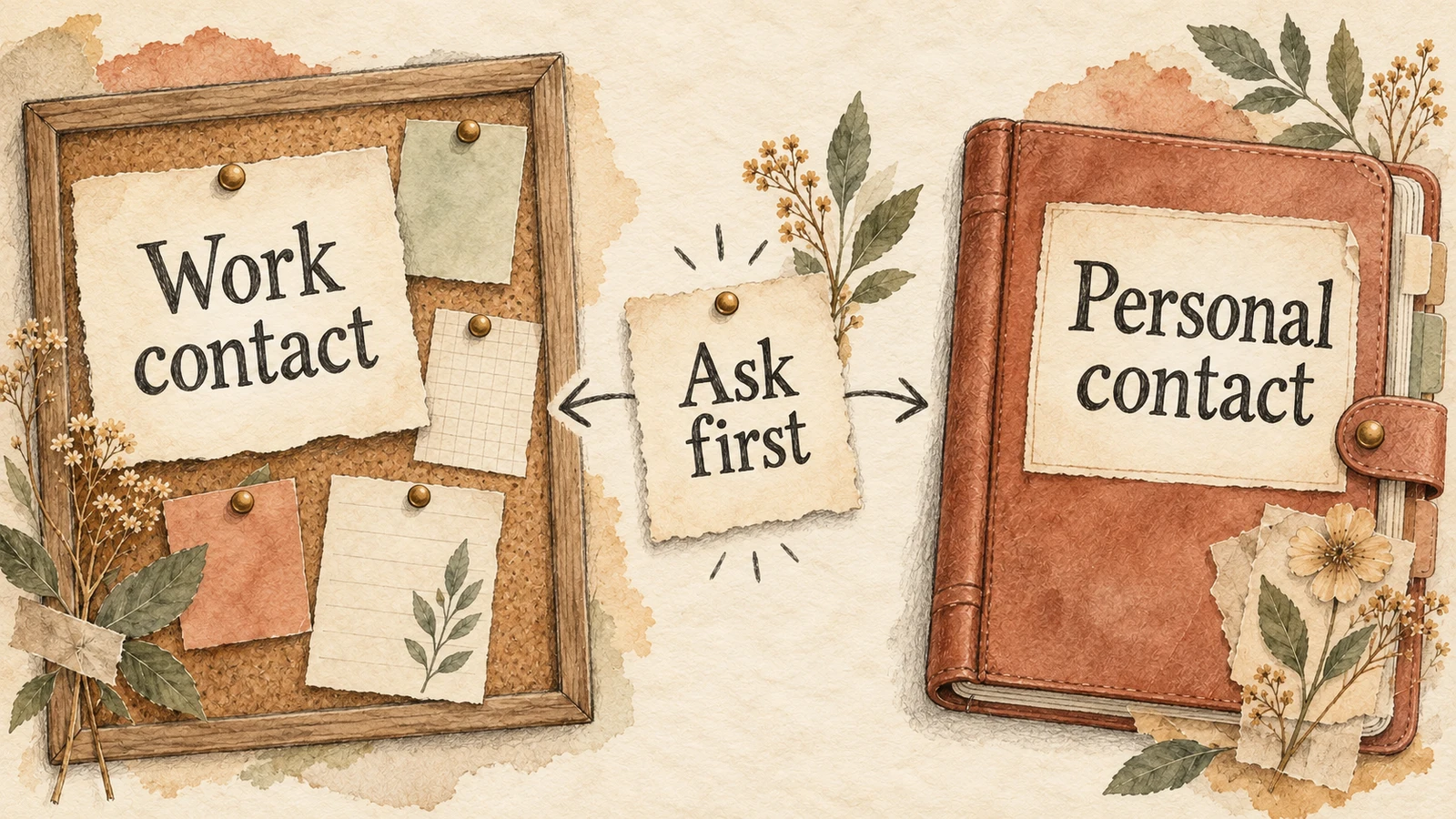
Ask before adding someone on a personal platform or moving a conversation to a private number: “Would you like to swap numbers for the weekend plan, or keep arranging it here?” Do not take a number from a work directory as permission for personal messaging.
Likewise, keep their disclosures out of team conversation. A colleague telling you something over lunch has not necessarily agreed that the whole department should know. If you are unsure whether information can be shared, ask.
Make room for friendship without making work awkward
Continue behaving professionally if a social plan does not happen or a friendship becomes less close. Return to ordinary greetings and task communication rather than punishing a declined invitation with silence. Both people need to be able to keep working without negotiating the friendship in every meeting.
If a friend repeatedly brings personal conflict into work, name the boundary: “I want to discuss that outside the team meeting. For this call, let's keep to the project.” For a broader limit, see setting boundaries with friends.
For remote friendships, consider whether a recurring catch-up suits you both instead of relying on spare minutes before meetings. Keep it easy to cancel or change; being friends should not create another compulsory meeting.
Make the transition when one person leaves
Before access to work channels ends, ask whether you both want to stay in touch and agree on a personal channel. Then suggest one actual plan after the move. Without that transition, a friendship can lose the daily contact that made it easy even when both people still like each other.
Try: “I've really enjoyed our lunches. Would you like to keep in touch after I leave? If so, shall we arrange coffee next month?” A warm goodbye is not the same as an agreed ongoing plan, so leave the answer open.
For specific wording, use asking someone to hang out. If the friendship has already gone quiet, see reconnecting with an old friend. For opening a conversation, try small talk that follows the answer.
PalmMingle's AI palmistry guide describes an optional symbolic reflection experience. It cannot assess a colleague's trustworthiness or determine who should become your friend; let voluntary contact and their conduct tell you more.
Palmistry is an interpretive tradition, not a diagnostic tool. PalmMingle frames palm readings as entertainment and self-reflection, not prediction.